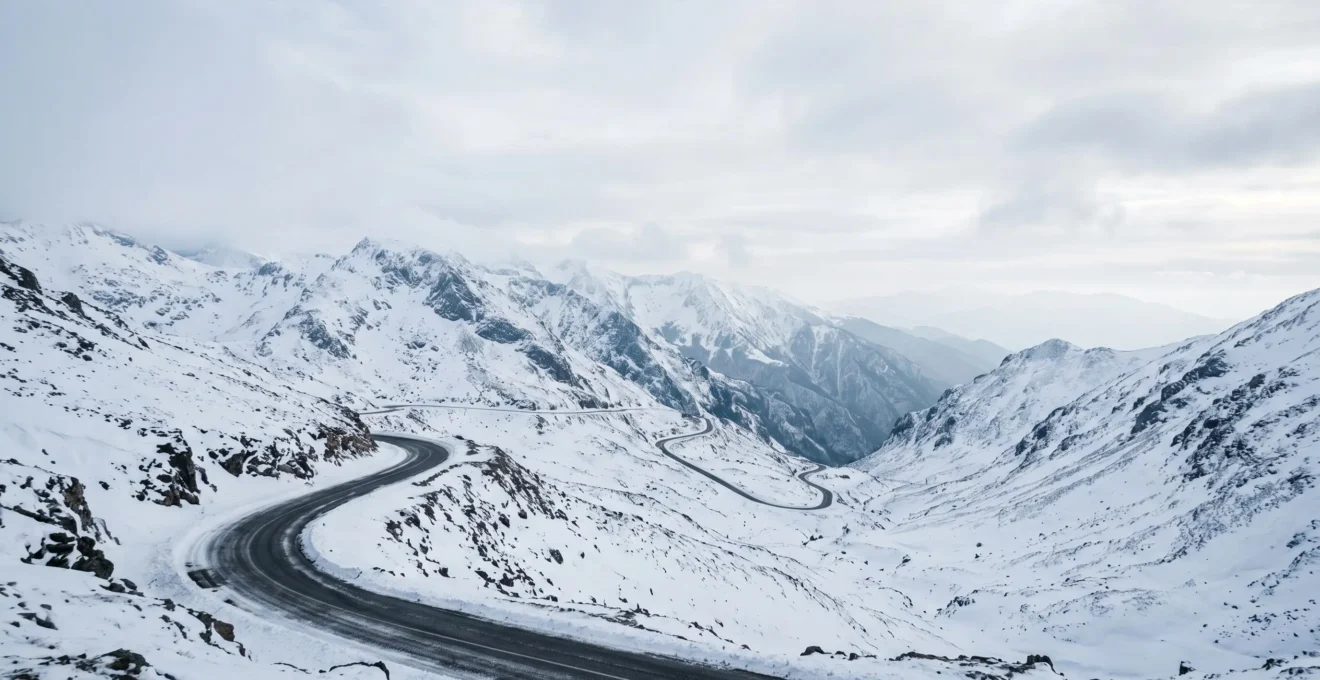
Driving in Macedonia’s snowy mountains for the first time can be intimidating, especially for a UK driver accustomed to rain and motorways. This guide shifts your focus from simply following rules to proactively managing risk. You’ll learn the physics of grip, the non-negotiable techniques for using snow chains, and the critical braking methods that prevent accidents, empowering you to handle challenging winter conditions with the confidence of a seasoned local.
For a driver from the UK, the idea of a winter road trip often conjures images of damp motorways and drizzly A-roads. The reality of a Macedonian mountain pass in January is a world away. Here, the challenge isn’t just visibility; it’s a fundamental change in the physics between your tyres and the road. The steep gradients, hairpin bends, and ever-present possibility of ice require a completely different mindset. Many guides will tell you to “drive slowly” or “check the weather,” but this advice is dangerously incomplete.
True safety in these conditions doesn’t come from a simple checklist; it comes from understanding the ‘why’ behind the rules. It’s about proactively managing your ‘traction budget’—the finite amount of grip your tyres have at any given moment. Every decision, from how you brake to the route you choose, either adds to or subtracts from your safety margin. This guide is built on that principle. We will not just tell you the rules; we will give you the mental model of an experienced winter driver.
This guide will equip you with the knowledge to move beyond fear and into a state of prepared confidence. We will cover the mandatory legal requirements, the critical hands-on skill of fitting chains, the truth about braking on ice, and how to plan your journey to avoid the worst hazards altogether. Prepare to transform your approach from a nervous tourist to a capable and safe mountain driver.
This comprehensive guide is structured to build your confidence and competence step-by-step. The following sections cover everything from legal obligations to practical, on-the-road techniques, ensuring you are fully prepared for your Macedonian winter adventure.
Table of Contents : A UK Driver’s Guide to Safe Winter Driving in Macedonia
- Are Snow Chains Mandatory on All Mountain Roads in Winter?
- How to Fit Snow Chains Quickly When You Have Never Done It Before?
- Snow Chains vs Winter Tyres: Which Is Better for Short Mountain Trips?
- The Braking Mistake That Causes Most Winter Accidents on Mountain Roads
- Which Mountain Roads Are Best Avoided After Heavy Snowfall?
- Are Snow Chains Mandatory on All Mountain Roads in Winter?
- The Braking Mistake That Causes Most Winter Accidents on Mountain Roads
- How to Plan a Ski Trip to Mavrovo on a Budget?
Are Snow Chains Mandatory on All Mountain Roads in Winter?
The short answer is yes, carrying winter equipment, including snow chains, is a legal requirement in North Macedonia. The regulations are strict and are in place for your safety and the safety of others. Specifically, the mandate to carry winter equipment runs from October 15 to March 15. This isn’t just a suggestion; it’s a legal obligation that rental companies and police enforce. For a UK driver, this is the first and most important rule to internalise: you cannot opt out.
However, “mandatory to carry” is different from “mandatory to fit.” You are required to have the chains in your vehicle throughout this period. You are only required to mount them on your tyres when specific road signs indicate it (typically a blue circular sign with a tyre and chain symbol) or when directed by police due to heavy snow or ice. For a rental car, this means you must confirm the chains are included before you leave the city. Do not assume they are in the boot. This is your responsibility to verify. The law requires winter tyres on mountain roads from November 15, but chains are your ultimate get-out-of-trouble tool.
Failing to comply can result in fines and, more importantly, leave you stranded in a dangerous situation. Approaching a police checkpoint without chains in your boot during a snowstorm is a scenario to be avoided at all costs. Think of it less as a bureaucratic rule and more as an essential piece of life-saving equipment, as critical as your spare tyre or first-aid kit. Before you even turn the key, ensuring your winter equipment is present and correct is the first step in proactive risk management.
Your Pre-Departure Rental Car Checklist
- Equipment Verification: Verbally confirm with the rental agent that legally required winter tyres are fitted and that snow chains are included in the vehicle. Physically inspect them before driving away.
- Chain Compatibility Check: Locate the tyre size on the sidewall (e.g., 205/55 R16) and check that the number on the snow chain box matches exactly. Incorrectly sized chains are useless and dangerous.
- Fitting Demonstration: Do not be embarrassed to ask for a quick demonstration. Ask the rental staff to show you how to attach and tighten the specific model of chains provided.
- Contractual Clauses: Briefly scan the rental agreement for any mention of winter equipment, non-compliance penalties, or liabilities. Know what you’ve signed up for.
- Usage Clarification: Ask the agent to clarify the difference between “mandatory to carry” (zakonski) and “mandatory to fit” (zadolzhitelno) to understand the local context and expectations.
How to Fit Snow Chains Quickly When You Have Never Done It Before?
The absolute worst time to learn how to fit snow chains is on the side of a narrow mountain road, in the dark, with snow blowing in your face and cars sliding past. This is a scenario where panic sets in. The key to avoiding this is mental and physical rehearsal. You must practice fitting your specific chains in a calm, dry environment before your trip begins. This is not a recommendation; it is an instruction for your safety. A dry run in a hotel car park will transform a 30-minute roadside struggle into a confident 10-minute procedure.
Lay the chains out on the ground first to untangle them. Modern chains are often colour-coded (e.g., yellow and blue ends) to help with orientation. Identify which wheels need the chains—this is critical. For a front-wheel-drive (FWD) car, which most standard rental cars are, the chains must go on the front wheels. This is where the power and steering are. Fitting them to the rear wheels of a FWD car is completely ineffective.
After draping the chain over the tyre and connecting the main hoops, the most-missed step follows: drive forward about 15 feet (5 metres). This allows the chains to settle onto the tyre tread. You must then get out and re-tighten the tensioning chain (often coloured red). A loose chain can flap, damage your car’s wheel arch, or even break. When properly tightened, the chain should be snug against the tyre with no droop or slack.
Case Study: Common First-Timer Installation Errors
An analysis of roadside assistance calls for chain-related issues reveals a pattern of three critical mistakes. The most frequent is fitting chains to the non-drive wheels (e.g., rear wheels on a front-wheel-drive car), providing zero traction benefit. The second is insufficient tensioning; drivers often fit the chain, feel it’s “on,” and drive away without the crucial re-tightening step after moving the car a few feet. This leads to slippage and potential tyre damage. Finally, the most dangerous oversight is failing to verify chain-to-tyre size compatibility before departure. Using chains that are too large or too small can cause them to snap under load or get tangled in the wheel well, causing catastrophic damage during mountain driving.
Snow Chains vs Winter Tyres: Which Is Better for Short Mountain Trips?
As a UK driver, you might wonder if the winter tyres required on your Macedonian rental car are enough. It’s a valid question that gets to the heart of managing your “traction budget.” The simplest way to think about it is this: winter tyres are for the cold, snow chains are for the extreme. They are not mutually exclusive; they are a team that works together.
Winter tyres (identifiable by a ‘three-peak mountain snowflake’ symbol) are made from a softer rubber compound that stays flexible in low temperatures, providing consistent grip on cold, dry pavement, slush, and light snow. They are your everyday foundation for safety throughout the winter. Snow chains, on the other hand, are a specialist tool. They are crude, heavy, and noisy, but they provide a level of mechanical grip on deep snow and sheer ice that no rubber tyre can match. They literally bite into the surface.
Winter tires provide general grip and braking, while chains are a get out of trouble tool for extreme low-speed, high-traction situations like a steep, icy incline.
– Tire World Utah, Winter Tires vs Chains Comparison
For a short mountain trip, you will be driving on winter tyres 95% of the time. However, for that final, steep, icy 5% of the journey up to the ski resort, chains are the difference between arriving safely and sliding backwards into a ditch. The following table breaks down the specific roles each plays.
| Factor | Winter Tires | Snow Chains |
|---|---|---|
| Best Use Case | Extended winter seasons, daily cold-weather driving | Extreme conditions: deep snow, icy mountain roads, steep inclines |
| Traction Performance | Consistent grip on cold pavement, light to moderate snow | Exceptional traction in deep snow and ice where rubber tires struggle |
| Installation | Seasonal swap, no roadside changes needed | Installed only when conditions require, 10-15 minute roadside process |
| Speed Limit | Normal highway speeds | Maximum 25-30 mph to prevent chain/tire damage |
| Cost (Initial) | Higher upfront ($400-800 for set) | Lower ($50-200 per pair) |
| Rental Car Reality | Often provided in Macedonia Nov-March upon request | Must be carried but only fitted when road signs mandate or conditions demand |
The Braking Mistake That Causes Most Winter Accidents on Mountain Roads
Picture the scene: you’re descending a snowy mountain road, you round a bend, and a stopped car blocks the way. Your instinct, honed by years of UK driving, is to slam on the brakes and perhaps give them a few “pumps” for good measure. In a modern car on a slippery surface, this instinct is dangerously wrong. The single most critical braking mistake is misunderstanding or fighting your car’s Anti-lock Braking System (ABS).
Nearly every rental car is equipped with ABS. The old advice to “pump the brakes” was for cars without it, to prevent the wheels from locking up. With ABS, the system does this for you, but much faster and more effectively than any human ever could. When it detects a wheel locking up, it releases and reapplies brake pressure up to 15 times per second. This allows the wheel to keep turning, which is essential because a turning wheel can be steered. A locked, skidding wheel cannot. Your job is to let the ABS do its job.
When you feel the ABS kick in, it will be an unnerving experience. The brake pedal will judder and pulsate violently, and you may hear a grinding or buzzing noise from under the bonnet. This is normal. It is the sound of the system working. Your one and only job is to press the brake pedal hard, hold it down, and focus on steering around the obstacle. The mantra is Stomp, Stay, Steer.
- Stomp: In an emergency, press the brake pedal as hard and as fast as you can. Don’t be gentle.
- Stay: Keep your foot firmly on the pedal. Do not lift. Do not pump. Ignore the pulsation and noise. Trust the system.
- Steer: Because the wheels are not locked, you still have steering control. Use it to guide the car into a safe space or around the hazard.
Mastering this technique is paramount. Defensive driving programs show that proper use of ABS in an emergency can improve stopping distances by over 20% on slippery surfaces. It preserves your ability to steer, which is often the difference between a near-miss and a collision.
Which Mountain Roads Are Best Avoided After Heavy Snowfall?
Not all mountain roads are created equal. As part of your proactive risk management, knowing which routes to favour and which to avoid is as important as your driving technique. In Macedonia, the general rule is to stick to the main arteries that service major ski resorts. These roads are a priority for snowploughs and are cleared more frequently. Scenic backroads, while tempting, can quickly become impassable traps after heavy snowfall and should be avoided unless you have a capable 4WD and local knowledge.
Before you even leave your hotel, check the weather forecast and live road conditions if available. Heavy snowfall can lead to temporary road closures, often for 2-4 hours while ploughs do their work. A key piece of local wisdom is to plan your travel times. Leaving a city like Skopje by 8:00 AM on a ski day means you’ll likely be ascending the mountain roads after the morning sun has had a chance to work on the ice, and after the first pass of the snowploughs.
Risk Assessment: The Road to Popova Šapka
The 30km mountain road ascending from Tetovo to the Popova Šapka ski resort is widely considered Macedonia’s most challenging winter drive. It features a series of serpentine switchbacks with significant and rapid altitude gain. Certain sections have a steep gradient where the grip of a 4WD vehicle becomes invaluable, and many parts are exposed to high winds that cause deep snowdrifts. While the road is regularly cleared, it remains notoriously icy in the early morning hours before temperatures rise. The ascent takes 30-40 minutes in good conditions. A front-wheel-drive car with winter tyres can make it, but it requires a confident and experienced driver; for a visitor, a 4WD is strongly recommended for this specific route.
Your planning should also include logistics. Fuel tanks should be filled in major towns like Skopje, Tetovo, or Gostivar before starting your ascent, as petrol stations are virtually non-existent in the mountains. Always have a “plan B”—an alternative route or a pre-determined point at which you will turn back if conditions deteriorate. Pushing on in the face of worsening weather is a gamble you should never take.
Are Snow Chains Mandatory on All Mountain Roads in Winter?
We’ve established the legal requirement to carry chains from October to March. Now, let’s discuss the practical application: when do you move from *carrying* them to *fitting* them? This decision isn’t always dictated by a police officer; it’s a judgment call you must learn to make. The primary trigger is a combination of road signs and road conditions. Look for a circular blue sign with a white tyre wrapped in a chain. This is the international symbol for “Snow Chains Mandatory.” When you see this sign, the law is no longer ambiguous. You must pull over at a safe spot and fit your chains.
However, you should not wait for a sign if conditions clearly demand it. If you are on an incline and you feel your drive wheels starting to spin and lose traction, you have already gone too far. The moment to fit chains is *before* you lose momentum on a steep hill. A safe driver anticipates this. If the road ahead is clearly covered in deep, unploughed snow or you can see a visible layer of ice, it’s time to pull over and fit the chains proactively. It is far safer to do this on a flat section of road than to wait until you are halfway up an icy slope and starting to slide backwards.
Think of it as your ‘traction budget’ becoming insolvent. Your winter tyres have done their job, but the demands of the steep, icy gradient are too high. Chains are the bailout package. They provide that brute-force mechanical grip to get you through the extreme section. Once you are over the pass and back on a ploughed or gritted road, you must stop and remove them. Driving with chains on clear tarmac at speeds over 30 mph will destroy both the chains and the road surface.
The Braking Mistake That Causes Most Winter Accidents on Mountain Roads
While the “Stomp, Stay, Steer” method is your tool for emergencies, the true mark of an expert winter driver is rarely needing it. The most common cause of accidents on mountain descents isn’t just improper braking during a crisis, but a complete failure to manage speed and energy *before* the crisis occurs. The key is to rely less on your foot brake and more on your engine.
Every car’s transmission is a powerful braking tool, known as engine braking. By selecting a lower gear (e.g., 2nd or 3rd gear, or ‘L’ in an automatic), you force the engine to run at higher RPMs, which creates resistance and naturally slows the car down without you ever touching the brake pedal. This is the single most important technique for a long, steep descent. It keeps your service brakes cool and ready for when you actually need them. Relying solely on your foot brake down a long mountain pass can cause them to overheat, a condition known as “brake fade,” where they become progressively less effective until they fail completely.
Your mantra for descents should be: the gear you used to go up the hill is the gear you use to go down. On a steep descent, shift down *before* you start going downhill. Let the engine control your speed. You should only need to use your foot brake for gentle, intermittent applications to scrub off a little extra speed before a sharp corner. Your goal is a smooth, controlled descent, not a series of panic-braking moments. This also drastically increases your ‘traction budget,’ as the tyres are not being asked to handle heavy braking and steering forces simultaneously. This proactive technique, rather than the reactive ABS stomp, is what truly separates safe drivers from statistics.
Key Takeaways
- Carrying snow chains is a legal mandate in Macedonia from Oct 15 – Mar 15; practice fitting them in a dry, safe place before your trip.
- In an emergency with ABS, the technique is Stomp, Stay, Steer. Press the brake pedal hard, keep it pressed, and steer around the hazard. Never pump the brakes.
- Winter tyres provide general cold-weather grip, but chains are your essential, non-negotiable tool for the extreme traction required on steep, icy mountain sections.
How to Plan a Ski Trip to Mavrovo on a Budget?
While safety must always be the top priority, it’s possible to plan a budget-conscious ski trip to a resort like Mavrovo without cutting dangerous corners. In fact, smart planning can enhance both your budget and your safety. One of the biggest decisions you’ll face at the rental counter is whether to pay a premium for a 4WD vehicle or stick with a standard 2WD car and rely on chains.
The access road to Mavrovo is generally less demanding than the one to Popova Šapka, and a 2WD vehicle with winter tyres and chains is often sufficient. However, the “budget” consideration isn’t just the daily rental cost. You must also factor in the “stress cost” and the “risk cost.” For an inexperienced winter driver, the peace of mind and superior grip of a 4WD can be worth the extra expense, especially if heavy snow is forecast. A 4WD doesn’t make you invincible—you still need to drive carefully—but it significantly reduces the likelihood of getting stuck on a steep, icy section. The cost of a tow truck will instantly wipe out any savings from choosing a cheaper car.
The great news for budget-conscious skiers is that Macedonia offers incredible value once you arrive. Prices are significantly cheaper than Western European resorts, with a full-day adult lift pass in Mavrovo costing around €20-25 and equipment rental available for €10-15. This saving can often justify the extra cost of a more capable rental car.
| Factor | Cheaper 2WD + Chains | 4WD Vehicle Rental |
|---|---|---|
| Daily Rental Cost | Lower base rate | Premium rate (+30-50%) |
| Safety on Popova Šapka | Manageable but stressful on steep sections | Confidently handles ascent in snow |
| Mavrovo Access Road | Sufficient – road less steep | Comfortable, no concerns |
| Driver Stress Level | High for inexperienced winter drivers | Significantly reduced |
| Risk of Getting Stuck | Moderate on steep/icy sections | Minimal with proper tires |
| Fuel Consumption | Lower in normal conditions | Higher due to vehicle weight and 4WD system |
| Budget Recommendation | Acceptable for Mavrovo trips only | Worth investment for Popova Šapka access |
Your winter journey in the Macedonian mountains is an adventure that demands respect and preparation. By embracing a mindset of proactive risk management and mastering the core skills outlined in this guide, you can ensure your trip is memorable for the stunning landscapes and exhilarating ski runs, not for a stressful roadside incident. Evaluate your options, prepare your vehicle, and drive with the confidence that comes from true competence.