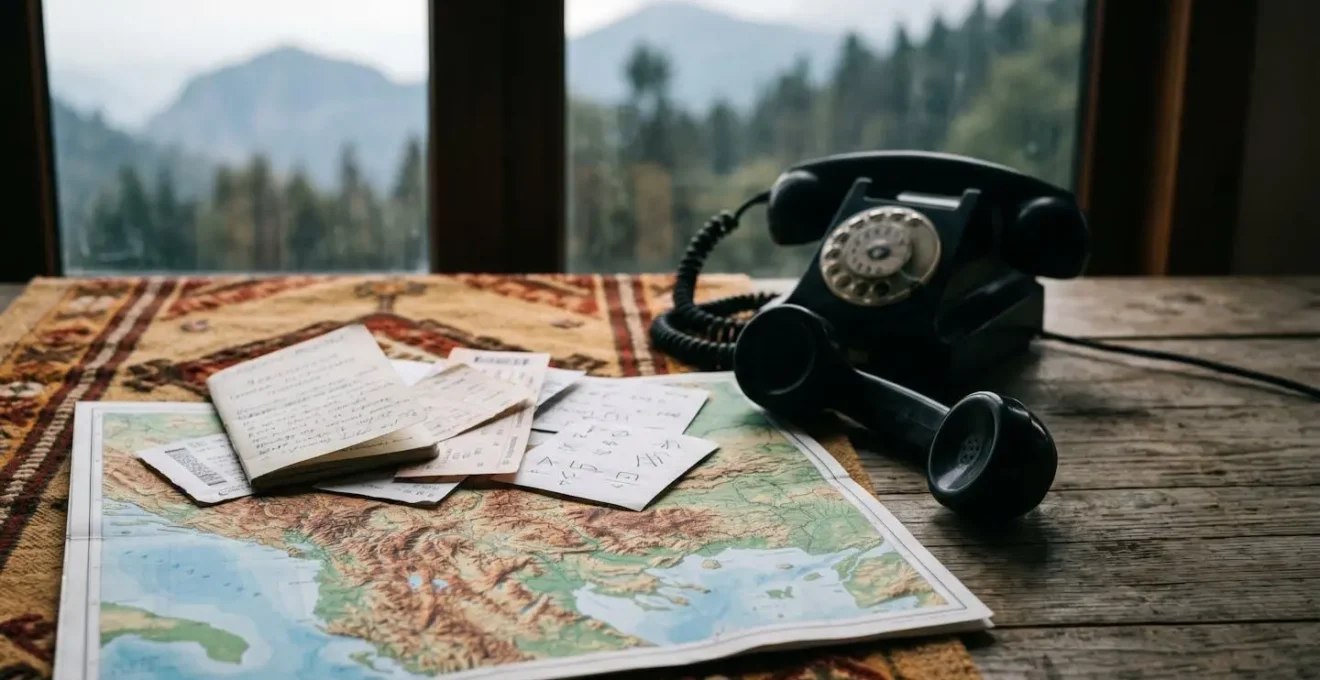
The core problem isn’t a lack of online presence, but a reliance on a different, relationship-based digital ecosystem.
- Major platforms like Booking.com miss the most authentic, family-run guesthouses, especially in rural areas.
- The key is mastering direct communication channels like Facebook Messenger, not as automated tools, but as conversation starters to build trust.
Recommendation: Adopt a hybrid strategy. Use Booking.com for a cancellable “safety net” booking in a major city, while simultaneously using direct contact methods to secure your ideal, authentic accommodation.
For the digitally-savvy traveler, arriving in North Macedonia can feel like a step back in time, and not always in a charming way. You open your favorite booking app, search for a cozy guesthouse in Mavrovo National Park or a traditional home in Kratovo, and are met with a dispiriting “No Results Found.” This initial frustration leads many to believe that the country’s tourism sector is simply “offline.” They stick to the few international hotels in Skopje or the heavily-listed properties in Ohrid, missing the very soul of Macedonian hospitality.
The common advice—”just call them” or “use Booking.com”—fails to address the real challenge. It ignores the language barrier, the uncertainty of a verbal agreement, and the fact that the most unique experiences aren’t on major platforms. But what if the issue isn’t a technological deficit, but a different cultural approach to business? The key to unlocking North Macedonia isn’t about finding a “Book Now” button. It’s about mastering the art of the “digital handshake”—a process of building trust and securing confirmation through channels that prioritize human connection over automated transactions.
This guide will provide a realistic, solution-oriented framework for navigating this unique booking landscape. We will explore which experiences require a more traditional approach, demonstrate why Facebook Messenger is your most powerful tool, and provide a clear strategy for payment, confirmation, and risk mitigation. By the end, you’ll be equipped not just to book a room, but to connect with the authentic heart of the country.
To help you navigate this process, this article breaks down the essential strategies into clear, actionable steps. Here is a summary of what you will learn to master the Macedonian booking system.
Summary: A Strategic Guide to Booking in North Macedonia
- Which Experiences in North Macedonia Still Require Phone or Walk-In Booking?
- Why Is Facebook Messenger the Best Booking Tool for Small Macedonian Hotels?
- Is Online Payment Safe for Macedonian Websites or Should You Pay on Arrival?
- The Confirmation Mistake: How to Verify Your Booking Is Actually Valid?
- What to Do If Your Online Reservation Is Not Honoured Upon Arrival?
- How to Effectively Use Messenger for a Successful Booking?
- Booking.com vs Direct Booking: Which Method Saves More Money in Macedonia?
- How to Book the Right Accommodation in North Macedonia for Your Travel Style?
Which Experiences in North Macedonia Still Require Phone or Walk-In Booking?
While North Macedonia is welcoming a growing number of visitors, with a reported 13.8% increase in international visitors in early 2024, its digital tourism infrastructure remains uneven. The most memorable and authentic experiences often exist completely outside mainstream booking platforms. For a digital native, the first step is recognizing which parts of your itinerary will require a manual, more personal approach. Expecting to find everything on a single website is the first mistake.
The divide isn’t random; it follows a clear pattern based on location, business type, and specialization. Accommodations in remote, protected areas like national parks, or highly specialized services, operate on a system of direct contact and local networks. These are not large-scale businesses but small, family-run operations where a personal phone call or a message is the standard. Attempting to force a digital-only approach here will only lead to missed opportunities. Instead, learning to identify these “offline” businesses is the first skill to master.
To identify experiences that likely require direct contact, look for these indicators:
- Location: Properties located deep within national parks such as Mavrovo or Pelister are rarely on booking platforms. The same applies to remote traditional villages.
- Business Type: Family-run guesthouses (pansion), mountain huts (planinarski dom), and monastery stays are staples of the local tourism scene but almost never use automated booking systems.
- Specialization: Niche services demand direct communication. This includes hiring private chefs, specialized birdwatching guides, arranging boat rentals on Lake Prespa, or participating in local village festivals.
- The “Onward Journey” Strategy: One of the most effective local techniques is to leverage your current host. Ask them to call ahead and book your next rural accommodation for you. They can navigate language barriers and have access to local numbers not found online.
Why Is Facebook Messenger the Best Booking Tool for Small Macedonian Hotels?
While the absence of “Book Now” buttons may seem like a flaw, it’s often a deliberate business choice for small Macedonian proprietors. For them, platforms like Booking.com are not just a service; they are a significant expense. By moving the booking conversation to Facebook Messenger, these small hotels and guesthouses are making a strategic financial decision. It allows them to bypass the hefty platform fees, which means the 15-20% commission savings can be passed on to you or reinvested in their property.
More importantly, Messenger transforms a cold transaction into a human conversation. In a culture that places a high value on hospitality and personal relationships, this is paramount. It gives the host a chance to get to know their guests and offer a personalized welcome, and it gives you, the traveler, a direct line of communication to ask questions and build trust. This is the essence of the digital handshake: a modern tool used to facilitate an age-old tradition of personal connection.
As this image suggests, the goal is not automation but connection. When you use Messenger, you are not interacting with a bot; you are often speaking directly with the owner. Many younger-generation hosts speak excellent English, making the process smoother than you might expect. This direct link is invaluable for confirming details, getting local tips, and building a rapport that simply doesn’t exist through an anonymous booking portal. It re-frames the booking process from a simple purchase to the beginning of your travel experience.
Is Online Payment Safe for Macedonian Websites or Should You Pay on Arrival?
Once you’ve made contact, the question of payment arises, presenting a significant cultural difference for travelers accustomed to pre-paid, card-based systems. The reality in much of North Macedonia, especially outside of major hotel chains, is that cash remains king. As the U.S. Department of State notes in its travel advisory, this preference extends to many services.
Most care providers overseas only accept cash payments.
– U.S. Department of State, North Macedonia International Travel Information
This “cash-first” culture means that demanding to pay by card online can be a dead end. Many small businesses lack secure payment gateways or find the fees prohibitive. However, paying entirely upon arrival carries its own risk for the traveler: your “booking” might be a soft promise that could be bumped for a guest who offered a deposit. The solution lies in a hybrid approach, balancing risk and security. Understanding the pros and cons of each method is crucial.
This matrix, based on information from government travel advisories and local expertise, breaks down your options. As this analysis of payment methods reveals, the safest strategy is often context-dependent.
| Payment Method | Risk Level | Key Risks | Key Benefits | Best Use Case |
|---|---|---|---|---|
| Pay on Arrival | Low for traveler | Host might cancel or overbook; No hard confirmation | Zero financial risk; No card details shared | Established hotels in major cities (Skopje, Ohrid) |
| Direct Bank Transfer | Medium to High | Potential fraud; Hard to reverse; Currency conversion fees | Creates ‘hard’ booking confirmation; Widely accepted | Only for highly-reviewed properties with verified presence |
| Local Payment Gateway | Medium | Website security varies; Less consumer protection | Possible chargeback option; Immediate confirmation | Hotels displaying recognized Macedonian bank logos (Komercijalna Banka, Stopanska Banka) |
| Hybrid Deposit (10-20%) | Low to Medium | Partial financial commitment | Secures booking; Balances risk; Acceptable via PayPal or Wise | Rural guesthouses, family-run accommodations, mountain huts |
For most independent travel, the Hybrid Deposit method offers the best balance. Offering to pay a small deposit (10-20%) via a service like PayPal or Wise shows you are a serious guest and provides the host with security. This solidifies your booking far more effectively than a simple promise to pay on arrival, without exposing you to the risks of a full upfront payment on an unknown website.
The Confirmation Mistake: How to Verify Your Booking Is Actually Valid?
The biggest mistake a traveler can make is assuming a friendly chat on Messenger and a “Yes, we have a room” constitutes a confirmed booking. In this relationship-based system, a casual agreement is not a binding contract. Without a clear, documented record, you risk arriving to find your room has been given to someone else. A true confirmation isn’t a single event; it’s a process of gathering verifiable details. This is where you move from a casual inquiry to a secured reservation.
To avoid this common pitfall, you must proactively lead the confirmation process. The goal is to collect a “dossier” of proof that is clear, written, and leaves no room for ambiguity. This isn’t about being mistrustful; it’s about professionalizing the informal process to protect both you and the host from misunderstandings. The Triple Confirmation Method is a simple but powerful framework to ensure your booking is rock-solid.
Your Action Plan: The Triple Confirmation Method
- Written Agreement: Obtain a clear, written summary via Messenger or email. This message must contain the exact dates of your stay, the total agreed-upon price (and currency), a list of included services (like breakfast), and the host’s cancellation policy.
- Location Pin: Request that the host send you a precise Google Maps pin of the property’s location. Addresses in rural Macedonia can be vague, and a pin prevents you from getting lost and confirms the property’s existence.
- Direct Phone Number: Secure a direct mobile number for the host or property owner, not just a landline. Test it by calling once briefly to verify it connects. This is your emergency contact upon arrival.
- Pre-Arrival Digital Handshake: Send a brief, friendly message 24-48 hours before you arrive. A simple “Hi [Host’s Name], we’re excited to see you tomorrow around 4 PM!” serves as a final check-in and reinforces your booking.
- Formalization Step: After your Messenger chat, send a summary email to the host listing all the agreed-upon details. This creates an official, searchable record of your agreement outside of the ephemeral nature of social media chats.
By systematically completing these steps, you transform a loose arrangement into a well-documented agreement. This process minimizes your risk and demonstrates to the host that you are an organized and reliable guest, often leading to better service upon arrival.
What to Do If Your Online Reservation Is Not Honoured Upon Arrival?
Despite your best efforts with the Triple Confirmation Method, you may face the nightmare scenario: you arrive at a remote guesthouse, tired from your journey, only to be told there is no room for you. Panic and anger are natural reactions, but they are counterproductive. The key to resolving this situation is to remain calm, be prepared, and apply strategic pressure rather than emotional force.
Your power in this moment comes from the documentation you’ve carefully assembled. This is not the time for arguing, but for a calm and methodical presentation of facts. The goal is not to “win” a fight, but to have the host solve the problem they created. Having a clear action plan ready can turn a potential disaster into a manageable inconvenience. Remember, your leverage is your written proof and the host’s reputation in their small community.
When a reservation is dishonored, immediately activate your on-the-spot action plan. The following steps should be followed in order:
- Present Proof Calmly: Show the host your written proof—Messenger screenshots, the summary email, and any payment receipts. Do this without raising your voice.
- Insist on a Solution: Politely but firmly state that you have a confirmed booking and that you expect them to find you equivalent alternative accommodation at their own expense. This is a standard hospitality practice.
- Activate Your Backup: If the host is uncooperative, it’s time to use your safety net. This is why having a pre-booked, fully cancellable backup hotel in a nearby town is a non-negotiable part of this strategy.
- Document Everything: Take photos of the property, save all digital communications, and make a note of the time, date, and the name of the person you spoke with. This is for your subsequent review.
- The Social Pressure Tactic: Instead of making threats, state the consequences calmly. A phrase like, “This is very unfortunate. I will have to explain in my review on Google Maps that my confirmed booking wasn’t honored,” is far more effective than yelling.
- The Local Ally Tactic: If you’re getting nowhere, walk to a nearby café or shop. Calmly explain the situation and ask for help. Local business owners often know each other and can act as effective, informal mediators.
How to Effectively Use Messenger for a Successful Booking?
Knowing that Facebook Messenger is the key is one thing; using it effectively is another. Your initial message sets the tone for the entire interaction. Avoid vague inquiries like “Do you have rooms?” A professional and detailed first contact will immediately signal that you are a serious and organized traveler, increasing your chances of a swift and positive response. Think of it as a cover letter for your stay.
Your opening message should be a template you adapt for each property. It needs to be clear, concise, and contain all the necessary information for the host to give you a definitive answer. This minimizes back-and-forth and respects the time of the small business owner. Even if you use a translation tool, a well-structured message will be understood and appreciated.
Best Practices for Your Messenger Inquiry
- Start with a Polite Greeting: Always begin with a friendly and respectful opening.
- Be Specific and Comprehensive: Your first message should include: your full name, the exact check-in and check-out dates, the number of guests (and ages of children, if any), and the type of room you are looking for.
- Ask Key Questions Upfront: In the same message, ask for the total price for the stay (and confirm the currency, usually MKD or EUR), what is included (e.g., breakfast, parking), and their payment policy (e.g., “Do you require a deposit?”).
- Keep it Simple: Use clear, simple language. This is especially important if you are relying on translation tools. Avoid slang or complex sentences.
- Show You’ve Done Your Research: A small personal touch, like “Your guesthouse looks beautiful and was recommended for its views,” can go a long way in building rapport.
Finally, be patient. You are not dealing with a 24/7 corporate call center. It may take a few hours or even a day to get a response. A polite follow-up message after 24 hours is acceptable, but pestering the host will be counterproductive. The goal is to build a positive relationship from the very first click.
Booking.com vs Direct Booking: Which Method Saves More Money in Macedonia?
The choice between a major platform and direct booking isn’t just about availability; it’s a strategic decision that impacts your budget, security, and the very nature of your travel experience. There is no single “best” method; the optimal choice depends entirely on your travel style, risk tolerance, and itinerary. A smart traveler doesn’t exclusively use one or the other but knows when to deploy each for maximum benefit.
Booking.com offers undeniable advantages in terms of security, standardization, and convenience, especially in urban centers. Its dispute resolution process and free cancellation policies provide a valuable safety net. However, this security comes at the cost of uniqueness and often a slightly higher price. Direct booking, on the other hand, is the gateway to authenticity and potential savings, but it requires more effort and carries a higher degree of personal responsibility.
The following table, based on an analysis of booking methods, provides a clear framework for deciding which approach to use and when.
| Evaluation Criteria | Booking.com | Direct Booking | Winner |
|---|---|---|---|
| Price | Usually identical; occasional Genius discounts (5-10%) | Potential 10-15% discount for cash or multi-night stays | Direct (if negotiated) |
| Security | Strong consumer protection; easy dispute resolution; free cancellation common | Varies widely; less recourse if issues arise | Booking.com |
| Property Uniqueness | Limited to listed properties; many family guesthouses not on platform | Access to unlisted rural stays, mountain huts, traditional villages | Direct |
| Booking Flexibility | Instant confirmation; 24/7 customer service; filter options | Requires negotiation; response time varies; more personalized | Booking.com |
| Local Connection | Transactional; no personal relationship | Direct relationship with host; insider tips; cultural immersion | Direct |
| Best Use Case | Major cities (Skopje, Ohrid); international hotel chains; last-minute bookings | Rural areas; family guesthouses; authentic experiences; extended stays | Context-dependent |
Case Study: The Pro-Level Backup Booking Strategy
A professional traveler strategy combines both methods: Book a fully refundable room on Booking.com in Skopje or Ohrid as a safety net. Simultaneously, pursue direct bookings with unique, offline guesthouses in rural areas like Mavrovo National Park via Facebook Messenger or phone calls. Once the direct booking receives triple confirmation (written agreement, Google Maps pin, direct phone number verified), cancel the Booking.com backup reservation without penalty. This pro-level approach eliminates all risk while unlocking access to authentic, off-platform accommodations that represent the true essence of Macedonian hospitality.
Key Takeaways
- Embrace the Digital Handshake: Shift your mindset from automated booking to relationship-building via direct messaging to access unlisted properties.
- Master the Triple Confirmation: A booking is only real when you have a written agreement, a location pin, and a direct phone number.
- Use a Safety Net: Always secure a fully refundable backup booking on a major platform while you negotiate directly for more authentic stays.
How to Book the Right Accommodation in North Macedonia for Your Travel Style?
Ultimately, a successful booking strategy isn’t just about finding a room; it’s about finding the *right* room for your specific travel style. North Macedonia offers a surprisingly diverse range of lodging, from rugged mountain huts for hikers to chic winery guesthouses for oenophiles. Using the wrong booking method for your desired experience is a common mistake. You won’t find a planinarski dom on Booking.com, and you don’t need to call a major international hotel in Skopje.
Matching your traveler archetype to the correct accommodation type and booking channel is the final piece of the puzzle. This requires understanding the local terminology and knowing where to look. Before you even start searching, identify what kind of traveler you are and what experience you seek. This will narrow your focus and make your search infinitely more efficient and successful.
This matching guide, compiled from multiple local tourism sources, serves as your compass for navigating the Macedonian accommodation landscape.
| Traveler Archetype | Ideal Accommodation Type | Booking Method | Key Search Terms/Platforms | Typical Region |
|---|---|---|---|---|
| The Peak Bagger (Hikers) | Planinarski Dom (mountain hut) | Direct phone call; hiking forums | Search hiking forums, contact national park offices directly | Mavrovo, Pelister, Shar Mountain |
| The Cultural Connoisseur | Etno Selo (ethnic village), monastery stays | Facebook search; Google Maps + Messenger | ‘Etno selo’ + region name on Google Maps; message via Facebook | Galicnik, Kratovo, villages near Bitola |
| The Wine Tourist | Boutique winery guesthouses | Direct email via winery website | Search ‘Tikveš wineries accommodation’; email directly for availability | Tikveš region (Kavadarci, Demir Kapija) |
| The Budget Backpacker | Hostels, Sobi (basic rooms in family homes) | Booking.com; Hostelworld; walk-ins | Search ‘hostel’ or ‘sobi’ on booking platforms or ask locals | Skopje Old Bazaar, Ohrid town center |
| The Comfort Seeker | International hotels, 4-5 star properties | Booking.com; hotel websites | Major booking platforms; international chain websites | Skopje center, Ohrid lakefront |
| The Local Experience Hunter | Apartman (self-catering apartment), Pansion (guesthouse with meals) | Facebook Messenger; Airbnb; direct contact | Facebook groups for North Macedonia travel; ask hosts for recommendations | All regions, especially secondary cities |
To use this guide effectively, you also need to decode the local lodging terms. A “Vila” in Macedonia can range from a luxury property to a simple guesthouse, so understanding the vocabulary is key to managing expectations.
- Vila: Can mean a luxury villa OR a simple multi-room family guesthouse—always check photos and reviews to understand the actual standard.
- Sobi: Basic rooms for rent, typically in a family home; minimal amenities, very affordable, authentic local experience.
- Apartman: Self-contained apartment with a kitchen; ideal for self-catering.
- Pansion: Traditional guesthouse, often family-run, usually includes breakfast and sometimes dinner; emphasis on personal hospitality.
- Planinarski Dom: Mountain hut in national parks; basic dormitory-style accommodation for hikers.
- Etno Selo: Recreated ethnic village accommodation focused on traditional architecture and cultural immersion.
By combining this strategic knowledge with a spirit of patient and polite communication, you can move beyond the frustrating limitations of generic booking platforms. Embrace the direct, personal approach, and you will unlock a side of North Macedonia that most travelers never get to see. Start planning your authentic Macedonian journey today by embracing the digital handshake.