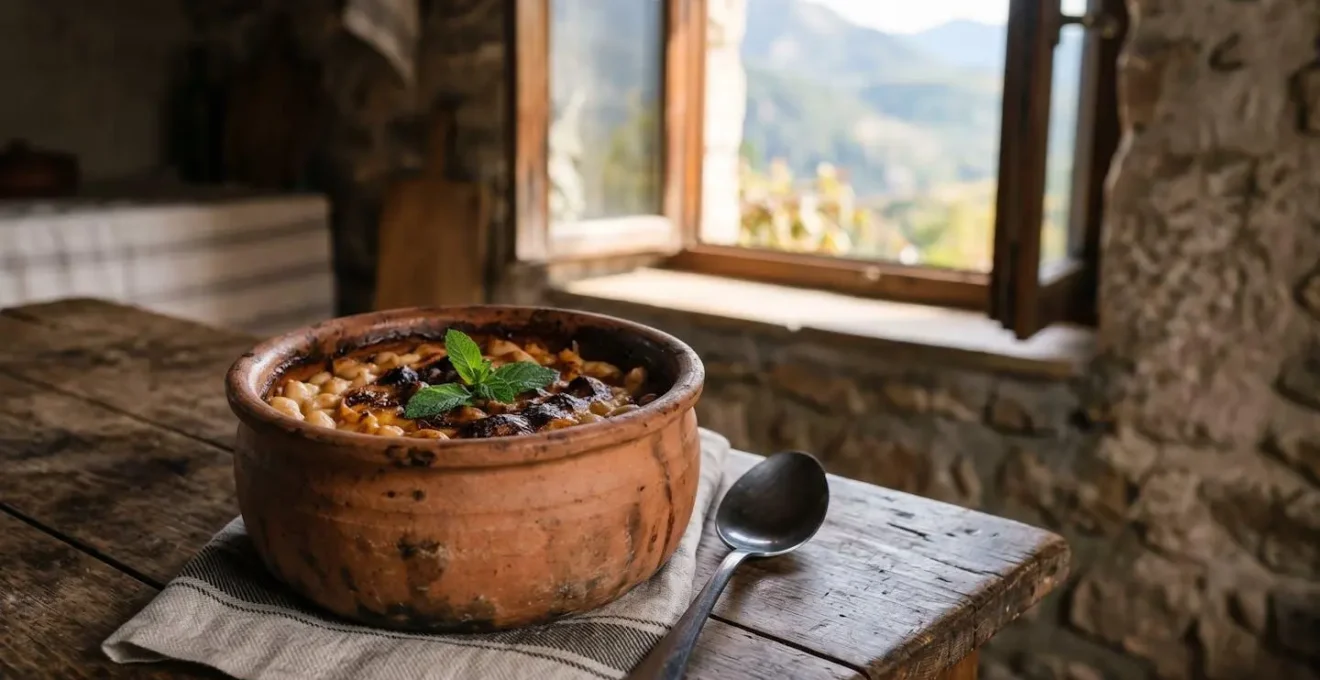
Tavče Gravče is far more than baked beans; it is the very heart of Macedonian culture on a plate, embodying our faith, hospitality, and connection to the land.
- Its role as a staple during Orthodox fasting periods cemented its place in our national identity.
- The specific clay pot and regional ingredients like Tetovo beans create a flavour profile unique to our terroir.
Recommendation: When you try it, seek not just the dish, but the full experience: slow-cooked, shared with friends in a traditional ‘kafana’, and enjoyed with a glass of rakija.
To truly know Macedonia, you must share a meal with us. And when you sit at our table, there is one dish that will inevitably appear, steaming and fragrant, in its humble clay pot: Tavče Gravče. Many visitors see a simple, rustic dish of baked beans, hearty and delicious, but for us, it is something far more profound. It is our history, our faith, and our welcome served in a single vessel. This isn’t just food; it’s a conversation with our ancestors and an open invitation into our homes.
The secret to its importance doesn’t lie in a complex recipe or rare ingredients. On the contrary, its power comes from its simplicity and its deep roots in the daily life of every Macedonian. It represents the duality of our spiritual life—a humble meal for days of fasting, and a rich feast when shared in celebration. In this guide, I will not give you just a recipe; I, as a restaurateur who has dedicated his life to preserving our traditions, will share with you the soul of this dish. We will explore its spiritual origins, uncover its regional variations, and understand why the hospitality with which it’s served is the most crucial ingredient of all.
This article delves into the heart of our culinary identity, exploring each facet of our national dish. The following summary outlines the journey we are about to take together, from the spiritual significance of the beans to the warmth of the welcome that accompanies them.
Summary: Unpacking the Soul of Macedonia’s National Dish
- Why Are Baked Beans So Important to Macedonian National Identity?
- Which Traditional Restaurant in Skopje Serves the Most Authentic Version?
- Ohrid Style vs Skopje Style: How Does Tavče Gravče Differ by Region?
- Is Traditional Tavče Gravče Always Vegetarian or Does It Contain Meat?
- Can You Make Authentic Tavče Gravče Without a Traditional Clay Pot?
- Which Traditional Restaurant in Skopje Serves the Most Authentic Version?
- Why Is Treating Guests Like Royalty a Matter of Honor Here?
- What Makes Traditional Macedonian Cuisine Unique in the Balkans?
Why Are Baked Beans So Important to Macedonian National Identity?
The story of Tavče Gravče is deeply woven into the spiritual fabric of our nation. To understand its importance, you must first understand the role of the Orthodox faith in our culture. With a significant portion of our population being Orthodox Christian, the calendar is marked by long periods of fasting, especially before Easter and Christmas. During these times, all animal products are forbidden. This is where the humble bean ascends to greatness. It is not just a source of protein; it is a symbol of piety, sustenance, and community during times of spiritual reflection.
This simple dish, known as ‘posno’ (fasting) when prepared without meat, became the cornerstone of our Lenten table. It’s a meal that is affordable, nourishing, and can be prepared in large quantities to share. This communal aspect is key. The dish represents our ability to create abundance from simplicity, to gather and find joy even in times of abstinence. In a country where, according to demographic data, nearly 70 percent of the population has roots in this faith, the shared experience of eating Tavče Gravče during these periods has cemented it as a unifying cultural icon. It transcends being mere food and becomes a shared ritual, a taste of home and heritage that connects generations.
Therefore, the bean is not just a legume; it’s a testament to our resilience and our faith. It tells a story of making the most of the earth’s gifts, of community, and of a spiritual discipline that has shaped our national character. Every pot of Tavče Gravče carries with it generations of shared memories from fasting days.
Which Traditional Restaurant in Skopje Serves the Most Authentic Version?
As a restaurateur in Skopje, I am often asked this question, and my answer is always the same: the “most authentic” version is the one that feels like it was cooked by a Macedonian grandmother. It’s about more than just a recipe; it’s about the atmosphere, the warmth, and the spirit of ‘merak’—that untranslatable word for a feeling of bliss and contentment derived from simple pleasures. You are looking for a ‘kafana’, a traditional tavern where time slows down.
For a truly genuine experience, I always point visitors towards places that cherish our heritage. One such gem is Skopski Merak, which perfectly captures the essence of traditional Macedonian hospitality. Its rustic décor, filled with antiques and folk art, immediately transports you. Here, you’ll get hearty portions of local classics, often with the soul-stirring sound of live Macedonian music in the background. It’s an experience that is as much about feeling as it is about tasting.
Another institution is the Old House (Stara Kuka). As the ETIC Hotels Journal rightly points out, its setting in a 19th-century house is half the experience. They are renowned for their food, and their approach to our national dish is exemplary. As they note in their review of Skopje’s best restaurants:
Located in a beautiful traditional house that dates back to the 19th century, Old House is renowned for its authentic Macedonian cuisine and ambiance. Try their tavče gravče (baked beans in a clay pot) or grilled trout, both of which are cooked to perfection.
– ETIC Hotels Journal, The 12 Most Famous Restaurants In Skopje, North Macedonia
Ultimately, finding the most authentic Tavče Gravče means finding a place that respects the tradition, from the ingredients to the slow-cooking method, and most importantly, serves it with a warm, welcoming heart. It’s in these places that you don’t just eat a meal; you partake in a cherished piece of our culture.
Your Checklist for an Authentic Tavče Gravče Experience
- Atmosphere Check: Does the restaurant feel like a ‘kafana’? Look for rustic décor, traditional music, and a relaxed, unhurried vibe.
- The Clay Pot Test: Is the dish served bubbling hot in its own individual, unglazed clay pot? This is non-negotiable.
- The Crust Exam: Does the top of the beans have a slightly dark, baked crust? This shows it was finished properly in the oven.
- Aroma and Spice: Can you smell the gentle aroma of dried mint and paprika? Look for the signature red hue from the paprika.
- The Company You Keep: Are there locals eating there? This is the ultimate sign of authenticity. Listen for the sounds of laughter and lively conversation.
Ohrid Style vs Skopje Style: How Does Tavče Gravče Differ by Region?
To think there is only one way to make Tavče Gravče is to misunderstand the rich tapestry of our country. Like any true national dish, it has a beautiful array of regional personalities, each telling a story about its local environment and history. The core ingredients—beans, onion, oil, paprika—remain, but the nuances are where the magic lies. The two most famous styles often discussed are those from the capital, Skopje, and the jewel of our country, Ohrid, but the variations extend even further.
In Skopje, you might find a slightly more modern interpretation. We love our creamy, locally grown white beans, and the flavour profile is often built around a perfect balance of sweetness from the onions and a deep, smoky warmth from high-quality paprika. Some chefs might add a hint of chili for a gentle kick. The focus is on a clean, rich bean flavour. In contrast, the style from the Tetovo region is famous for a reason. Their beans are legendary. As one Macedonian food blogger notes, “Tetovo beans are characterized by their small size, tender skin, and rich, nutty flavor.” This superior bean often means the dish from this region needs less adornment, letting the bean itself be the star, sometimes with more pronounced spices like cumin to complement its nutty character.
But the variations don’t stop there. As a case study on regional differences highlights, the preparation method itself can define a style. In the Vardar Valley, for example, Tavče Gravče for communal feasts is often slow-cooked over an open fire, imparting a distinctive smoky flavour you won’t find anywhere else. The Ohrid style, influenced by the lake, is often lighter, perhaps using fresh peppers and herbs more liberally. Each region has embraced this national recipe and made it its own, a delicious reflection of our country’s diverse landscape and culinary creativity.
Is Traditional Tavče Gravče Always Vegetarian or Does It Contain Meat?
This is a wonderful question that gets to the very heart of Macedonian culture: the rhythm of ‘posno’ (fasting) and ‘mrsno’ (feasting). The traditional Tavče Gravče is indeed vegetarian, or more accurately, vegan. This is the ‘posno’ version, the foundation of the dish, born out of the necessity and piety of Orthodox fasting days. It is pure, simple, and allows the flavour of the beans and paprika to shine. This is the version that connects us to our spiritual roots and is a staple in every household.
However, when the fast is over, we Macedonians love to celebrate! This is when the ‘mrsno’ version makes its glorious appearance. This is Tavče Gravče transformed into a rich, indulgent feast. While the vegetarian version is the soul, the meat version is the heart-pounding celebration. We often enrich the beans with pieces of smoked meat, which infuses the entire dish with a profound, savoury depth. The most popular additions are smoked pork ribs or chunks of spicy, homemade sausages similar to sujuk or chorizo.
As described in a wonderful feature on the dish, the process is a labour of love. The Balkan-style smoked pork ribs are often pre-roasted with paprika and pepper before being nestled into the par-cooked beans. The entire dish is then baked slowly together. The fat from the meat renders out, mingling with the creamy beans, while the top forms a beautiful, irresistible crust. So, the answer is both. Traditional Tavče Gravče is vegetarian, but the celebratory, feasting version, rich with smoked meat, is just as traditional and beloved in its own right. It represents the two sides of our national character: pious reflection and joyous celebration.
Can You Make Authentic Tavče Gravče Without a Traditional Clay Pot?
You can make a delicious bean stew in a modern dish, of course. But can you make authentic Tavče Gravče? My friend, I must tell you from the heart: no. The traditional earthenware pot, the ‘tavče’, is not a serving suggestion; it is an essential ingredient. It is the vessel that holds not just the beans, but the history and the very soul of the dish. To serve it from anything else would be like trying to drink a fine Macedonian Vranec wine from a paper cup—it simply misses the point.
The clay pot is a porous, natural material that breathes. It distributes heat more gently and evenly than metal or glass, allowing the beans to cook slowly and develop a deep, complex flavour without becoming mushy. The unglazed interior absorbs the flavours over time. As Wikipedia rightly notes, the pot “can even impart a special flavour to the dish” if used regularly. My own restaurant’s pots are decades old, and I can assure you, they hold the memory of thousands of delicious meals.
This is not just culinary folklore; it is a connection to our artisan heritage. The production of these clay pots was a major industry in towns like Veles and Vranestica. While modern manufacturing disrupted this tradition, there has been a heart-warming resurgence of these artisan potters, many of whom are returning to the craft of their ancestors. Using a traditional clay pot is a way of honouring these craftsmen and keeping a vital piece of our heritage alive. It gives the dish its rustic appearance, keeps it piping hot at the table, and most importantly, it completes the ritual. The pot is the hearth of this dish, and without it, you are missing its warmth.
Which Traditional Restaurant in Skopje Serves the Most Authentic Version?
While naming specific restaurants like Old House or Skopski Merak gives you a starting point, finding the “most authentic” experience is also about understanding the culture of the Macedonian ‘kafana’. There are more than 5,000 establishments in our small country that could fall under this category, each with its own character. An authentic experience is not a quiet, formal dinner. It is lively, a bit loud, and full of heart.
Look for places where you can hear the sound of ‘starogradska muzika’ (old town music), often played live by a small band of musicians who move between tables. This music is the soundtrack to our lives, telling tales of love, loss, and patriotic pride. The musicians are part of the experience, not just background noise. A truly authentic kafana will have them.
The service should also be a clue. It won’t be rushed. In Macedonia, we like to eat at a slow pace, to savour each morsel and each moment of conversation. The waiter should treat you like a guest in his own home, offering suggestions, perhaps bringing you a complimentary ‘rakija’ (our potent fruit brandy) to start the meal. The authenticity lies in this feeling of being welcomed and cared for, not just being served. It’s an immersive experience where the food, music, and atmosphere combine to create ‘merak’.
So, while I gave you names, my real advice is to use your senses. Follow the sounds of laughter and music. Look for the warm glow of a place filled with locals sharing food and stories. That is where you will find the most authentic Tavče Gravče, because it will be served with the most important ingredient: the Macedonian soul.
Why Is Treating Guests Like Royalty a Matter of Honor Here?
In Macedonia, we have a saying: “Gostin vo kuka, Gospod vo kuka,” which means “A guest in the house is God in the house.” This is not a quaint platitude; it is the guiding principle of our social lives and a matter of deep personal and family honour. Hospitality, or ‘gostoprimstvo’, is the highest virtue. To fail to show a guest the utmost respect and generosity is to bring shame upon your household. This is why, when you visit us, you are not just a tourist; you are an honoured guest, and we will go to great lengths to make you feel welcome.
This philosophy extends from our homes to our restaurants. The act of sharing food is the ultimate expression of this hospitality. As National Geographic observed when exploring our customs, the experience is all-encompassing: “When calling on someone, you’re given slatko (fruits preserved in a thick syrup) to sweeten your visit, and even if you’re just popping in for a coffee you’ll probably end up staying for dinner.” This is the essence of it. An invitation is open-ended; a small gesture of welcome quickly blossoms into a feast.
We are obsessed with ensuring our guests are full, happy, and comfortable. Offering you Tavče Gravče is not just about giving you food; it’s about sharing the best of what we have. It’s a humble dish, but it is made with pride and served with love. Refusing a second helping is often met with genuine concern! This deep-seated code of honour surrounding hospitality is what transforms a simple meal into a memorable experience. It is the invisible ingredient that makes everything taste better. When you eat with us, you are family, and for family, we give nothing but our very best.
Key takeaways
- Tavče Gravče’s importance is intrinsically linked to its role as a hearty, permissible meal during Orthodox Christian fasting periods.
- The traditional clay pot (‘tavče’) is not just for serving; its porous nature is crucial for the slow cooking process and imparts a unique, subtle flavour.
- True Macedonian hospitality (‘gostoprimstvo’) is considered a matter of honour, making the welcome you receive as vital to the experience as the food itself.
What Makes Traditional Macedonian Cuisine Unique in the Balkans?
While we share many culinary traditions with our Balkan neighbours, Macedonian cuisine has a character all its own, a flavour profile born from our unique terroir and history. The secret, I believe, lies in the exceptional quality of our produce. As Wikipedia’s overview rightly states, “The relatively warm climate of the country provides excellent growth conditions for a variety of vegetables, herbs and fruits.” We are blessed by the sun. Our food is not complex, but it is honest, and its quality comes directly from the earth.
The perfect example of this is the Macedonian tomato. You may think you know what a tomato tastes like, but I assure you, until you have tried an heirloom variety from the fertile valleys around Strumica, you have not experienced its full potential. These tomatoes are sweet, intensely flavoured, and form the base of so many of our dishes, from salads to stews. This, combined with our rich, locally produced olive oil and aged vinegars, creates a taste of the Macedonian sun that sets our cuisine apart. It’s a freshness and intensity that is hard to replicate.
This focus on quality ingredients is what makes our food so beloved by those who visit. It’s not just a patriotic belief; a 2020 research study on food tourism perception, which surveyed both visitors and residents, highlighted the positive impressions our culinary offerings leave. Our cuisine is a direct reflection of our land: fertile, diverse, and generous. From our world-class dairy products and distinctive wines to the potent local ‘rakija’, our uniqueness comes from this intimate connection between the people, the soil, and the sun. Tavče Gravče is the ultimate expression of this: simple, high-quality ingredients, transformed by time and tradition into something truly special.
So when you come to Macedonia, come with an open heart and an empty stomach. Don’t just order Tavče Gravče. Ask about its story. Share a glass of rakija with the people at the next table. Allow yourself to be drawn into the music and the conversation. When you do, you will discover that you are tasting not just our national dish, but our national soul.