In summary:
- Authentic Ohrid pearls are not grown in oysters but are handmade using a secret emulsion from the scales of the endemic Plashica fish.
- Only two families, the Talev and the Filev, are the sole keepers of this 100-year-old secret. Buying from them is the only guarantee of authenticity.
- Verify a real pearl by its slightly gritty texture, cool feel, and subtle surface imperfections—fakes are perfectly smooth, light, and uniform.
- Always request a certificate of authenticity, which is provided with every purchase from the official family workshops in Ohrid.
The allure of an Ohrid pearl is not just in its milky, iridescent glow. It’s in the story it holds—a secret whispered down through generations, rooted in the ancient waters of one of Europe’s oldest lakes. For any discerning jewelry buyer, the quest for an authentic Ohrid pearl is a journey into the heart of Macedonian heritage. But in a market where imitations are rife, how do you ensure the piece you bring home is a true “living gem” and not just a clever counterfeit? Many will tell you to simply “buy from the right families” or “look for a certificate,” but this advice barely scratches the surface.
The truth is, genuine authenticity is not just a piece of paper; it’s a deep understanding of what makes these pearls unique. It’s a chain of authenticity that links the geological past of Lake Ohrid to the unique biology of a tiny fish, and finally, to the hands of the artisans who guard the secret. Forget the simple platitudes. The key to buying a real Ohrid pearl lies not just in knowing where to go, but in understanding *why* you are going there. It’s about recognizing the biological fingerprint, the custodial craft of the families, and the subtle signs that separate a masterpiece from a mass-produced copy.
This guide will take you through that entire chain. We will explore the ancient origins of the lake, the magic within the Plashica fish scales, the distinct legacies of the Talev and Filev families, and the practical tests you can perform to verify your treasure. By the end, you will not just be a buyer; you will be a connoisseur, able to appreciate the profound story behind every luminous pearl.
Summary: How to Buy Authentic Ohrid Pearls Directly from the Families?
- Why Are Plashica Fish Scales Key to Making Ohrid Pearls?
- Talev vs Filev: What Is the Difference Between the Two Original Families?
- The Lighter Test: How to Check if Your Ohrid Pearl Is Fake?
- The Perfume Mistake That Can Ruin Your Ohrid Pearl Necklace
- Which Pearl Design Suits a Young Traveler vs a Classic Collector?
- Why Are Plashica Fish Scales Key to Making Ohrid Pearls?
- Why Is Lake Ohrid Considered One of the Oldest Lakes in Europe?
- Why Is Macedonian Filigree Jewelry Considered Among the Best in the Balkans?
Why Are Plashica Fish Scales Key to Making Ohrid Pearls?
The secret to the Ohrid pearl’s ethereal glow doesn’t lie in an oyster but in the shimmering scales of a small, unassuming fish: the Plasica (Alburnus scoranza). This fish is not just any fish; it is a species endemic to the ancient, crystal-clear waters of Lake Ohrid. Its uniqueness is the first crucial link in the chain of authenticity. Unlike the calcium carbonate that forms traditional pearls, the iridescence of an Ohrid pearl comes from a carefully guarded, secret emulsion made from the Plasica’s scales.
What makes these scales so special is their high concentration of guanine crystals. These microscopic, plate-like crystals are what give the fish its silvery, reflective shimmer—a natural defense mechanism to confuse predators in the deep, clear water. When meticulously extracted and processed, these same crystals refract and reflect light in a way that perfectly mimics the deep, multi-layered luster (or “orient”) of the world’s finest natural pearls. The process is a form of biomimicry perfected over a century.
Therefore, the Plasica fish is not merely an ingredient; it is the very soul of the pearl. The supply of these scales is finite and directly tied to the health of Lake Ohrid’s delicate ecosystem. This biological fingerprint is impossible to replicate synthetically, which is why authentic Ohrid pearls can only come from this specific place and this specific craft. Any “Ohrid-style” pearl made elsewhere is, by definition, a fake, as it lacks the essential biological material that gives the genuine article its unique life and luster.
Talev vs Filev: What Is the Difference Between the Two Original Families?
The secret of transforming Plasica scales into a luminous pearl emulsion is not public knowledge. It is a legacy, a treasure passed down through the male lines of just two families in Ohrid: the Talev and the Filev. For nearly a century, they have been the sole guardians—or as they should be seen, the custodians of the craft. When you purchase from either of these families, you are not just buying jewelry; you are becoming part of a 100-year-old story of artistry and secrecy that began in the 1920s when the original formula was brought to Ohrid by a Russian immigrant.
While both families share the same foundational secret and an unwavering commitment to quality, they have evolved with distinct styles and philosophies, offering a unique choice to the discerning buyer. Understanding their differences is key to finding the piece that resonates most with you. As confirmed by experts at AramcoWorld Magazine’s feature on the craft, the Talev and Filev families are the sole keepers of authentic Ohrid pearlmaking. The following table breaks down their key characteristics, based on information gathered from travelers and local historians.
| Aspect | Talev Family | Filev Family |
|---|---|---|
| Established | 1924 (purchased recipe from Russian emigré) | 1920s (received recipe through family restaurant connection) |
| Shop Location | Main walking street in retail district | Two shops in Old Town (Stari Grad) |
| Notable Clients | Queen Elizabeth II (gifted 2001), former President Crvenkovski | Queen Margrethe II of Denmark, Queen of Netherlands, Princess Diana |
| Product Range | Exclusively Ohrid pearls with traditional designs | Ohrid pearls plus Swarovski crystals, modern jewelry updates |
| Generational Succession | Passed father-to-son only (currently 4th generation) | Passed father-to-son (Mihajlo is 4th generation artisan) |
| Awards | Gold medal at ‘Eureka’ Brussels 2001 (handmade craft competition) | Long-standing family museum showcasing technique history |
Ultimately, the choice between Talev and Filev depends on personal taste. For a classic, heritage piece with a story rooted in tradition, the Talev family is an excellent choice. For a more contemporary design that might blend the pearl with other elements, or for the experience of visiting their family museum, the Filev family offers a different but equally authentic journey.
The Lighter Test: How to Check if Your Ohrid Pearl Is Fake?
A persistent myth surrounding Ohrid pearls is the “lighter test,” where a flame is held to the pearl to prove it’s real. Let’s be unequivocally clear: do not do this. While a genuine Ohrid pearl, with its multiple layers of emulsion on a mother-of-pearl core, can withstand a brief exposure to flame without melting like plastic, this is a crude and potentially damaging test. It can easily discolor the surface or damage the setting. Instead, you can rely on several non-destructive methods that appeal to your senses and reveal the true nature of the pearl.
Authenticity is often felt, not just seen. Fakes made of glass or plastic are designed to look perfect, but they lack the subtle, organic characteristics of a handmade gem. An authentic Ohrid pearl carries the signature of its creation. The slight variations on its surface are not flaws; they are proof of the artisan’s touch. To help you distinguish a real treasure from a cheap imitation, here are the key signs to look for.
As the macro view above reveals, the surface of a real Ohrid pearl is a landscape of subtle texture and depth. This is a world away from the sterile, flawless surface of a plastic bead. Train your eye to look for these signs of life, and you’ll be able to spot an imitation from across the room.
Your Authentication Checklist: 4 Key Tests
- The Tooth Test: Gently rub the pearl against the edge of your front teeth. A real Ohrid pearl will feel slightly gritty or sandy due to the natural emulsion layers. Fakes made of plastic or glass will feel perfectly smooth and slippery.
- The Weight & Temperature Test: A genuine pearl has density. It will feel cool to the touch at first and then slowly warm up against your skin. A fake plastic pearl is lightweight and will feel room temperature almost immediately.
- The Imperfection Test: Examine the pearl’s surface closely under good light. A handmade Ohrid pearl will have very subtle irregularities, tiny ridges, or slight variations in its spherical shape. A strand of fakes will have pearls that are unnervingly identical and perfectly round.
- The Certificate Guarantee: The most foolproof method is prevention. By purchasing only from the official Talev or Filev family shops, you will receive an official certificate of authenticity with each piece, completely eliminating any guesswork.
The Perfume Mistake That Can Ruin Your Ohrid Pearl Necklace
An authentic Ohrid pearl is a durable work of art, designed to last for generations. While its unique emulsion makes it more resilient than many natural sea pearls, it is not invincible. The single most common mistake that can permanently damage its deep luster is exposure to chemicals, particularly those found in perfumes, hairsprays, and lotions. These substances contain alcohol and acids that can eat away at the delicate layers of the pearl’s surface, causing it to become dull, cloudy, and lifeless over time.
The rule of thumb for any pearl owner is simple yet crucial: pearls should be the last thing you put on and the first thing you take off. Apply your perfume, hairspray, and any cosmetics *before* you put on your necklace or earrings. Allow these products to dry completely on your skin. When you return home, remove your pearls before your clothes to avoid snagging them and wipe them gently with a soft, dry cloth to remove any skin oils or residues they may have picked up during the day.
This isn’t just generic advice; it’s a principle rooted in the very chemistry of the pearl. As fourth-generation artisan Vane Talev explained in an interview, the secret formula is a delicate balance. He noted the danger of everyday chemicals, stating:
Get the formula wrong, and the pearls will lose their shine when confronted with perspiration.
– Vane Talev, Fourth-generation Ohrid pearl craftsman interview
If even the body’s natural chemistry can pose a challenge, it’s clear why introducing a spray of alcohol-based perfume directly onto the pearl is so destructive. Treat your Ohrid pearl with the care it deserves, and its captivating glow will last a lifetime and beyond.
Which Pearl Design Suits a Young Traveler vs a Classic Collector?
The beauty of Ohrid pearls is that their timeless elegance can be translated into a vast range of styles, from the minimalist and modern to the opulent and traditional. Choosing the right design is a personal decision that reflects your own aesthetic and how you intend to wear your piece. The families understand this, offering creations that appeal to everyone from a young backpacker seeking a meaningful souvenir to a serious jewelry collector looking for a statement piece.
For the young traveler or minimalist, the focus is often on versatility and understated elegance. A single, perfect pearl on a delicate silver chain or a durable leather cord is a popular choice. It’s a piece that can be worn every day, a subtle yet profound reminder of a journey to the heart of the Balkans. Small stud earrings or a simple pearl bracelet also fit this category, offering a touch of classic beauty without being overpowering. These designs celebrate the pearl itself, in its purest form.
For the classic collector or someone seeking an heirloom, the artistry can be far more elaborate. This is where multi-strand necklaces, graded in size for a dramatic effect, come into play. These are statement pieces, often reserved for special occasions, that showcase the family’s mastery over their craft. Elaborate bib-style necklaces, where pearls are woven into intricate patterns, or pieces that combine pearls with the delicate art of Macedonian filigree, represent the pinnacle of local craftsmanship. These are not just accessories; they are wearable art and a tangible investment. As the craft is limited to just two families, these larger, more complex pieces are finite and hold significant value that appreciates over time, making them true family heirlooms.
Why Are Plashica Fish Scales Key to Making Ohrid Pearls?
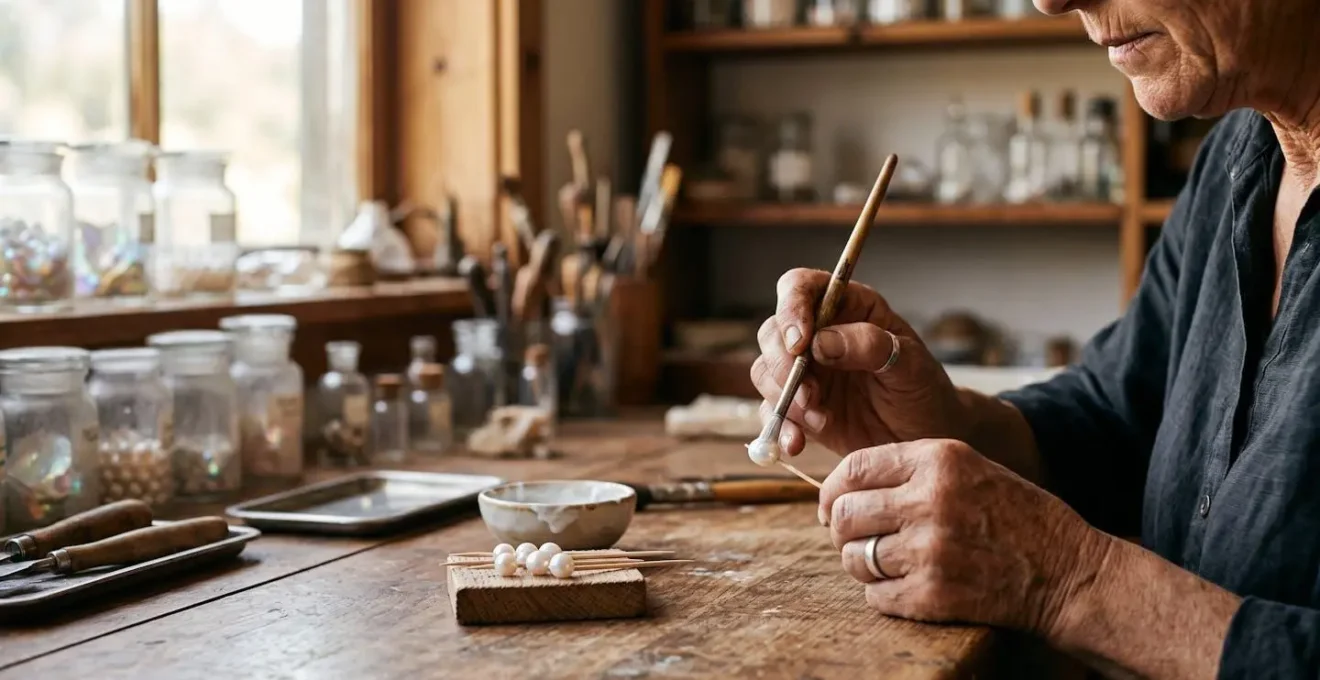
Understanding that Plasica fish scales are the source of the luster is one thing; appreciating the artistry of the process is another. The transformation of these delicate scales into a durable, shimmering emulsion is the core of the 100-year-old secret. This is not a simple coating but a meticulous, multi-layered process that gives the pearl its depth and resilience. The core of the pearl is typically a bead carved from mother-of-pearl, which provides a solid, sympathetic base for the emulsion.
The harvested scales are not simply melted down. They are carefully cleaned and processed to isolate the guanine crystals, which are then suspended in a secret liquid formula. This emulsion is then hand-painted onto the mother-of-pearl core, one layer at a time. Each layer must be allowed to dry completely before the next is applied. A high-quality Ohrid pearl can have up to 40 or 50 layers of this emulsion, a process that can take weeks to complete. It is this patient layering that creates the deep, seemingly bottomless glow that makes the pearls so captivating.
After the final layer is applied and cured, a final protective coating is added. This last step is what gives the Ohrid pearl its renowned durability, protecting it from moisture and everyday wear in a way that many natural pearls cannot match. This entire, painstaking procedure is performed by hand, in the family workshops, just as it has been for a century. The process is a testament to the idea that true luxury is not about speed or mass production, but about patience, skill, and a deep connection to natural materials.
Key Takeaways
- Authenticity is guaranteed only by buying from the Talev or Filev family shops in Ohrid.
- Use the “tooth test” and “weight test” for quick, non-destructive verification; real pearls feel gritty and cool.
- Protect your pearl’s luster by avoiding direct contact with perfumes, lotions, and other chemicals.
Why Is Lake Ohrid Considered One of the Oldest Lakes in Europe?
To truly understand the Ohrid pearl, you must first understand its cradle: Lake Ohrid. This is not just a beautiful body of water; it is a geological marvel, a “living museum.” Geologists classify it as an ancient lake, one of only a handful in the world to have existed continuously for over a million years. According to geological dating and analysis from the NASA Earth Observatory, it is estimated to be 1 to 1.4 million years old, placing it in an elite class of ancient lakes worldwide.
Its extraordinary age is the result of persistent tectonic activity. The lake sits in a graben, a valley that is continuously sinking between two fault lines, which has allowed it to persist for eons without filling with sediment. This incredible stability over a vast timescale has created a unique, isolated environment—a perfect laboratory for evolution. The lake’s cold, deep, and oxygen-rich waters have served as a refuge for species that have gone extinct elsewhere.
This is why Lake Ohrid boasts an astonishing level of biodiversity. It is home to over 200 endemic species, meaning plants and animals found nowhere else on Earth. This exceptional ecosystem is the reason the Ohrid pearl can even exist. The Plasica fish, with its unique shimmering scales, is a product of this ancient evolutionary crucible. As the UNESCO World Heritage Centre eloquently states:
Lake Ohrid provides a refuge for numerous endemic species of freshwater fauna and flora dating from the Tertiary period.
– UNESCO World Heritage Centre, Natural and Cultural Heritage of the Ohrid Region Official Description
Therefore, the Ohrid pearl is more than a craft; it is a piece of geological heritage. Each pearl is an indirect product of millions of years of geological and biological evolution, a story that begins not in a workshop, but at the bottom of an ancient lake.
Why Is Macedonian Filigree Jewelry Considered Among the Best in the Balkans?
While an Ohrid pearl is a masterpiece on its own, its beauty is often elevated to another level when set in traditional Macedonian filigree. This ancient metalworking technique, which involves twisting and weaving fine threads of silver or gold into lace-like patterns, is another celebrated craft from the Ohrid region. The synergy between the luminous, simple pearl and the intricate, delicate filigree is a hallmark of the finest Balkan jewelry.
What sets Macedonian filigree apart is the sheer complexity and fineness of the work. Artisans who have mastered this craft can create incredibly detailed butterfly and floral motifs using wires that are sometimes as thin as a human hair. This level of detail requires immense patience and a steady hand, a skill passed down through generations of guild artisans, much like the pearl-making secret itself.
Case Study: The Synergy of Pearl and Filigree
According to heritage documentation from North Macedonia’s official tourism board, the crafts of pearl-making and filigree evolved side-by-side in the same artisan guilds of Ohrid’s Old Bazaar. This created a natural artistic partnership. Filigree settings are not designed to overwhelm the pearl, but to enhance it. The openwork patterns allow light to pass through the setting and illuminate the pearl from all angles, amplifying its natural luster. A piece that combines a genuine Ohrid pearl with handmade local filigree is therefore a powerful symbol of Macedonian heritage, offering two layers of celebrated craftsmanship in a single object.
For a buyer, this means that a filigree setting is not just a decorative choice; it is a way to own a more complete piece of Ohrid’s artistic soul. When you see a pearl set in this intricate metalwork, you are looking at a collaboration between two of the region’s most treasured traditions. It transforms a piece of jewelry into a profound cultural statement, a testament to the enduring legacy of Balkan craftsmanship.