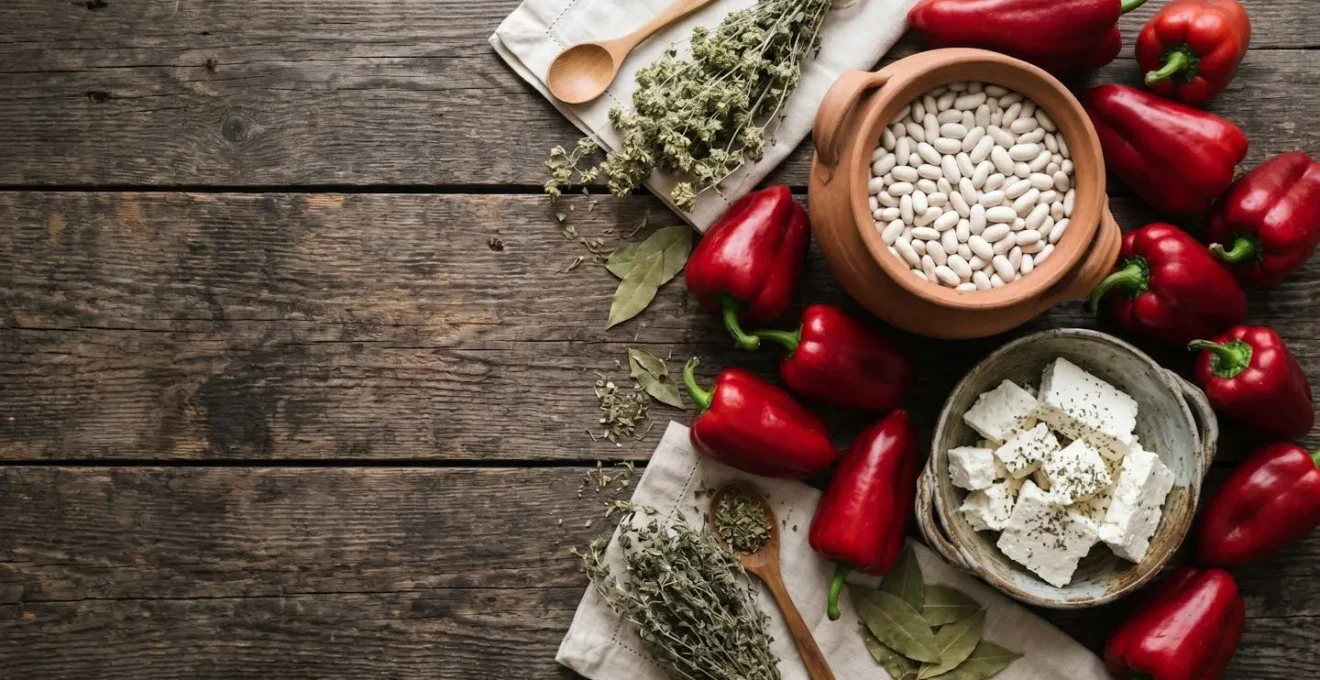
The secret to Macedonian food isn’t in a list of shared Balkan ingredients, but in its unique vegetable-forward soul and the generational memory cooked into every dish.
- It prioritizes the terroir of local peppers and tomatoes over the meat-centric focus of many neighbours.
- Its uniqueness comes from adapting Ottoman techniques (like phyllo and slow-cooking) with distinctly local produce (like potatoes in musaka).
Recommendation: To truly understand it, look beyond the menu: seek out the daily ‘gotveni jadenja’, respect the ajvar-making ritual, and taste the difference that sunshine makes.
People come to the Balkans and they think they understand the food. They see the charcoal grills, the endless platters of meat, the flaky burek in the bakeries, and they often assume it’s all one and the same. I’ve seen it countless times. Travellers enjoy a meal in Belgrade, then another in Sofia, and they arrive in Skopje thinking they know what to expect. And in a way, they are not entirely wrong. We are brothers and sisters in the Balkans, and our histories are woven together like the threads of a colourful rug.
Of course, we share a culinary language, much of it written during the over 500 years of Ottoman presence. But to say our food is the same as our neighbours’ is like saying two brothers have the same soul simply because they share a family name. The true, beating heart of Macedonian cuisine is different. It’s warmer, gentler. It tastes of sunshine. It’s a flavour born from our rich soil, the intense sweetness of our red peppers, and the generational memory passed down from grandmother to grandchild in kitchens filled with laughter and the scent of baking bread.
The uniqueness isn’t just in the recipes; it’s in the rituals, the vegetable-forward philosophy, and the subtle twists that make a familiar dish undeniably our own. In this guide, I want to welcome you into my kitchen, to take you past the tourist menus and let you taste the real stories on our plates. We will explore our history, understand not just what to order but *why* it tastes different here, and I’ll even share the secrets to finding the little places where locals go for a taste of home.
To guide you on this flavourful journey, this article breaks down the essential elements that define our culinary identity. From historical influences to must-try dishes and practical tips, here is a complete map to the heart of Macedonian gastronomy.
Table of Contents: A Journey Through the Heart of Macedonian Flavours
- How Did Ottoman and Mediterranean Influences Shape Macedonian Food?
- Which 5 Dishes Should Every First-Time Visitor Order?
- Macedonian vs Serbian Food: What Are the Key Differences?
- The Restaurant Mistake: How to Spot Authentic Places from Tourist Traps?
- Where Can You Take a Hands-On Cooking Class in Skopje or Ohrid?
- Which 5 Dishes Should Every First-Time Visitor Order?
- How to Identify Turkish Influence in Traditional Macedonian Dishes?
- How to Make Authentic Ajvar at Home After Your Trip to Macedonia?
How Did Ottoman and Mediterranean Influences Shape Macedonian Food?
To understand our food, you must understand our history. Our land has always been a crossroads, a place where empires and cultures met. The two most important flavours you will taste are those of the Ottoman Empire and the sun-drenched Mediterranean. The Ottomans brought with them a rich, complex culinary tradition. You see it in our love for grilled meats (kebapche), our use of yogurt, and the delicate art of making pastries with paper-thin dough. It’s a technique that requires patience and love, a craft passed down through generations.
This influence is not just a copy; it’s a conversation. We took Ottoman ideas and made them our own, using the incredible bounty our land provides. A perfect example is our musaka. While you may know the Greek version with eggplant, our grandmothers have always made it with layers of potato, ground meat, and a rich egg topping. It’s a heartier, more comforting dish that speaks of our fields and our farms, a true case study in culinary adaptation.
Macedonian Musaka: A Case Study in Culinary Adaptation
Macedonian musaka demonstrates how external culinary concepts are adapted with local ingredients. Unlike the Greek version made with eggplant, Macedonian musaka is made of ground beef meat and fried onion spread on layers of potato slices, creating a uniquely national dish that reflects local agricultural resources and preferences.
But while the Ottoman techniques gave us structure, the Mediterranean sun gave us our soul. We are blessed with incredible produce. Our tomatoes are sweet and full-bodied, and our peppers, especially the ‘Kurtovska Kapija’, are the pride of our nation. This focus on fresh, seasonal vegetables is what truly sets our cuisine apart. It’s a lighter, sunnier expression of Balkan food, where meat is often a companion to the vegetables, not always the star. This beautiful marriage of history and terroir is the very foundation of our kitchen.
Looking at these delicate layers, you can almost taste the history. This is the artistry of the Ottoman bakers, a technique we embraced and perfected. It’s this fusion—the rich, layered history and the vibrant, fresh character of our land—that you’ll find in every bite of authentic Macedonian food.
Which 5 Dishes Should Every First-Time Visitor Order?
When someone visits my home for the first time, I don’t ask them what they want to eat. I cook for them from the heart. A visitor to Macedonia is a guest in our collective home, and these are the five dishes we would lovingly prepare for you. They are not just meals; they are the essential chapters of our culinary story. To leave without trying them is to leave without truly knowing us. Think of this not as a menu, but as a welcoming embrace from our kitchen.
Each dish represents a different facet of our culture. You’ll find the humble, comforting soul of the nation in a clay pot, the fiery spirit of our harvest in a simple spread, and the ancient traditions of our lakes and mountains on your plate. Forget what you think you know about Balkan food for a moment, and let these five authentic tastes guide your palate on a true Macedonian journey. Here is what you must not miss:
- The National Comfort: Tavče Gravče – This is it. If Macedonia had a flavour, it would be this hearty bean stew. Slowly baked in a traditional clay pot until the top is crisp and the inside is creamy, it’s seasoned with our famous paprika and a touch of mint. We traditionally eat it on Fridays, but its comforting warmth is welcome any day of the week.
- The Red Gold: Ajvar – More than a spread, ajvar is a ritual. Every autumn, families and neighbours gather to roast mountains of sweet red peppers over open fires. The smoky, sweet, and slightly tangy result is our national treasure. Spread it on fresh bread with a slice of salty `sirenje` (white cheese) for an experience of pure bliss.
- The Lakeside Delicacy: Ohrid Trout – From the deep, ancient waters of Lake Ohrid comes this unique fish. It’s a protected species, and a true delicacy. Typically grilled or baked with minimal seasoning to let its delicate, sweet flavour shine through, it’s a taste you can only find here, a direct connection to the pristine nature of our country.
- The Street Food Essential: Kebapche – In the heart of Skopje’s Old Bazaar, the smell of grilling meat will lead you to these little treasures. These are not just sausages; they are a social tradition. Simple minced meat, seasoned perfectly and grilled over charcoal, served with fresh onions and warm bread. It’s the taste of a bustling afternoon, best enjoyed with friends.
- The Regional Specialty: Pastrmajlija – Often called the ‘Macedonian pizza’, this is a dish you’ll dream about long after you’ve left. It’s a long, boat-shaped flatbread, crispy on the outside and soft within, topped with tender chunks of marinated pork and sometimes a sprinkle of red pepper flakes. It’s a carnivore’s delight and a specialty from the central part of our country.
Macedonian vs Serbian Food: What Are the Key Differences?
This is a question I hear often, and it is a good one. To the untrained palate, our cuisines can seem very similar. We both make wonderful grilled meats, we share a love for rakija, and many dishes have similar names. But the soul of the cooking, the philosophy in the kitchen, is where you find the real differences. It’s in the details, the little touches that a grandmother adds to a pot, that our distinct culinary identity shines through.
The most significant difference is our celebration of vegetables. While our Serbian brothers have a proud, robust cuisine that is deeply meat-centric, we Macedonians build our meals around the gifts of our soil. Our cooking is a reflection of our fertile valleys and the long, sunny days. This is why our ajvar is a religion, and why a simple tomato and pepper salad can be a revelation. We also use a different palette of spices. As Gordana from the Macedonian Cuisine blog notes, we have a lighter touch.
Unlike Bulgarian and Serbian cuisine, Macedonian dishes rarely include čubrika. Our traditional spices are more focused on paprika, garlic, parsley and black pepper.
– Gordana, Macedonian Cuisine Blog
This subtle shift in seasoning changes everything. The absence of the strong, savory `čubrika` allows the natural sweetness of the vegetables to come forward. It’s a philosophy of cooking that seeks to enhance, not mask. To help you become a true connoisseur, here is a comparison of some key differentiators you can look for on your culinary journey. It’s in these nuances that you’ll find the true heart of our kitchen.
| Aspect | Macedonian Cuisine | Serbian Cuisine |
|---|---|---|
| Culinary Philosophy | Vegetable-forward, celebrating terroir of famous peppers and tomatoes | Meat-centric, especially grilled and smoked meats |
| Ajvar Composition | Exclusively red peppers (Kurtovska Kapija variety), chunkier texture, eggplant common | Red peppers with smoother texture, eggplant less traditional |
| Signature Spices | Paprika, garlic, parsley, black pepper (no čubrika) | Čubrika (savory), paprika, garlic |
| Rakija Base | Predominantly grape-based (yellow grape rakija), plum varieties | Primarily plum-based (šljivovica), with regional fruit variations |
| Burek Style | Round, baked in large trays, cut into quarters, various fillings including cheese, spinach, pizza-style | Spiral-shaped, primarily meat-filled |
The Restaurant Mistake: How to Spot Authentic Places from Tourist Traps?
My heart breaks a little when I see visitors sitting in a shiny new restaurant with a 10-page laminated menu in five languages. They are eating, but they are not tasting Macedonia. The greatest mistake a food-loving traveller can make is to confuse polish with authenticity. Our best food is often found in the most humble of places, places that value the quality of the meal over the gloss of the menu. So, how do you find these hidden gems? You must learn to see with a local’s eyes.
An authentic Macedonian restaurant, a `gostilnica`, is not about endless choice; it’s about daily perfection. The owner has gone to the market in the morning, seen what is fresh, and decided what to cook. This is the food of the home, the food of the heart. It will be a short menu, perhaps even handwritten on a chalkboard. These slow-cooked dishes are called `gotveni jadenja`, and they are the soul of our daily cuisine. When you see a place offering these, you are on the right track.
Look for the simple things: the quality of the bread, the tang of the house cheese (`sirenje`), the presence of locals arguing about football. These are the signs that you have found a real place, a place that cooks for its community, not just for tourists. A restaurant that proudly serves `Tavče Gravče` on a Friday is honouring a tradition, not just a recipe. To help you on your quest, I have prepared a small checklist. It is your secret map to a truly authentic meal.
Your Checklist for Finding an Authentic Macedonian Restaurant
- The ‘Gotveni Jadenja’ Test: Look for a short, handwritten list of daily slow-cooked dishes. Authentic ‘gostilnica’ venues change menus based on what’s freshly cooked that day, not laminated multi-page menus.
- The Bread and Sirenje Quality Check: Genuine restaurants serve fresh, house-baked or high-quality local bread with tangy, firm white cheese. Industrial bread and bland cheese are major red flags.
- Restaurant Type Decoder: Distinguish between ‘Kafana’ (for meze, drinks, and music), ‘Gostilnica’ (for traditional slow-cooked meals), and ‘Burekčilnica’ (specialized burek bakeries).
- The Menu Language Trick: Authentic venues have menus primarily in Macedonian with English as secondary. Menus dominated by glossy photos and multiple foreign languages target tourists, not locals.
- The Friday Tavče Gravče Indicator: Traditional restaurants will prominently feature tavče gravče on Fridays, reflecting the Orthodox Christian fasting tradition still observed by locals.
Where Can You Take a Hands-On Cooking Class in Skopje or Ohrid?
So, you have tasted our food, and now you feel it. That little spark, that desire to understand it more deeply, perhaps even to bring a piece of it home with you. This is a wonderful feeling! Many visitors look for a cooking class, and this can be a beautiful way to connect with our culture. But just like with restaurants, not all classes are created equal. The goal is not just to learn a recipe; it is to understand the story behind it, the feel of the ingredients in your hands.
A true Macedonian cooking experience should feel like being welcomed into a family’s kitchen. It should start at the local green market, amidst the vibrant colours of the produce and the lively chatter of vendors. It should be about learning why we use this specific pepper, or why we stir the pot in a certain way. It’s about the stories shared over a glass of homemade rakija while the food simmers. It’s less of a formal ‘class’ and more of a ‘culinary immersion’.
Whether you find yourself in the bustling capital of Skopje or by the tranquil shores of Lake Ohrid, opportunities exist. But to ensure you find an authentic one, you must become an inquisitive student before you even book. Ask the right questions. A good host will be happy to share their philosophy. To help you, here are the questions I would ask to find a class that teaches the soul of our cuisine, not just the steps.
- Are the ingredients sourced from a local green market on the day of the class?
- Will we cook regional specialties specific to Skopje or Ohrid, or generic Balkan dishes?
- What is the cultural story and historical context behind the dishes we will make?
- Is this a homestay experience with a local family or a professional restaurant setting?
- Do you offer seasonal specialty workshops, such as ajvar making in September or zimnica preparation?
- Will we learn traditional techniques like hand-mincing for ajvar or clay pot cooking for tavče gravče?
- What is the class size, and how much hands-on cooking will each participant do?
- Are there opportunities to visit local producers, such as cheese farms or rakija distilleries?
- Do you teach the art of making ‘Tava’ dishes central to Macedonian home cooking?
- Can you accommodate dietary restrictions while maintaining authenticity of traditional recipes?
Which 5 Dishes Should Every First-Time Visitor Order?
We’ve already listed the five essential dishes you must order. But knowing their names is only the beginning. To truly appreciate them, you must understand the spirit in which they are eaten. It is like knowing the words to a song, but not the music. Each of these dishes has a time, a place, and a feeling associated with it. This is how you move from being a tourist who eats to a traveller who dines.
Take `Tavče Gravče`, for example. It is more than just a bean stew; it is the embodiment of our hospitality. As one local expert beautifully put it, it’s a dish that represents a warm, humble welcome.
Tavče Gravče isn’t just beans; it’s the national comfort food, a symbol of humble, hearty hospitality
– Local food expert, Nomad Paradise – Macedonian Food Guide
When a family shares their `Tavče Gravče` with you, they are sharing their comfort and their warmth. Enjoy it slowly, using the fresh bread to scoop up every last bit. `Kebapche`, on the other hand, is the taste of spontaneity and community. It’s eaten standing up, in the middle of a busy day, a quick and joyful moment shared with friends before moving on. Don’t look for a fancy restaurant; find a small hole-in-the-wall in the Old Bazaar with a line of locals. That’s where the magic is.
Ajvar should be enjoyed simply, allowing its complex smoky-sweetness to be the star. We have it for breakfast, as a `meze` before a larger meal, or as a late-night snack. Paired with our salty `sirenje` cheese, it is a perfect symphony of flavours. And when you are enjoying the delicate Ohrid Trout by the lake, do it with reverence. You are tasting something ancient and unique to that very spot. Understanding this context, this *rhythm* of eating, is the final step to truly appreciating our cuisine.
How to Identify Turkish Influence in Traditional Macedonian Dishes?
Once you start to really pay attention, you’ll see the Turkish and Ottoman signature everywhere in our cuisine. It’s like a secret language hidden in plain sight. It’s in the names of the dishes, the techniques we use, and the flavours we combine. Learning to spot these clues will transform your dining experience from a simple meal into a fascinating historical treasure hunt. It’s a game any food lover can play at the table.
One of the most direct examples of this syncretism is a beloved stew called `Turlitava`. It’s a dish that tells a story in every layer. In a single pot, you have the entire history of our land. It’s a perfect illustration of how we have absorbed and reinterpreted influences over centuries. This one dish is a delicious lesson in culinary anthropology.
Turlitava: Dissecting Layers of Culinary Influence
Turlitava, a traditional Macedonian vegetable and meat stew, perfectly illustrates culinary syncretism. The clay pot cooking vessel represents the pre-Ottoman Balkan/Slavic foundation. The medley of vegetables (peppers, tomatoes, eggplant) showcases the local Mediterranean terroir and agricultural abundance. The slow-cooking method and the Turkish-origin name ‘turli’ demonstrate Ottoman influence. This single dish embodies three distinct culinary layers working in harmony.
To help you become a true “culinary detective,” I’ve put together a simple toolkit. These are the key signals to look for. Once you learn them, you’ll start seeing connections everywhere, from the street-side bakeries to the most elegant restaurant tables. Your meal will become a conversation with the past.
- The Lexicon Test: Listen to the names. If a dish is called `burek` (börek), `kebap` (kebab), `pilav` (pilaf), `sarma` (wrapped), or `baklava`, you are hearing a direct echo from the Turkish language.
- The Technique Recognition: Watch how the food is made. The use of paper-thin phyllo dough, the art of stuffing vegetables (like in `sarma`), grilling meat on skewers, and slow-cooking in ceramic pots are all hallmark Ottoman techniques we have perfected.
- The Flavor Profile: Taste for specific combinations. A heavy reliance on yogurt as both a sauce and a marinade is a clear sign. The tradition of ending a meal with a thick, strong coffee prepared in a `džezve` is another ritual that has stayed with us.
- Direct Adoption Examples: Some dishes were so perfect we barely changed them. `Baklava`, `Turkish Coffee`, and `Burek` are prepared in ways that would be instantly recognizable in Istanbul.
- Creative Adaptation Examples: These are my favorite. Dishes like our potato-based `Musaka` or `Turlitava` stew show how we took an Ottoman concept and made it entirely our own using our local vegetables.
Key Takeaways
- Macedonian cuisine’s uniqueness stems from its vegetable-forward philosophy, celebrating local peppers and tomatoes.
- Key differentiators from neighbors include the absence of certain spices (like čubrika) and unique preparations of shared dishes (like round burek).
- Authenticity is found in rituals like communal ajvar making and daily-cooked ‘gotveni jadenja,’ not in multi-language tourist menus.
How to Make Authentic Ajvar at Home After Your Trip to Macedonia?
There is one flavour that, more than any other, captures the essence of a Macedonian autumn: ajvar. This “red gold” is the taste of our harvest, the result of a cherished ritual that brings families and communities together. I’ve heard visitors call it a dip, a spread, or a relish. To us, it is simply ajvar, and it is a piece of our heart in a jar. Many people try to replicate it at home, but often miss the essential secrets that give it its true soul.
The biggest mistake is using a blender. My grandmother would faint at the thought! Authentic ajvar has texture; it’s a rustic, chunky spread, not a smooth purée. The character comes from the patient hand-mincing of fire-roasted peppers. This ritual, known as `Ajvarijada`, is a celebration. We gather to roast dozens of kilos of peppers, their smoky scent filling the air, and then stir the mixture for hours in huge pots. It’s a labour of love, a way of preserving the last of the summer sun for the long winter months.
Macedonian families gather to make tens of kilos of ajvar and store it in jars for the winter period. If you only try one dish during your visit to Macedonia, make sure it’s ajvar!
– Milena, Macedonian food expert, Nomad Paradise – Traditional Macedonian Dishes
Bringing a jar of real ajvar home is wonderful, but learning to make it yourself is a way to keep the memory of Macedonia alive in your own kitchen. It may seem daunting, but if you follow the old ways, the true “grandmother’s secrets,” you can capture its authentic spirit. Here is how we do it.
- The Pepper Choice: This is everything. You must use red, fleshy, meaty peppers. In Macedonia, we use the ‘Kurtovska Kapija’ variety. If you cannot find them, look for the thickest-walled red bell peppers you can. Avoid thin-skinned peppers; they will burn and have no substance.
- The Roasting Method: The smoke is essential. A wood fire is traditional, but a gas grill or even an oven broiler on the highest heat will work. The goal is to char the skins completely until they are black and blistered. This steams the pepper inside and makes it sweet.
- The Texture Trick: Once peeled and de-seeded, NEVER use a blender. This is the cardinal rule. You must finely chop the peppers by hand or, if you must, use a meat grinder on its coarsest setting. You want visible texture, not a paste.
- The ‘Ajvarijada’ Ritual: This is the slow-cooking process. You cook the minced peppers with sunflower oil and salt for hours, stirring constantly. It’s a meditation. The ajvar is ready when a wooden spoon drawn through the mixture leaves a clear path that doesn’t immediately fill back in.
- The ‘Zimnica’ Preservation: Like all our winter preserves (`zimnica`), we store ajvar in sterilized jars. Fill hot jars with the hot ajvar, seal them tightly, and store them in a cool, dark place. It’s a jar of sunshine for a cold winter day.
So the next time you are in Macedonia, I invite you not just to eat, but to taste the stories. And if you bring a jar of homemade ajvar home with you, you bring a piece of our heart and our sunshine with you. Begin your journey, explore these flavours, and find your own Macedonian food story to tell.