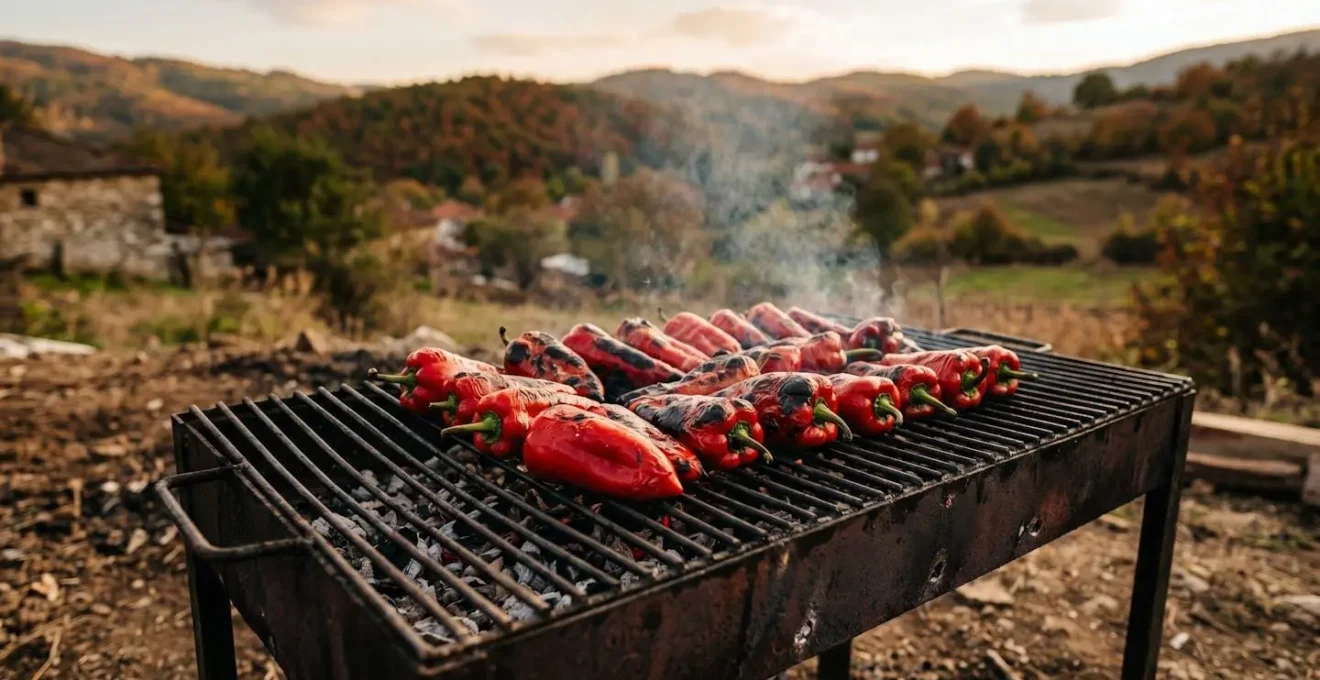
The secret to recreating that unforgettable Ajvar from your trip isn’t in a recipe, but in embracing the Macedonian tradition of craft and community.
- Authenticity comes from using the right pepper—the Kurtovska Kapija—and understanding why its properties are essential for flavor.
- The deep, smoky taste you love is achieved through real fire-roasting and slow-cooking, a process that cannot be rushed or faked.
Recommendation: Focus less on exact measurements and more on the sensory cues of the process—the smell of charring peppers, the texture of the spread, and the color of a deep sunset. That is the true Macedonian way.
Ah, my dear, so you’ve come back from my beautiful Macedonia with a taste still lingering on your tongue, haven’t you? The taste of real Ajvar, warm from the sun and spread thick on a piece of fresh bread. You’ve looked online, I’m sure. You’ve seen the lists of ingredients – peppers, eggplant, oil, salt. It seems so simple. But those recipes, they are like a photograph of a person; they show you the face, but not the soul. They tell you what to do, but not why you do it, and they certainly don’t tell you the most important secret of all.
The truth is, making Ajvar is not a kitchen task; it is a seasonal ritual, a celebration we call zimnica, the preparing of winter foods. It is about community, patience, and a deep respect for the ingredients that the earth gives us. Forget the sterile instructions you’ve read. If you truly want to capture that flavor, that memory, you must understand that Ajvar is not just made, it is brought to life. It is a story told with fire, patience, and a very specific kind of red pepper. So, pull up a chair, and let your Macedonian baba (grandmother) tell you the real story. We will not just follow a recipe; we will walk through a tradition together.
Summary: How to Make Ajvar the Macedonian Way
- Why Is Ajvar Season a Community Event in Macedonian Villages?
- Which Pepper Variety Makes the Most Authentic Homemade Ajvar?
- Homemade vs Store-Bought Ajvar: Can You Really Taste the Difference?
- The Storage Mistake That Makes Your Ajvar Go Bad Within Weeks
- Which Creative Recipes Use Ajvar Beyond the Traditional Bread Spread?
- Which Pepper Variety Makes the Most Authentic Homemade Ajvar?
- Why Is Autumn Harvest Season the Best Time for Farm Dining?
- Why Is Tavče Gravče Considered the National Dish of North Macedonia?
Why Is Ajvar Season a Community Event in Macedonian Villages?
You must understand, my child, that in Macedonia, no one makes Ajvar alone. To even try would be missing the entire point. When the air turns crisp in late summer and the red peppers hang heavy and ripe on the vine, a special kind of energy fills the villages. This is Ajvar season. It’s a time when families and neighbours spill out into their yards, and the entire community becomes a single, bustling open-air kitchen. The air fills with the sweet, smoky perfume of roasting peppers and the sound of laughter and chatter.
Traditionally, this was a grand affair. The process was a beautiful dance of shared labour where everyone had a role. As one lovely account of this tradition notes, the work was spread among generations. The men would tend to the huge fires, the grandmothers and mothers would expertly turn the peppers over the open flames, and the children would sit in circles, their small fingers busy peeling the charred skins from the cooled peppers, all dreaming of that first taste. Entire weekends were dedicated to filling the pantry for the cold months ahead. It was, and still is, a time for bonding, for storytelling, and for passing down our heritage, one jar of “red gold” at a time.
This communal spirit is the first secret ingredient. It infuses the Ajvar with something you can’t buy: love, memory, and a sense of belonging. When you taste real Ajvar, you are tasting the warmth of a community. So when you make it, even if you are far away, gather your loved ones. Make it an event. The process is long, and many hands make the work light and the Ajvar taste better.
Which Pepper Variety Makes the Most Authentic Homemade Ajvar?
Now, for the most important part, the very soul of the Ajvar: the pepper. You cannot simply use any red pepper from the supermarket and expect the same result. It would be like trying to paint a masterpiece with poster paints. For authentic Ajvar, we use a very specific variety, one that is perfectly designed for this purpose. It is called the Kurtovska Kapija, or sometimes simply ‘Ajvarka’. This is not just a pepper; it is the heart of our creation.
Look at this beautiful pepper. It’s not just a vegetable; it’s a promise of the flavour to come.
The Kurtovska Kapija is a type of bull’s horn pepper, long and tapered, with a deep, almost crimson red colour when fully ripe. It is prized for several reasons that make it superior for Ajvar. It has a thin skin that blisters and peels away easily after roasting, which is crucial for a smooth texture. More importantly, it has a very high flesh-to-seed ratio and low water content. This means you get more sweet, flavourful pepper and less water to cook off, resulting in a richer, thicker spread. Of course, you may not find this exact pepper in your local store, but do not despair! Your baba has advice for that, too.
Your Global Shopping Guide: Finding the Perfect Pepper
- Best authentic option: Kurtovska Kapija (also called Ajvarka) – the traditional Macedonian bull’s horn pepper.
- North American substitute: Red bull’s horn peppers or Marconi peppers – look for thin-skinned varieties that are meaty.
- UK/European alternative: Corno di Toro or Ramiro peppers – sweet, elongated peppers with thick flesh ideal for roasting.
- Standard supermarket option: Red bell peppers – choose the ripest, meatiest ones, but know they have more water and will require a longer cooking time to thicken.
Homemade vs Store-Bought Ajvar: Can You Really Taste the Difference?
Oh, my sweet child. To ask if you can taste the difference between homemade Ajvar and the kind from a store is like asking if you can tell the difference between a real hug from your grandmother and a polite handshake. Of course, you can! The difference is not just noticeable; it is everything. The jar from the store can be a pleasant-enough condiment, but the jar from your own kitchen is an experience.
The main reason is the process. Commercial Ajvar is made in a factory. It is efficient. The peppers are often baked, not fire-roasted. The smoky flavour is often an additive, a trick called ‘liquid smoke’. The texture is uniform, puréed by a machine into a perfectly consistent but lifeless paste. It is pasteurized at high heat, which keeps it stable on the shelf but dulls the bright, vibrant flavours of the fresh vegetables. When you make it at home, you control everything. You roast the peppers over real flames until the skin is black and the flesh is smoky and sweet. You decide the texture—do you like it rustic and chunky, or silky smooth? You balance the flavours yourself.
This is not just my opinion; the difference is tangible in every aspect, from the aroma to the colour. As this helpful comparison of homemade versus commercial Ajvar shows, the gap in quality is immense.
| Quality Indicator | Homemade Ajvar | Store-Bought Ajvar |
|---|---|---|
| Smoke Aroma | Genuine charcoal smoke from fire-roasting peppers | Often uses liquid smoke flavoring as shortcut |
| Texture | Customizable from chunky to smooth, natural coarseness | Uniform machine-purée consistency |
| Color | Deep caramelized red-orange with natural variation | Uniform bright color, sometimes artificially enhanced |
| Flavor Profile | Fresh, pronounced roasted vegetable notes with bright acidity | Muted flavors due to pasteurization process |
| Preservatives | None required with proper canning technique | May contain metallic tang from commercial preservatives |
| Shelf Life (unopened) | 1+ year with pressure canning | 4-6 months (shelf-stable) |
The Storage Mistake That Makes Your Ajvar Go Bad Within Weeks
Now, listen closely, because this part is very important. After all your hard work—the roasting, the peeling, the long, patient stirring—the greatest tragedy would be to see your beautiful Ajvar spoil. Preserving it correctly is the final, crucial step that turns your day of cooking into a treasure for the whole year. Many people make simple mistakes here that can ruin their entire batch. You will not be one of them.
The number one mistake is failing to create a proper seal. This happens in two ways: an improper jar seal or an insufficient oil layer. The jars must be sterilized, and the lids must be new. After you fill the hot jars with hot Ajvar, you must ensure a vacuum seal forms as they cool. You will hear a satisfying ‘pop’ sound. This is the sound of success! The second, and uniquely Balkan, secret is the oil seal. Before closing the jar, a thin layer of hot oil is poured on top of the Ajvar. This creates an anaerobic barrier, preventing air from touching the surface and stopping mould from growing. Do not skip this step.
Another common error is not cooking the Ajvar long enough. It may look thick, but if there is too much water remaining, it can ferment in the jar. You must stir and cook, stir and cook, until the spread is so thick that when you drag a wooden spoon through the bottom of the pot, it leaves a clean path that stays open for a few seconds. When done right, your Ajvar will be safe to eat for a very long time. In fact, with proper canning, the shelf life can be well over a year, giving you a taste of summer in the dead of winter.
Your Action Plan: The Ajvar Preservation Checklist
- Sterilize Jars and Lids: Boil your jars and lids for at least 10 minutes to kill any contaminants. Let them dry completely.
- Cook to Thickness: Simmer your Ajvar, stirring constantly, until it is a very thick paste. The ‘clean path’ test with a wooden spoon is your best guide.
- Hot Pack Method: Ensure both the Ajvar and the jars are hot when you fill them. This helps create a strong vacuum seal.
- Create the Oil Seal: Ladle the hot Ajvar into the hot jars, leaving a little headspace. Pour a thin layer (about 1/4 inch) of hot sunflower oil on top to create a protective barrier.
- Check the Seal: After the jars have cooled for 24 hours, press the center of each lid. It should be concave and should not flex or pop. If it does, the seal has failed; refrigerate that jar and eat it within a week.
Which Creative Recipes Use Ajvar Beyond the Traditional Bread Spread?
In Macedonia, we laugh when people call Ajvar a simple “spread.” That is like calling the sun a simple “light.” Yes, its purest joy is found on a thick slice of fresh bread, perhaps with some crumbled sirene (our white cheese), but that is only the beginning of its journey. A well-stocked pantry with jars of homemade Ajvar is like having a secret weapon in your kitchen. It is a flavour base, a sauce starter, a condiment, and a star ingredient all in one.
Once you have your precious jars, you can start to think like a true Balkan cook. Stir a large spoonful into your next pot of soup or stew to add incredible smoky depth and sweetness. Mix it with a little olive oil and vinegar for the most delicious salad dressing you have ever tasted. Use it as a marinade for chicken or fish before grilling. A dollop on top of fried eggs in the morning is a revelation! It transforms an ordinary meal into something special.
As one observer, a Peace Corps volunteer serving in my country, wisely noted after seeing families process over 60 kilograms of peppers, this tradition is about more than just food.
Making ajvar is a family tradition that has been passed down for generations… this tradition is about more than food preservation, representing cultural continuity and family bonds.
– Peace Corps Volunteer, Medium
When you make so much, you learn to use it in everything. Here are a few of our favourite ways to use our winter gold:
- Tavče Gravče Enhancement: Stir 2-3 tablespoons of Ajvar into the classic Macedonian baked beans during the last 20 minutes of cooking for a smoky, sweet depth.
- Braising Medium: Use a cup of Ajvar mixed with stock as the base for slow-cooking lamb shoulder or beef chuck. The meat will be unbelievably tender and flavourful.
- Smoky Ajvar Aioli: Whisk 1/2 cup of Ajvar with 1/2 cup of Greek yogurt or mayonnaise, a clove of garlic, and a squeeze of lemon for a perfect dip for fries or grilled vegetables.
- Polenta or Mashed Potato Enrichment: Swirl a generous amount of Ajvar into creamy polenta or mashed potatoes just before serving. It’s a simple trick with a huge impact.
- Balkan Breakfast Board: Make Ajvar the centerpiece of a board with feta cheese, cured meats like sujuk, olives, and hard-boiled eggs.
Which Pepper Variety Makes the Most Authentic Homemade Ajvar?
We have spoken of the Kurtovska Kapija, my dear, but what if you cannot find it? Do you give up? Never! A good cook learns to work with what they have. The key is not just to know the name of the pepper, but to understand *why* that pepper is perfect. If you understand the principles, you can make intelligent choices anywhere in the world. You must become a pepper detective.
When you are at the market, you are looking for a pepper that has the right character. First, look for a deep, uniform red colour. This indicates full maturity and a high sugar content, which is essential for the natural caramelization that gives Ajvar its sweet, complex flavour. Avoid peppers with green streaks. Second, feel the pepper. You want one that feels heavy for its size, which means it is meaty. You also want a relatively thin skin. Thick-skinned peppers are harder to peel and can leave tough bits in your final product. The ideal pepper will blister and char quickly, with the skin almost wanting to leap off the flesh.
Finally, consider the shape. The long, horn-shaped peppers (like a Corno di Toro or Marconi) are generally a better choice than a round bell pepper. This is because they tend to have a smaller seed cavity and a lower water content. Bell peppers can be used in a pinch, but they will release a lot of water as they cook, meaning you will have to stand at the stove stirring for much longer to achieve that thick, jam-like consistency we are looking for. So, the final selection criteria are: deep red colour, thin skin, high sugar content for caramelization, and a meaty flesh with minimal seeds. If you keep these qualities in mind, you will find a suitable candidate to make a beautiful Ajvar you can be proud of.
Why Is Autumn Harvest Season the Best Time for Farm Dining?
Ah, autumn in Macedonia. It is a magical time. The sun is gentle, the air is crisp, and the earth offers up its greatest gifts. This is the season of harvest, and it is undoubtedly the best time for what you might call “farm dining.” For us, it is just called “eating.” It is a time when the food on your plate has traveled no more than a few steps from the soil to the kitchen.
In the autumn, the fields and gardens are overflowing. The tomatoes are at their sweetest, the corn is plump, the potatoes are ready to be dug up, and of course, the peppers are a sea of red. This is when flavours are at their absolute peak. There is no need for complicated recipes or fancy spices because the ingredients themselves are so full of life. A simple salad of fresh tomatoes, cucumbers, and onions tastes like sunshine. A piece of grilled meat is just a companion to the bounty of roasted vegetables piled high on the plate.
More than that, farm dining in the harvest season is a celebration of a cycle completed. All the hard work of spring planting and summer tending has come to fruition. The meals are bigger, heartier, and more joyful. They are a reward for our labour and a way of giving thanks. It is in this spirit of abundance and celebration that we undertake the biggest task of all: making the Ajvar. It is the grand finale of the harvest, capturing the best of the season’s flavours to be enjoyed all winter long. Eating on the farm in autumn is not just about the food; it’s about tasting the success and soul of the season.
Key Takeaways
- Authentic Ajvar is more than a recipe; it’s a communal tradition rooted in the Macedonian harvest season.
- The choice of pepper is crucial. The Kurtovska Kapija is ideal due to its thin skin, high flesh content, and low water content.
- Proper preservation, especially the ‘hot oil seal’ and ensuring a vacuum, is non-negotiable to prevent spoilage and enjoy your Ajvar for over a year.
Why Is Tavče Gravče Considered the National Dish of North Macedonia?
If Ajvar is the king of our condiments, then Tavče Gravče is the heart of our table. You will find it everywhere in Macedonia, from the humblest home to the fanciest restaurant. It is a simple, rustic dish of baked beans, but to call it just “baked beans” does it a great disservice. It is our national dish because it represents our history, our land, and our soul.
Its origins are humble, like many of the best things in life. It is said to have been perfected in the monasteries, a hearty, nourishing, and inexpensive dish to feed the monks. It is traditionally made with special beans from the region of Tetovo, which are large, white, and incredibly creamy when cooked. The beans are first boiled until tender, then mixed with sautéed onions, oil, dried red pepper, and other spices, before being baked slowly in a traditional earthenware pot, which is called a ‘tava’—hence the name, ‘beans in a pot’.
Tavče Gravče is our comfort food. It is the dish that is present at every important family gathering, every celebration, and it is a staple during our religious fasting periods when meat is forbidden. It is vegetarian, but so rich and flavourful that no one ever feels like anything is missing. It embodies the Macedonian spirit: taking simple, beautiful ingredients from our own soil and, with a little time and love, turning them into something profoundly satisfying and soulful. It is a taste of home, a dish that connects us to our past and nourishes our present. To eat Tavče Gravče is to understand the warm, generous heart of Macedonia.
The tradition is now in your hands. You have the knowledge not just to follow a recipe, but to understand its spirit. Start with one small batch, gather your loved ones, and don’t be afraid to get your hands dirty. Let the aroma of roasting peppers fill your home, and with each stir of the spoon, you will be doing more than just cooking—you will be keeping a beautiful tradition alive. Go on now, make your baba proud.