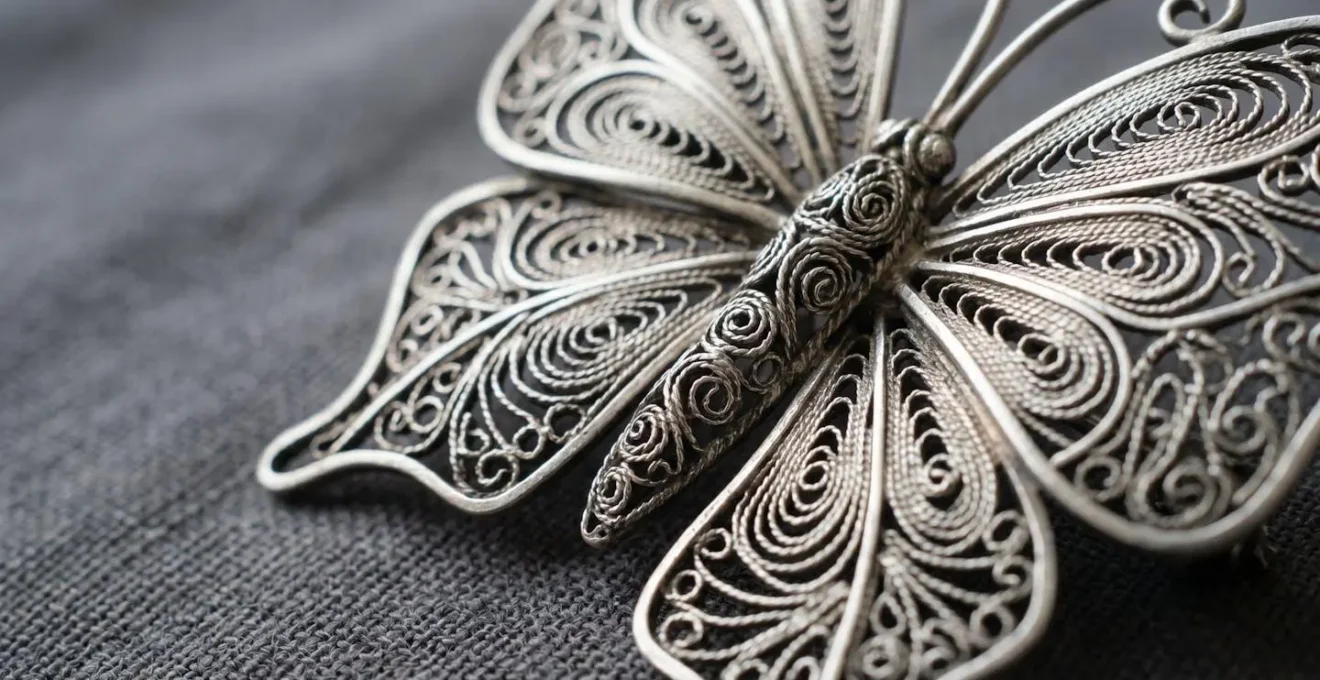
Macedonian filigree’s elite status comes from a trinity of value: centuries of inherited skill, uncompromising material purity, and distinct regional artistic identities.
- True filigree is crafted from sterling silver (92.5% pure), not plated base metal.
- Artistic styles vary significantly, from the dense Ottoman patterns of Skopje to the airy, European-influenced designs of Bitola and Ohrid.
Recommendation: Look for the ‘925’ hallmark and inquire about the story behind the piece; you are acquiring a piece of tangible history, not just an accessory.
To hold a piece of Macedonian filigree is to feel the weight of history in your palm. It dances in the light, a web of silver threads so delicate it seems impossible they were shaped by human hands. For many travelers and connoisseurs, it represents the pinnacle of Balkan craftsmanship, but the question remains: what elevates it from a beautiful souvenir to a treasured work of art? The common answer points to its ancient tradition and the intricate beauty of its design, and while true, this only scratches the surface.
Most discussions of filigree focus on the visual—the gossamer butterflies, the intricate floral motifs. But to truly understand its value, we must look beyond the finished form. We must see it not as a static object, but as the culmination of a process, a physical manifestation of time, material, and place. The real magic of Macedonian filigree is not just in what you see, but in the invisible elements woven into its very structure.
This guide will not simply show you what to buy. Instead, it will teach you how to *see*. We will deconstruct the mystique of this art form, moving past the aesthetics to reveal the three pillars of its superiority: the generational time captured in every twist of wire, the uncompromising purity of the materials used, and the distinct artistic dialects that evolved in cities like Skopje, Bitola, and Ohrid. By understanding these elements, you will no longer see just a piece of jewelry, but a crafted narrative of a nation’s soul.
To navigate this journey into the heart of Macedonian craftsmanship, the following sections will explore each facet of what makes this art form truly exceptional. From the hours of dedication to the very soul of the silver, prepare to appreciate filigree on a new level.
Summary: Deconstructing the Artistry of Macedonian Filigree
- How Many Hours Does It Take to Make a Butterfly Filigree Brooch?
- Sterling Silver vs Plated: What Materials Are Used in Skopje Filigree?
- How to Commission a Custom Filigree Piece During Your Stay?
- Packing Tips: How to Bring Fragile Filigree Home Without Breaking It?
- Is Filigree Style Different in Bitola Compared to Skopje?
- How Many Hours Does It Take to Make a Butterfly Filigree Brooch?
- Wood carving: How to Distinguish Walnut Wood form Cheaper Alternatives?
- Why Should You Buy Traditional Crafts Instead of Mass-Produced Souvenirs?
How Many Hours Does It Take to Make a Butterfly Filigree Brooch?
Asking how many hours it takes to create a single filigree butterfly is like asking how long it takes to write a poem. The answer, measured in simple hours—perhaps eight, ten, or even twenty for a masterwork—is profoundly misleading. It ignores the centuries of knowledge, the generational muscle memory, and the immense historical weight that informs every single movement of the artisan’s hands. The true answer is not measured in hours, but in millennia. This technique is not a modern invention; filigree is thought to have originated as far back as 3,000 BC in ancient Mesopotamia and Egypt, its traditions slowly migrating and evolving across cultures.
What you are witnessing in a Macedonian workshop is the living end of an unbroken chain. The value is not just in the artisan’s time, but in the accumulated time of their teachers, and their teachers’ teachers. Each delicate twist of the silver wire, known as *srma*, is an echo of a technique perfected over countless generations. The creation of a single brooch is a performance of history.
This image captures the essence of the craft: the intense focus, the weathered hands that hold a library of tactile knowledge, and the impossibly fine wire being coaxed into a form of beauty. It’s a slow, meditative process that stands in stark defiance of modern mass production. When you purchase a piece of filigree, you are not just paying for the hours spent at the bench; you are becoming a patron of a living tradition, acquiring a small piece of this vast, interwoven history.
Sterling Silver vs Plated: What Materials Are Used in Skopje Filigree?
The soul of authentic filigree resides in its material. The delicate, airy structures can only be achieved with a metal that is both pliable and strong, and traditionally, that metal is silver. However, not all silver is created equal. The distinction between genuine sterling silver and cheap, silver-plated base metals is the difference between a treasured heirloom and a fleeting trinket. In the workshops of Skopje, a commitment to material integrity is paramount. True Macedonian filigree is crafted not from plated brass or copper, but from sterling silver.
By definition, sterling silver is an alloy made up of 92.5% pure silver, with the remaining 7.5% typically being copper. This small addition of copper provides the necessary hardness and durability that pure, 100% silver lacks, allowing for the creation of intricate yet resilient designs. A piece made of plated metal will often feel too light for its size, may trigger skin allergies, and will inevitably have its thin silver coating flake away, revealing the dull base metal beneath. Sterling silver, by contrast, has a satisfying density, is hypoallergenic for most people, and develops a beautiful patina over time that can be polished away if desired, without ever losing its fundamental character.
Discerning real from fake is a crucial skill for any buyer. While trust in the artisan is key, arming yourself with knowledge empowers you to invest with confidence. The following checks can help you verify the authenticity of a piece before you purchase.
Your checklist for identifying genuine sterling silver
- Look for the hallmark: Use a magnifying glass to find the ‘925’ stamp, typically hidden on clasps, the back of earrings, or inside rings.
- Perform the weight test: Solid sterling silver is dense and should feel substantial for its size; if it feels suspiciously light, it may be plated.
- Use a magnet: Genuine sterling silver is not magnetic. If a magnet is attracted to the jewelry, it is not real silver.
- Inspect for flaking or seams: Plated jewelry may show seams or, over time, the plating can chip, revealing a different colored base metal underneath.
- Consult a professional: For a definitive answer, a jeweler can perform a non-destructive test to confirm the exact metal composition.
How to Commission a Custom Filigree Piece During Your Stay?
Beyond purchasing a ready-made piece, the ultimate way to connect with the filigree tradition is to commission a custom work. This transforms the experience from a simple transaction into a creative collaboration with an artisan. Many family workshops in the bazaars of Skopje, Bitola, and Ohrid welcome such projects, seeing it as a vital way to keep the craft dynamic and personal. The process usually begins with a conversation—sharing your ideas, sketches, or inspirations—and then trusting the master’s hands to translate your vision into a silver reality.
This deep, personal connection to the craft is exemplified by the legacy of masters like Vangel Dereban of Ohrid, whose family continues his life’s work. To commission a piece from such a workshop is to participate in a story that spans generations.
Case Study: The Vangel Dereban Legacy in Ohrid
Vangel Dereban, known as the man with the ‘golden hands’, was the sixth generation of filigree masters in his family. His skill was so revered that after his death, his former workshop in the Ohrid Bazaar was transformed into the Museum of Filigree in his honor. This is not a static display; one room remains an active workshop where his grandchildren continue the craft. They carry on his will that the art not be forgotten, welcoming visitors to witness the process and commission pieces. This living museum demonstrates how generational knowledge is the true backbone of the craft, allowing a visitor’s idea to be filtered through centuries of family expertise, resulting in a piece that is both personal and deeply rooted in tradition.
When you embark on a commission, you are not just dictating a design; you are engaging with this profound heritage. The artisans’ primary goal is to create a piece of lasting quality. As noted by experts in the field, this commitment starts with the raw material itself. In an article on Macedonian traditions, one publication highlights the artisans’ credo:
For making filigree is needed the purest silver from 1000 carats which is obtained by refining (hardening) of silver with lower quality.
– Macedonian Cuisine, Filigree – A Trademark of Macedonia
This quote, while using the colloquial “1000 carats” to mean absolute purity, underscores the principle: starting with the best possible material is non-negotiable. It is the foundation upon which all the intricate artistry is built.
Packing Tips: How to Bring Fragile Filigree Home Without Breaking It?
The very quality that makes filigree so enchanting—its delicate, lace-like structure—also makes it incredibly fragile. The thought of a cherished new piece being crushed in your luggage is a traveler’s nightmare. Proper packing is not an afterthought but a crucial final step in safeguarding your investment and the artisan’s work. The key is to create a protective shell that isolates the piece from both impact and pressure. A soft pouch is insufficient; you need a system of layered protection.
Your goal is to prevent the fine silver wires from bending, snagging, or being compressed. A bent filigree piece is nearly impossible to repair perfectly without specialized tools. Heat and humidity can also accelerate tarnishing, especially on long journeys. Taking a few moments to pack your jewelry correctly will ensure it arrives home in the same pristine condition as when it left the workshop. Most artisans will provide a small, hard box, which is the perfect starting point for your packing strategy.
Follow these professional steps to ensure your filigree treasure travels safely:
- Use the Original Box: Always place the filigree piece in its original small, hard gift box. This is its first line of defense against being crushed.
- Create a ‘Nest’: Place the small gift box inside a larger, rigid container—a hard-sided sunglasses case, a small plastic food container, or a travel case—positioning it in the center.
- Cushion the Gaps: Pad the empty space around the inner box with soft items like socks or a scarf. This creates a shock-absorbing buffer, preventing it from rattling around.
- Separate for Storage: Keep cleaned pieces in soft, anti-tarnish pouches. Never use rubber bands for bundling, as they release sulfur compounds that dramatically speed up tarnishing.
- Document Your Purchase: For valuable custom pieces, keep the receipt and any artisan certificates in a separate part of your luggage. This is essential for insurance purposes and can simplify customs declarations.
Is Filigree Style Different in Bitola Compared to Skopje?
Yes, absolutely. To the untrained eye, all Macedonian filigree might appear similar, but to a connoisseur, the regional differences are as distinct as local dialects. The “look” of filigree is not monolithic; it is a language with regional accents, shaped by centuries of different historical and cultural influences. The two major centers, Skopje and Bitola, showcase a fascinating stylistic divergence, reflecting their unique histories. A third center, Ohrid, adds another layer of complexity and beauty to the nation’s filigree tapestry.
Skopje’s filigree, born from the bustling heart of the Old Bazaar, often carries a denser, more robust character. The patterns can be more compact, with tighter spirals and geometric forms that echo the city’s strong Ottoman heritage. The pieces feel substantial, rooted in the aesthetics of a major trading crossroads. In contrast, Bitola’s filigree tends to be lighter and more airy. As a historical hub for European diplomats, famously known since the Ottoman period as “the city of the consuls,” Bitola was more exposed to Western European tastes. This influence can be seen in its filigree, which often features more elongated, floral, and neoclassical motifs with more open space in the design.
This side-by-side comparison reveals the story. On one side, the dense, powerful geometry of Skopje; on the other, the delicate, flowing lines of Bitola. But the story doesn’t end there. Ohrid has cultivated its own unique voice in the world of filigree, blending local inspiration with the ancient technique.
Case Study: The Distinct Style of the Ohrid School
Beyond Skopje and Bitola, Ohrid stands as a third pillar of Macedonian filigree, recognized as a national treasure. Here, the craft has evolved to incorporate motifs directly inspired by its unique surroundings. Artisans like Marta Pejoska, an architect who dedicated herself to the craft, operate workshops in the old town, creating pieces with a specific local flavor. The Ohrid style often integrates elements from the nearby lake’s flora and fauna and draws heavily from the region’s rich Byzantine religious iconography. This has led to a distinct regional school of filigree, where the ancient oriental technique is used to tell uniquely Macedonian stories in silver.
How Many Hours Does It Take to Make a Butterfly Filigree Brooch?
We’ve established that the time to create a filigree piece is imbued with centuries of tradition. But let’s return to the literal hours at the workbench and consider their value. In an age of instant gratification and automated production, the deliberate slowness of filigree is a radical statement. The twenty hours an artisan might pour into a complex brooch are not just a measure of labor; they are a measure of devotion. It is time spent in absolute concentration, transforming raw material into an object of pure intention.
This time represents a direct investment of a human life into an object. Unlike a machine-stamped trinket that takes seconds to produce, a handmade filigree piece carries the energy, focus, and skill of its creator. When you purchase such an item, the price reflects not just the cost of silver, but the value of this irretrievable time. It’s a validation of the artisan’s choice to pursue a difficult, time-consuming craft rather than a more lucrative, less demanding trade. The hours are not a cost; they are the core of the piece’s intrinsic worth.
Therefore, the question shifts from “How many hours does it take?” to “What is the value of an hour of a master’s life?” Each hour is a rejection of the mediocre and a commitment to excellence. It is time spent ensuring every join is perfect, every curve is graceful, and every detail contributes to the whole. This dedication is what separates craft from mere production and what elevates Macedonian filigree to the realm of art. The hours are the story, and the finished brooch is its beautifully told conclusion.
Wood carving: How to Distinguish Walnut Wood form Cheaper Alternatives?
While exploring the world of filigree, you will inevitably encounter Macedonia’s other great craft tradition: deep wood carving. In the workshops of Ohrid, it’s not uncommon to see a filigree master’s studio right next to a wood carver’s, both artisans engaged in a similar pursuit of revealing beauty from raw materials. Just as with silver, the material choice in wood carving is critical. The most prized material is walnut wood, cherished for its rich, dark color, beautiful grain, and ability to hold fine detail. Cheaper alternatives, like beech or linden, are softer, lighter in color, and cannot achieve the same level of crisp, intricate detail.
To distinguish walnut, look for a deep, chocolate-brown color, often with complex swirls and figuring in the grain. It should feel dense and heavy for its size. Cheaper woods are often stained to mimic walnut, but the color can appear flat or superficial, and the underlying grain will be simpler and less pronounced. A true walnut carving has a depth and luster that stain cannot replicate. However, focusing solely on material identification can sometimes miss the larger point.
The shared philosophy between these crafts is more important than the specific material. Both filigree and wood carving are traditions passed down through generations, telling stories of history, nature, and faith.
Case Study: Parallel Philosophies in Silver and Wood
In Ohrid, the traditions of wood carving, dating back to before the twelfth century, and filigree are seen as two sides of the same artistic coin. Both are considered family trades, passed through generations. Both use a plethora of themes, from historical events to religious iconography. The deep carving technique in wood and the intricate wire-twisting in filigree are simply different methods for achieving the same goal: revealing beauty and telling a story. Masters of both crafts demonstrate that the ultimate value lies not just in distinguishing walnut from beech, or silver from steel, but in appreciating the generations of skill and cultural narrative embodied in the final object.
Key takeaways
- True Value is Legacy: The worth of Macedonian filigree is not just its beauty, but the centuries of skill, knowledge, and history woven into every piece.
- Material Matters: Authentic filigree is always crafted from sterling silver (‘925’), a standard of purity that ensures durability and lasting value.
- Style is a Language: The designs are not random; they are regional dialects reflecting the unique history of cities like Skopje (Ottoman-influenced) and Bitola (European-influenced).
Why Should You Buy Traditional Crafts Instead of Mass-Produced Souvenirs?
In a world saturated with mass-produced goods, choosing to purchase a piece of traditional craft like Macedonian filigree is a conscious act with far-reaching implications. It is a choice that transcends simple consumerism. A generic, factory-made souvenir is a hollow object; it has no story, no soul, and its purchase supports an anonymous, often exploitative, global supply chain. A handcrafted item, by contrast, is a vessel of culture, skill, and personal dedication. It is an investment in authenticity.
When you buy directly from an artisan, you are doing more than acquiring a beautiful object. You are participating in a virtuous economic and cultural cycle. You are ensuring that a master craftsman can afford to keep their workshop open, buy materials, and, most importantly, pass on their invaluable skills to the next generation. This act of patronage helps keep a living tradition from becoming a fossilized relic in a museum. It validates the artisan’s life’s work and provides the resources needed for that work to continue.
This direct support for artisans has a tangible effect on the local community, fostering economic resilience and cultural pride. As one analysis on the importance of traditional crafts states, the impact is direct and powerful:
By purchasing handmade products over mass-produced alternatives, consumers directly support these artists and their families. This, in turn, keeps money circulating within local communities, fostering economic stability in areas that may otherwise struggle.
– Thomas J Powell Grant, Reviving Lost Arts: Why Traditional Crafts Still Matter
Ultimately, the choice is between an object with a price tag and an object with a story. By choosing the latter, you not only bring home a more meaningful and beautiful memento, but you also become a guardian of the culture that created it. You cast a vote for quality over quantity, for skill over speed, and for human connection over anonymous commerce.
Your journey into the world of Macedonian filigree begins with this understanding. By seeking out authentic artisans, asking about their process, and choosing a piece that speaks to you, you are doing more than buying a souvenir; you are becoming part of a story that has been unfolding for centuries.