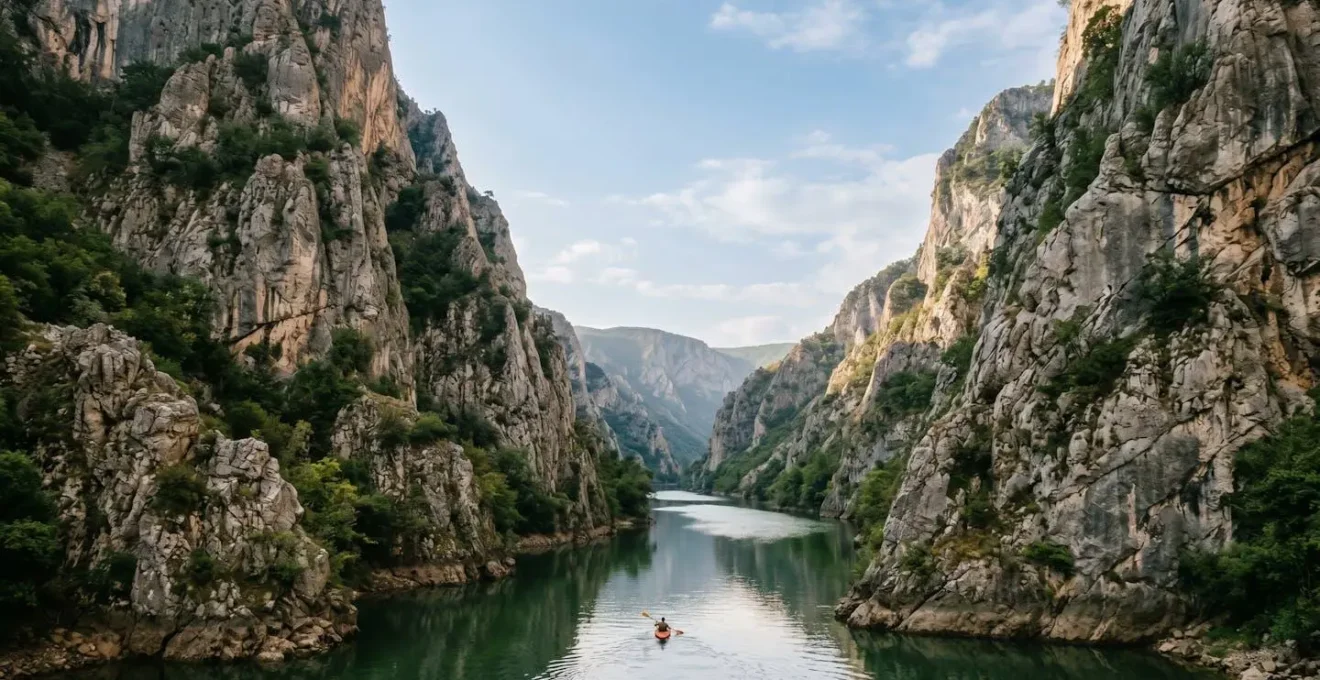
Many visitors arrive at Matka Canyon with a checklist, rushing from one point to the next. But the true escape isn’t found in completing tasks; it’s discovered by attuning yourself to the canyon’s ancient rhythm. This guide is an invitation from the water itself, showing you how to move with its current—from the silent glide of a kayak to the quiet reverence of an early morning visit—transforming a simple trip into a moment of profound connection with nature.
The hum of Skopje fades behind you, a distant memory after a mere thirty-minute journey. Ahead, the world narrows and deepens. The air cools, carrying the scent of damp stone and wild thyme. This is Matka Canyon, an escape that feels a world away. Most come with a plan: see the cave, take a photo, eat at the restaurant. It is a valid way to visit, but it is like listening to a song with only half the notes.
The real magic of this place is not in what you see, but in what you allow yourself to feel. It’s in the profound silence between the echoes, the deep green of the water holding centuries of secrets, and the patient gaze of the cliffs that have watched civilizations rise and fall. It is a story told not in words, but in stone, water, and light. The traveler who seeks only to check boxes will leave with pictures; the one who comes to listen will leave with a piece of the canyon’s soul.
But how does one listen? It begins by understanding the canyon’s own language. It’s about choosing the right rhythm for your journey, respecting its quiet hours, and knowing the paths that reveal its truest character. This isn’t just a guide on how to get here; it’s a map to the heart of the canyon, showing you how to find its pulse and make it your own, even if only for an afternoon.
The journey into Matka’s depths is a story told in chapters. This guide follows that narrative, from the geological whispers of its cliffs to the practical choices that define your experience, ensuring your escape is as deep and resonant as the canyon itself.
Summary: A Boatman’s Guide to Matka Canyon’s Soul
- Why Are Matka Canyon Cliffs So Vertically Dramatic?
- Kayak or Motorboat: Which Offers a More Immersive Matka Experience?
- Is Vrelo Cave Really One of the Deepest Underwater Caves in the World?
- The Sunday Mistake: Why Matka Canyon Becomes Overcrowded After 11am?
- How to Hike to the Monastery and Return by Boat Through the Canyon?
- The Sunday Mistake: Why Matka Canyon Becomes Overcrowded After 11am?
- Kayak or Motorboat: Which Offers a More Immersive Matka Experience?
- Which National Park in North Macedonia Fits Your Hiking Style?
Why Are Matka Canyon Cliffs So Vertically Dramatic?
Before your boat even leaves the dock, the canyon speaks its first word: stone. The cliffs do not simply rise; they command. Their verticality is a testament to an immense and patient power, a geological drama played out over millions of years. These are not just rocks; they are the exposed bones of the earth. This is a prime example of karst topography, where the relentless Treska River has spent eons carving its path through soft limestone and dolostone, a patient artist sculpting a masterpiece.
The story begins in the Paleozoic era, some 600 million years ago, when this land was the floor of a shallow sea. The lowest layers of stone still hold the faint outlines of ancient marine life, a silent memory of a world long vanished. As the river etched its way downward, it exposed this history layer by layer, creating the sheer, imposing walls that tower above the water today. They are a library of time, written in sediment and shadow.
But these cliffs are not barren. Life clings to them with fierce tenacity. They create a unique microclimate, a sanctuary for flora that can be found nowhere else on the planet. It is said that 20% of Matka Canyon’s plant species are endemic, whispering a story of resilience and isolation. To gaze upon them is to understand that drama and life are intertwined here, a vertical garden clinging to the edge of time.
Kayak or Motorboat: Which Offers a More Immersive Matka Experience?
Once you’ve felt the presence of the stone, your next choice is how to converse with the water. The canyon offers two distinct languages: the steady hum of the motorboat or the quiet dip of a kayak paddle. Neither is better than the other; they simply offer different conversations. The motorboat is a guided narrative, a story told to you. The kayak is a personal meditation, a story you discover for yourself.
The motorboat carves a swift, decisive line through the water. It’s efficient, carrying you to the mouth of Vrelo Cave with purpose. The driver’s voice becomes part of the landscape, sharing tales and facts that give context to the towering cliffs. It’s a social experience, a shared journey. For those with limited time or a desire for guidance, it is the perfect rhythm.
To choose the kayak, however, is to choose silence. It’s to trade the engine’s hum for the sound of your own breath and the gentle lapping of water against the hull. You set the pace, free to drift, to trace the shoreline, and to discover hidden coves that the larger boats pass by. It demands more from you—more effort, more time—but it offers an intimacy that cannot be found otherwise. You are no longer a passenger; you are a participant in the canyon’s quiet flow.
The table below helps translate these feelings into practical considerations, allowing you to choose the experience that calls to your own spirit.
| Decision Factor | Kayak | Motorboat |
|---|---|---|
| Time Commitment | 1+ hours (flexible, self-paced) | 30-60 minutes (fixed schedule) |
| Physical Effort | High (paddling required) | Minimal (sit and enjoy) |
| Budget | Lower cost per hour | €4-7 per person for tour |
| Photo Opportunities | Excellent (stop anywhere) | Limited (moving boat) |
| Access to Vrelo Cave | External view only | Included with guided entry |
| Freedom & Exploration | Maximum (hidden coves) | Fixed route only |
| Local Context & Stories | None (solo experience) | Driver provides narrative |
Is Vrelo Cave Really One of the Deepest Underwater Caves in the World?
The motorboat journey has a clear destination: Vrelo Cave. Its entrance is a dark mouth in the cliffside, swallowing the light and promising mystery. Above the water, the cave is a chamber of wonders, with stalactites that drip with the memory of time—the “Concert Hall,” the “Pine Cone,” the writing on the walls. But the true secret of Vrelo is not what is seen, but what remains hidden beneath the placid surface of its underground lake.
The question of its depth hangs in the cool, damp air. For years, it was a local legend, a bottomless pit leading to the earth’s core. Modern exploration has only deepened the enigma. Divers descend into the silent, black water, their lights cutting through a world without sun, and still, they do not find its end. It is a place that defies easy answers, reminding us that even in a world so thoroughly mapped, there are still frontiers.
The cave keeps its secrets well, but occasionally it offers a clue. Recent diving expeditions have pushed the known boundaries, with some explorations reportedly reaching a depth of 287 meters, marking it as the deepest underwater cave in the Balkans and a contender on the world stage. Yet, the final depth remains unconfirmed. This uncertainty is the cave’s greatest gift. It is not a place to be conquered and measured, but a space for wonder. It asks you to contemplate the immense, silent, and undiscovered worlds that lie just beneath the surface of what we know.
The Sunday Mistake: Why Matka Canyon Becomes Overcrowded After 11am?
The canyon has two faces: the one it shows in the quiet solitude of the morning, and the one it presents to the midday crowds. To experience the first is a gift; to arrive in the midst of the second is to risk missing the canyon’s true voice. The “Sunday Mistake” is not about the day of the week, but the time of day. After 11 a.m. on any sunny weekend, the canyon’s rhythm shifts from a slow, contemplative melody to a bustling chorus.
The reason is simple: Matka is Skopje’s beloved backyard. When the city dwellers seek respite, they come here. The single-lane road fills, parking becomes a challenge, and a queue forms at the boat dock. The tranquility is replaced by a vibrant, but different, energy. As one local guide lamented, “Weekends at Matka Canyon can be mayhem.” The sacred silence is broken, and the intimate conversation with the canyon becomes a public gathering.
To avoid this, you must move with the morning light. Arriving early means you share the canyon with the birds and the mist rising from the water. You find a boat waiting, the cave is a place of quiet reverence, and the path is your own. The experience is transformed. The choice is not merely about avoiding crowds; it is about choosing which version of Matka Canyon you wish to meet.
Your Action Plan: The Perfect Morning Timeline
- Arrive before 8:00 AM by taking one of the first buses or a taxi from Skopje to be among the first visitors at the canyon entrance.
- Start your boat tour or kayak rental immediately, before the queues begin to form and the water becomes busy.
- Visit Vrelo Cave around 9:00 AM to experience its peaceful atmosphere with minimal wait time.
- Enjoy a coffee or breakfast at the canyon restaurant around 10:00 AM, when seating is readily available and the view is unobstructed.
- Begin your departure around 10:30 AM to avoid the 11:00 AM rush, when crowds surge, buses fill, and queues can stretch for an hour.
How to Hike to the Monastery and Return by Boat Through the Canyon?
While the water offers one perspective, the cliffs offer another. The hike to the Monastery of St. Nikola Shishovski is an ascent not just in elevation, but in understanding. From the water, you are looking up in awe. From the monastery’s perch, you are looking down with perspective, seeing the canyon’s serpentine form laid out like a map. This journey—up on foot, down by water—is perhaps the most complete way to experience Matka.
The path is a rustic one, steep and rocky in places, demanding respect and proper footwear. It winds through the woods, the scent of earth and leaves replacing the cool air of the river. The 30-45 minute climb is a small pilgrimage, a physical effort that quiets the mind and focuses the senses. With every step, the view changes, offering glimpses of the emerald river through the trees.
The reward is a panorama that 90% of visitors never see. At the top, the world opens up. You see the motorboats as tiny specks, the kayakers as silent water-striders. The entire gorge reveals its scale and grandeur. From this vantage point, you arrange for your return. There is no taxi stand here; you call a boatman, whose number you wisely secured before you began your ascent. The boat arrives at the small monastery dock, and your journey down is a triumphant glide through the heart of the landscape you just surveyed.
Checklist for Your Hike-and-Boat Journey
- Locate the trail: The start is often missed. Look for the path marked for St. Nikola Monastery near the main entrance complex.
- Wear proper footwear: The trail has steep, rocky sections where sandals are dangerous. Sturdy hiking shoes are essential.
- Budget your time: Plan for a 30-45 minute ascent. It’s a steady climb through the woods, often longer than signs suggest.
- Arrange your return: This is critical. Before hiking, get a boat driver’s phone number or pre-arrange a specific pick-up time at the monastery.
- Call for pick-up: From the monastery viewpoint, call your boatman. There is no formal dock or service; the pickup is a personal arrangement.
The Sunday Mistake: Why Matka Canyon Becomes Overcrowded After 11am?
But what if you cannot arrive with the morning sun? What if your journey brings you to the canyon in the heart of the midday bustle? Is the experience lost? Not at all. It is simply different. The “Sunday Mistake” is a warning, not a damnation. If you find yourself in the thick of the crowd, the key is not to fight the current, but to find a quieter eddy.
The main dock and the restaurant will be a hub of vibrant energy. Instead of focusing on the main attractions, turn your attention to the details. Find a spot along the path that winds past the main buildings. Sit on a stone bench and watch the light play on the water’s surface. The canyon’s beauty is not confined to Vrelo Cave; it is in every ripple, every fern growing from a rock crevice, every dragonfly that hovers over the green depths.
The crowd is a river. You can let it carry you, or you can step to its bank. Let the queues for the boats grow long. Use that time to explore the area around the Monastery of St. Andrew, a 14th-century gem that sits right at the water’s edge. Its ancient frescoes tell stories that are just as deep as the canyon itself. By shifting your focus from the grand to the intimate, you can still have your moment of peace, a quiet conversation with the canyon while the world bustles by just a few feet away.
Kayak or Motorboat: Which Offers a More Immersive Matka Experience?
We have spoken of the practical choice between kayak and motorboat, but the true difference lies in the senses. To be truly immersed is to listen with more than your ears and see with more than your eyes. It is a choice between two kinds of sensory poetry. One is a ballad, recited and shared; the other is a haiku, personal and deeply felt.
On the motorboat, your senses are guided. You hear the boatman’s voice weaving stories over the engine’s thrum. You feel the spray on your face as the boat turns, a collective experience of speed and sound. Your eyes follow where the guide points, to a specific cliff formation, a hidden church, the mouth of the cave. It is an experience curated for you, a narrative that gives structure to the landscape. It is the story of the canyon, told aloud.
On the kayak, your senses are unleashed. The world’s volume turns down. The dominant sound is the rhythmic *plop-and-drip* of your paddle. You hear the whisper of wind funneling between the cliffs. You feel the subtle shift in current as you round a bend. You can reach out and touch the cold, mossy stone of the canyon wall. Your eyes are free to wander, noticing the iridescent blue of a damselfly or the way sunlight filters through the leaves of an overhanging tree. This is the story of the canyon, whispered directly to you.
Key Takeaways
- The canyon’s dramatic cliffs are not just rock; they are a 600-million-year-old story of time, water, and life.
- Your experience is defined by rhythm: choose the motorboat for a guided narrative or the kayak for silent, personal immersion.
- Timing is everything. Arrive before 10 a.m. to meet the canyon in its quiet, contemplative state and avoid the midday crowds.
Which National Park in North Macedonia Fits Your Hiking Style?
Your half-day in Matka may awaken a deeper hunger for the wild landscapes of North Macedonia. The canyon is a perfect introduction, a concentrated dose of natural wonder, but it is just the first verse of a much larger epic. The country is a haven for hikers, with its three main national parks—plus the newly designated Šar Mountains—each offering a unique personality and a different kind of challenge. Matka is the quick escape; these are the deep immersions.
If the verticality of Matka’s cliffs inspires you to seek greater heights, Mavrovo National Park calls to the “Peak Bagger.” Home to Mount Korab, the highest peak in the country at 2,764 meters, it offers alpine adventures and sweeping vistas that demand a full day or more. For those enchanted by water, Pelister National Park is for the “Lakeside Wanderer,” with its famous “Pelister Eyes”—two glacial lakes nestled high in the mountains.
If your spirit soars with panoramic views, Galičica National Park is unmatched. Its signature ridge trail offers the breathtaking and unique experience of seeing two vast lakes, Ohrid and Prespa, on either side of you. And for the “Cultural Hiker” who enjoyed the monasteries of Matka, the Šar Mountains blend rugged peaks with ancient villages and a rich historical tapestry. As official documentation confirms, North Macedonia has three national parks, each a world unto itself, with Mavrovo holding the crown jewel of Mount Korab.
Matka is the perfect test. It lets you sample the terrain, the views, and the feeling of being in the Macedonian wild. Use the following table to see where that taste might lead you next.
| Park Name | Best For (Hiker Profile) | Signature Trail | Distance from Skopje | Time Commitment |
|---|---|---|---|---|
| Mavrovo National Park | Peak Baggers & Alpine Adventurers | Mount Korab (2,764m) – highest peak | ~100 km west | Full-day to multi-day |
| Pelister National Park | Lakeside Wanderers & Forest Lovers | Pelister Eyes (glacial lakes) | ~150 km south | Full-day trip |
| Galičica National Park | Panoramic View Seekers | Ridge trail overlooking Lake Ohrid & Prespa | ~170 km southwest | Full-day trip |
| Šar Mountain National Park | History Buffs & Cultural Hikers | Mount Ljuboten peak with cultural villages | ~70 km west | Full-day to weekend |
| Matka Canyon | Half-Day Hikers & Canyon Explorers | River trail to St. Nikola Monastery | 15 km (30 min drive) | Half-day escape |
When you return to Skopje, the city’s sounds will seem different. Your brief escape will have recalibrated your senses. The memory of the cool air, the green water, and the silent stone will linger—a quiet anchor in the bustling world. A half-day is not a long time, but in a place like Matka, it is long enough to find a peace that lasts.