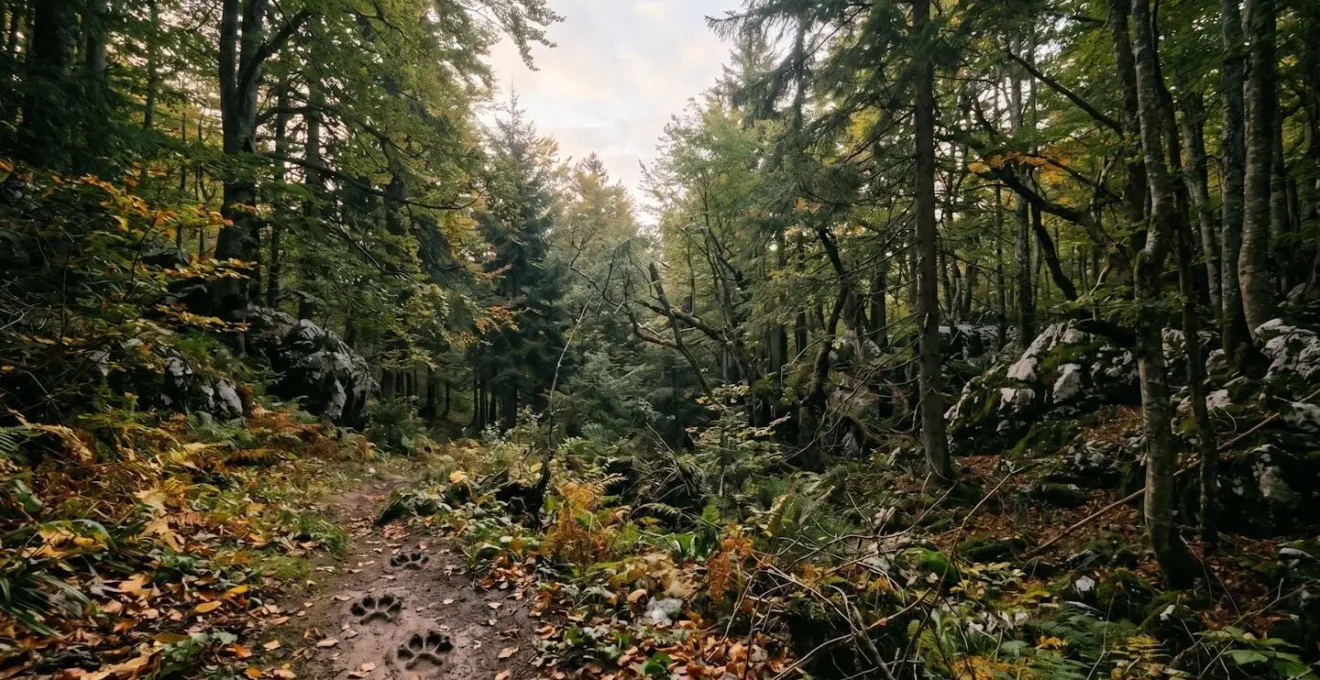
True support for the Balkan lynx is not about seeking a rare sighting, but about consciously minimizing the invisible pressures your presence creates.
- The population is critically endangered, and human disturbance—even unintentional—is a significant threat.
- Simple actions like avoiding geotagging photos and respecting fire bans directly protect the lynx’s fragile habitat.
Recommendation: Shift your mindset from tourist to guardian. The most meaningful contribution you can make is to ensure the “ghost of the forest” can remain unseen and undisturbed.
The Balkan lynx, a specter in the ancient forests of Southeastern Europe, captures the imagination of every wildlife enthusiast. Its near-mythical status fuels a desire to journey into its territory, with many travelers hoping for a once-in-a-lifetime glimpse of this elusive cat. The common advice for ecotourists often revolves around visiting national parks like Mavrovo in North Macedonia, hiring a local guide, and staying on marked trails. While well-intentioned, this advice barely scratches the surface of what it means to be a responsible visitor in a critically endangered species’ habitat.
But what if the entire premise of “lynx tourism” is flawed? What if the goal shouldn’t be to see the lynx at all? This guide challenges the conventional approach. It proposes that true, meaningful support for the Balkan lynx comes not from the fleeting thrill of a potential sighting, but from a profound understanding of the invisible pressures that threaten its survival. It’s about adopting the mindset of a conservationist, where every decision, from the photo you post to the trail you walk, is a deliberate act of protection.
This article will guide you through the science and ethics of traveling in lynx territory. We will explore why its ghostly reputation is a key to its protection, what specific hiking mistakes create stress for the population, and how your actions can either contribute to its decline or become a vital part of its conservation story. Prepare to shift your perspective from passive observer to active, informed guardian.
Summary: A Conservationist’s Handbook for Balkan Lynx Protection
- Why Is the Balkan Lynx Called the “Ghost of the Forest”?
- Can Tourists Join Lynx Monitoring Expeditions in Mavrovo?
- Lynx Spotting: What Are Your Real Chances of Seeing One?
- The Hiking Mistake That Could Stress the Lynx Population
- Winter Tracking: Why Is Snow Essential for Lynx Research?
- Why Is the Balkan Lynx Called the “Ghost of the Forest”?
- The Campfire Mistake That Is Strictly Prohibited in Dry Season
- Why Is Mavrovo’s Forest Density Perfect for Wildlife Observation?
Why Is the Balkan Lynx Called the “Ghost of the Forest”?
The moniker “Ghost of the Forest” is not just a romantic notion; it is a stark reflection of the Balkan lynx’s desperate reality. The primary reason for its phantom-like existence is its critically low population. Conservation efforts and systematic monitoring have painted a grim picture: the entire subspecies teeters on the brink of extinction. Recent data confirms a population of fewer than 50 mature individuals scattered across the remote mountains of North Macedonia, Albania, and Kosovo. This extreme rarity means the animal is a ghost in the statistical sense—its presence is an anomaly, its absence the norm.
This scarcity is compounded by its naturally elusive behavior, honed over millennia of survival. The lynx is a solitary, crepuscular hunter, most active at the low-light hours of dawn and dusk, times when the forest is quiet and human presence is minimal. Its survival depends on avoiding detection, not only by its prey but also by potential threats, including humans. This innate cautiousness makes any encounter extraordinarily rare. As the Smithsonian Magazine team reported on the challenges of studying them, the lynx’s reaction to being documented is often that of a “startled house cat,” an instinct to flee from the unexpected. Its ghostly reputation is, therefore, a direct consequence of its fight for survival against overwhelming odds.
The term “ghost” serves as a constant, haunting reminder of what is at stake. We are not dealing with a common species that is simply shy; we are dealing with the last vestiges of a unique lineage. Every footprint in the snow, every pixel on a camera trap, is a precious data point proving that the ghost, for now, still roams its ancestral home. The challenge for travelers is to respect this ghostly nature, understanding that protecting the lynx means helping it remain an unseen, undisturbed presence in its domain.
Can Tourists Join Lynx Monitoring Expeditions in Mavrovo?
The desire to contribute directly to conservation is admirable, leading many passionate travelers to ask if they can join scientific monitoring expeditions. For the Balkan lynx, the answer is a firm but necessary no. The sensitivity of the research and the critically endangered status of the animals mean that direct participation by the public is not feasible. Scientific monitoring is a meticulous, highly controlled process designed to gather data with minimal disturbance to the animals.
The Balkan Lynx Recovery Programme (BLRP)
Since 2006, the BLRP has been the cornerstone of efforts to save the species. Through a partnership of local and international organizations, the program uses methods like camera trapping, GPS collaring, and snow-track surveys. These activities require specialized skills and are designed to avoid habituating the lynx to human presence. Access to these scientific activities is highly restricted to protect the integrity of the research and, more importantly, to shield the tiny population from any additional stress. The data gathered is far too valuable to risk contamination or disturbance from untrained participants.
This professional approach is crucial for understanding population dynamics and threats. Researchers handle sensitive equipment and analyze data that informs continent-wide conservation strategies. Introducing tourists into this environment would not only disrupt the animals but could also compromise the scientific validity of the work.
However, the closed door to scientific expeditions does not mean there are no avenues for support. The BLRP actively collaborates with and trains certified local guides. By hiring these specific guides, you are indirectly supporting the monitoring network. These guides are educated on the program’s findings, understand the principles of non-disturbance, and often contribute valuable field observations. Choosing a certified guide ensures your tourism money funnels back into the local community and supports individuals who are frontline stewards for lynx conservation. It is the most effective and responsible way for a traveler to align with the scientific efforts on the ground.
Lynx Spotting: What Are Your Real Chances of Seeing One?
Let’s address the central question for many aspiring visitors: what are the actual odds of seeing a Balkan lynx in the wild? To be unequivocally clear, the chances are infinitesimally small. You should travel with the firm expectation that you will not see a lynx. This isn’t pessimism; it’s a realistic and responsible mindset rooted in the animal’s biology and conservation status. The combination of an extremely small population and a vast, densely forested territory makes a natural sighting an event of pure, unadulterated luck, even for researchers who spend years in the field.
This reality is consistently echoed by those with the most experience in the region. Wildlife photographers and seasoned guides who know the terrain intimately can spend entire seasons in Mavrovo National Park without a single glimpse of the cat. They might see tracks or other signs, but a visual encounter is the exception that proves the rule. As one guidebook candidly notes, “Balkan lynx records are extremely rare, so don’t count on a sighting.”
Wildlife encounters are possible in Mavrovo National Park, with sightings of brown bears, wolves, chamois, and diverse bird species relatively common from respectful distances. However, as one guidebook notes: ‘Balkan lynx records are extremely rare, so don’t count on a sighting.’ The dense mixed forests that provide excellent habitat for the lynx make observation nearly impossible for casual visitors, reinforcing that the absence of sightings is actually a positive indicator of undisturbed wildlife.
– Wildlife photographer’s experience, TakeYourBackpack.com
Here, we must apply our conservationist mindset. The lack of sightings is not a failure; it is a resounding success. It means the lynx’s habitat is secure enough, and its instincts sharp enough, that it can successfully avoid humans. An easily spotted lynx is often a stressed, displaced, or habituated lynx—all of which are signs of a population in trouble. Therefore, the goal of your trip should be to appreciate the richness of the entire ecosystem—the bears, wolves, chamois, and ancient trees—that supports this apex predator. Celebrating the health of the forest *is* celebrating the lynx. Your reward is not a photo, but the knowledge that you walked through a wild, functional ecosystem where the ghost is allowed to remain a ghost.
The Hiking Mistake That Could Stress the Lynx Population
In the age of social media, the most significant mistake a hiker can make is not physical but digital: geotagging. While sharing a beautiful photo from a remote trail seems harmless, adding a precise location tag to an image taken in a sensitive wildlife habitat can have devastating consequences. This single action can transform a quiet, undisturbed area into a crowded hotspot, placing immense stress on the very wildlife you came to admire.
This phenomenon is not theoretical. Researchers and park managers worldwide have documented the negative impact of geotagging. In the Greater Yellowstone Ecosystem, for example, wildlife photographers have documented 30-40 people congregating at previously quiet wildlife spots within hours of a geotagged photo being posted. For a species as shy and sensitive as the Balkan lynx, such a sudden influx of human activity can cause it to abandon territory, disrupt hunting patterns, and increase stress levels, which can affect its health and reproductive success. You may not see the lynx, but it certainly sees, hears, and smells the increased human traffic.
The ethical dilemma is clear, as scientific research points out the double-edged sword of this technology. A study on social media’s role in conservation highlighted this exact conflict.
While geotagging photos of endangered species can help scientists in their studies, for example it can also encourage the general public to encroach upon these species’ habitats.
– Carleton University research team, FACETS journal
The solution is a conscious and deliberate choice to practice “digital discretion.” This means turning off automatic geotagging functions on your phone and camera before you even enter the park. When sharing your incredible photos, use generic, broad location tags like “Mavrovo National Park” or “#BalkanMountains.” Never tag a specific trail, valley, or landmark within the park’s more remote areas. This simple act of digital responsibility is one of the most powerful conservation tools a traveler possesses. It protects the wildness of the place and ensures the ghost of the forest has the solitude it needs to survive.
Your Responsible Hiker’s Checklist: Protecting the Unseen Lynx
- Digital Footprint: Review your social media settings. Disable automatic geotagging on all photos before your trip.
- Route Planning: Use official park maps and marked trails. Download offline maps instead of relying on live-tracking social apps.
- Encounter Protocol: If you see any wildlife, maintain an absolute minimum distance. Never approach. Note the location mentally but do not share it publicly.
- Sensory Discipline: Minimize noise. Use headphones at a low volume if you listen to music. Avoid loud conversations in dense forest areas.
- Post-Trip Audit: When sharing photos, use generic tags like “Mavrovo National Park,” never the specific trail name or a precise GPS location, especially for any potential wildlife sightings.
Winter Tracking: Why Is Snow Essential for Lynx Research?
While winter in the Balkans may seem harsh and inhospitable, for lynx researchers, it is the season of revelation. Snow is the single most important environmental factor for non-invasive monitoring of this elusive species. A fresh blanket of snow acts as a vast, white canvas, recording the movements, behaviors, and even the genetic makeup of animals that would otherwise be completely invisible. It is during these cold months that scientists can gather some of the most valuable data without ever laying a hand on a lynx.
The most obvious benefit of snow is the ability to conduct snow-track surveys. Trained researchers can follow a set of tracks to understand an individual’s hunting patterns, territorial range, and interactions with other species. But the information goes much deeper than just footprints. As they follow the tracks, scientists can collect biological samples left behind in the snow, such as urine, scat, and hair. These samples are a goldmine of information, providing the DNA needed to identify individual animals, determine their sex, assess their health, and map out the species’ genetic diversity—all crucial for developing effective conservation and potential reinforcement strategies.
This non-invasive genetic approach, combined with other methods, provides a comprehensive picture of the population’s status. As a decade-long study in Mavrovo demonstrated, this dual approach is critical for long-term assessment.
Alongside any future release or reinforcement measures, we advocate a robust monitoring strategy that includes both camera-trapping and non-invasive genetics. Such a ‘dual approach’ has proven successful in other lynx populations.
– D. Melovski et al., ScienceDirect research team
The insights from this research are vital. For example, the long-term monitoring in Mavrovo revealed a worrying decline in density from 2.3 lynx per 100 km² to 1.2 over a decade. This is the hard data that drives policy changes, secures funding, and focuses conservation efforts where they are needed most. For the traveler, this understanding is key: respecting trail closures during sensitive winter periods is not an inconvenience, but a direct contribution to allowing this essential scientific work to proceed undisturbed. Your respect for the winter landscape helps scientists read the stories that the snow has to tell.
Why Is the Balkan Lynx Called the “Ghost of the Forest”?
Beyond the stark reality of its low numbers, the Balkan lynx earns its “ghost” title through its physical and behavioral adaptations for stealth. This is not an animal that blunders through the woods; it is a master of silent, unseen movement, perfectly evolved for its dense forest habitat. Its very biology is engineered for invisibility. The lynx’s coat is a marvel of natural camouflage. As noted in observations, its tawny coat and black spots break up its outline, allowing it to melt into the dappled light and shadow of the forest floor. In the sun-drenched beech forests of Mavrovo or the snowy landscapes of winter, it becomes just another pattern, a trick of the light.
Its physical structure is equally designed for stealth. The most notable features are its large, furry paws. These act like natural snowshoes, distributing its weight and allowing it to move silently over snow, leaf litter, or soft earth without snapping a twig. This silent tread is essential for an ambush predator that must get within striking distance of wary prey like roe deer and chamois. Combined with its exceptionally keen hearing, aided by the distinctive black tufts on its ears that act like antennae, the lynx perceives its world with a sensory acuity far beyond our own. It often knows a human is present long before the human has any inkling of its presence, allowing it to quietly slip away.
This biological toolkit for stealth is why even a healthy, stable lynx population would remain largely unseen. It is a creature of the in-between spaces and the quietest hours. Understanding this aspect of its nature is crucial for the responsible traveler. It transforms the forest from a place where you “look for” wildlife into a place you move through with quiet respect. By keeping your voice low, avoiding sudden movements, and simply being an unobtrusive presence, you are honoring the evolutionary contract that allows this magnificent predator to thrive. You are allowing the ghost to go about its business, which is the greatest support you can offer.
The Campfire Mistake That Is Strictly Prohibited in Dry Season
A campfire can seem like a quintessential part of a wilderness experience, but in the context of Balkan lynx conservation, it represents an unacceptable risk. The single, seemingly small mistake of lighting a fire in the wrong place or at the wrong time can lead to catastrophic wildfires, and habitat destruction is one of the most severe threats facing the lynx. The dry seasons in the Balkans are becoming hotter and longer, making the forests tinder-dry and highly susceptible to ignition from a single stray ember.
The consequences of habitat loss are not abstract. The forests of the Balkans are the only home the lynx has. Any degradation, whether from illegal logging or from fire, directly shrinks their world, reduces their prey base, and can isolate populations, leading to genetic decline. The habitat is already under immense pressure. For context, between 2000 and 2012, countries within the lynx’s range experienced significant deforestation, with Albania and North Macedonia experiencing 4-7% forest loss. In a landscape already fragmented and under stress, an accidental wildfire is not just a loss of trees; it’s the erasure of vital hunting grounds and safe corridors for an entire generation of lynx.
This is why park regulations regarding campfires are not suggestions; they are absolute, non-negotiable rules based on a deep understanding of ecological risk. In Mavrovo National Park and other protected areas, there are strict prohibitions on open fires, especially during the dry summer months. These rules are in place to protect the entire ecosystem upon which the lynx depends. As a conservation-minded traveler, your responsibility is to know and adhere to these rules without exception. This means using a portable stove for cooking, never leaving any heat source unattended, and understanding that the temporary comfort of a campfire pales in comparison to the permanent damage a wildfire can inflict. Resisting the urge for a campfire is a direct, tangible act of protecting the lynx’s home from an existential threat.
Key takeaways
- The Balkan Lynx population is critically endangered, with fewer than 50 individuals remaining.
- Responsible tourism focuses on minimizing human impact, not on sightings; geotagging is a major threat.
- Supporting certified local guides and respecting park rules (like fire bans) are concrete conservation actions.
Why Is Mavrovo’s Forest Density Perfect for Wildlife Observation?
The question itself contains a common tourist-centric misconception. While the dense, diverse forests of Mavrovo National Park are indeed a hotspot for wildlife, their perfection lies not in their suitability for *our observation*, but in their ability to support and conceal a rich tapestry of life. For a reclusive apex predator like the Balkan lynx, the forest’s density is its shield and its pantry. The structure of the forest is precisely what allows it to thrive, largely unobserved.
Mavrovo is a park of immense ecological complexity. It is not a uniform stand of trees but a mosaic of different habitats. Official data shows that Mavrovo National Park contains 6 life zones supporting 22 forest and 16 grass ecosystems. This incredible diversity creates a multitude of niches for different species. The dense beech and fir forests provide cover and denning sites for the lynx, while the grassy subalpine meadows support healthy populations of its primary prey, such as chamois and roe deer. This intricate web of life means the lynx has everything it needs to hunt, rest, and raise its young without having to venture into open, exposed areas where it would be vulnerable.
Therefore, the “perfect” nature of this forest for a conservationist is its capacity to be a self-sustaining, resilient sanctuary. It’s a place where natural processes can unfold with minimal human interference. For the traveler, this means reframing the experience of “wildlife observation.” Instead of scanning the woods for a specific animal, the focus should be on observing the health of the habitat itself: the presence of ancient trees, the clarity of the streams, the signs of a robust prey base. Recognizing these indicators of a healthy ecosystem is far more meaningful than a fleeting glimpse of a single animal. These protected areas are the last, best hope for the species.
Protected areas are not the only, but an extremely important cornerstone of any effective strategy to protect the Balkan lynx.
– Gabriel Schwaderer, EuroNatur Executive Director
By visiting respectfully, you are validating the importance of this protected area and contributing economically to its maintenance. Your presence, when managed correctly, sends a message that these forests are more valuable left standing than logged. This is the ultimate form of observation: seeing the forest for what it is—not a stage for our entertainment, but the last bastion of survival for one of Europe’s most enigmatic creatures.
Your journey to the home of the Balkan lynx can be a profound act of conservation, but only if you travel with intention and awareness. The path to supporting this magnificent creature lies in humility—in accepting that the best thing you can do for the ghost of the forest is to help it remain a ghost. It means choosing certified guides, practicing digital discretion, and following park rules with unwavering diligence. By shifting your mindset from consumer to custodian, you transform your trip from a simple vacation into a meaningful contribution to the survival of a species on the brink. Become a silent guardian, and leave behind nothing but respect and a wilder future for the Balkan lynx.