Contrary to the popular belief that the Italian Renaissance invented emotional realism, the key insight is that 12th-century Macedonian frescoes achieved it 140 years earlier through a unique form of “theological humanism.”
- Macedonian artists expressed profound human emotion not as a humanist statement, but as a form of divine empathy or “theopathy”—suffering with the divine.
- The “Lamentation of Christ” at Nerezi (1164) is the prime example, displaying a raw, emotional intensity that directly challenges the timeline of Western art history.
Recommendation: To truly appreciate these sites, shift your perspective from a tourist’s glance to an art historian’s gaze, looking for the subtle expressions that revolutionized sacred art.
Imagine standing in the cool, silent darkness of a centuries-old church. The air is thick with the scent of incense and time. On the walls, figures glimmer in the low light—saints and angels with solemn, golden faces. This is the classic image of Byzantine art: divine, distant, and deeply stylized. For many, it represents a formal, almost rigid, form of religious expression, a world away from the human drama we associate with the later Renaissance.
While this perception holds a certain truth, it overlooks a seismic shift that occurred in the heart of the Balkans. What if these ancient walls held a secret? What if, long before Giotto was celebrated in Italy for his expressive figures, artists in Macedonia were already painting tears, sorrow, and profound human connection? The conventional narrative of art history often positions the Italian Renaissance as the singular moment when art rediscovered humanity. This guide challenges that assumption.
The true key to understanding the importance of Macedonian churches lies not just in their number or their age, but in their revolutionary expression of what could be called theological humanism. This is not simply about appreciating old buildings; it is about learning to see them differently, to read the stories of profound emotion painted onto their walls. This article will guide you through the historical context of this artistic explosion, teach you how to “read” one of its most important masterpieces, and provide the practical, respectful guidance needed to experience this heritage firsthand.
To fully grasp the depth and significance of this unique artistic heritage, this guide explores the crucial questions that unlock its secrets. From the art-historical revolution to the practicalities of a respectful visit, we will journey into the soul of Macedonian sacred art.
Summary: The Essential Guide to Macedonian Byzantine Art and its Spiritual Depth
- Why Are Macedonian Frescoes Crucial to Pre-Renaissance Art History?
- How Does the Nerezi Lamentation Predate Giotto’s Emotions by 140 Years?
- How to Read the “Lamentation of Christ” Fresco at Nerezi Monastery?
- Ohrid’s 365 Churches: Which 5 Are Absolutely Unmissable?
- How to Plan a Route Visiting the Most Secluded Mountain Churches?
- What Are the Dress Code Rules for Entering Active Orthodox Monasteries?
- The Photography Mistake That Could Get You Kicked Out of a Church
- Integrating the Sacred Gaze: From Tourist to Conscious Observer
Why Are Macedonian Frescoes Crucial to Pre-Renaissance Art History?
To appreciate the revolution, one must first understand the context. The Macedonian Renaissance was not an isolated event but the culmination of a specific historical moment. As art historian Călin Ioan Dușe notes, “the Macedonian period, peaking between 867 and 1025, represents a pinnacle of Byzantine artistic vitality and creativity.” This era, defined as a cultural and artistic revival lasting from 867-1056 CE, laid the groundwork for a profound shift in artistic expression.
This artistic flowering was fueled by imperial support. The Komnenoi dynasty (1081-1185), in particular, were significant patrons of the arts. After a period of instability, they sponsored projects that pushed the boundaries of traditional Byzantine style. Artists under their patronage began to move away from the static, hieratic figures of the past and toward a greater humanism and emotion. This new style wasn’t confined to the capital; its popularity spread throughout the empire, finding fertile ground in the monasteries of Macedonia.
What makes the Macedonian frescoes so crucial is that they represent a tangible bridge between the formal divinity of early Byzantine art and the celebrated humanism of the Italian Renaissance. They are not merely an interesting regional variation; they are a key chapter in the story of Western art, demonstrating that the desire to depict raw, human emotion was not born in 14th-century Florence, but was already being powerfully expressed in the 12th-century Balkans. These frescoes force us to reconsider the linear, Italy-centric narrative of art history and to recognize a parallel, and in some cases earlier, path to emotional realism.
How Does the Nerezi Lamentation Predate Giotto’s Emotions by 140 Years?
The debate over Nerezi’s importance hinges on a simple, yet startling, chronological fact. The frescoes at the Monastery of St. Panteleimon in Nerezi were completed in 1164. Giotto di Bondone, widely credited with igniting the Renaissance by painting emotionally charged religious scenes, painted his famous *Lamentation* in the Scrovegni Chapel around 1305. A direct comparison reveals that the Nerezi fresco predates Giotto’s work by 141 years. This fact alone dismantles the idea that the depiction of profound human grief in religious art began in Italy.
The Nerezi *Lamentation* is not just a static icon; it is a scene of heartbreaking sorrow. The Virgin Mary clutches the body of Christ, her face contorted in a way that is unmistakably human. Other figures weep openly. As British art historian Andrew Graham-Dixon observed, the frescoes “had the capacity to change into something more obviously human and realistic, anticipating the West’s emphasis on depicting Christ as a man of flesh and blood by some 150 years.” This was not a subtle shift; it was a radical departure from the serene, detached style that had dominated Byzantine art.
However, the most profound difference lies in the philosophical underpinning of this emotion. Giotto’s humanism was rooted in the rediscovery of Aristotelian thought. In contrast, the emotional intensity at Nerezi stems from a concept known as theopathy. As an analysis from Oxford scholars on Byzantium and its influence on Italian Renaissance art clarifies, this is the idea of empathetic suffering with the divine. The viewer, and the artist, are not just observing a sacred event but are participating in its emotional reality. It is a theological, rather than a secular, humanism. While Giotto may never have seen Nerezi, his work was built upon Byzantine models, proving that this emotional language was developed first in the Greek East.
How to Read the “Lamentation of Christ” Fresco at Nerezi Monastery?
Approaching the *Lamentation* at Nerezi is not like viewing a painting in a modern gallery. To truly “read” it, one must adopt a contemplative gaze, focusing on the specific details that convey its revolutionary emotional power. Forget the grand composition for a moment and look closer at the human interactions. The core of the scene is the relationship between mother and son, a moment of ultimate and earthly grief that transcends the divine narrative.
Notice the Virgin Mary. As the Smarthistory guide to Byzantine art points out, her posture is a deliberate echo of an earlier moment of joy: “The Virgin cradles her dead son in her lap, recalling how she carried him into the temple” as an infant. This juxtaposition of birth and death, of maternal love at its beginning and end, is a stroke of narrative genius. Her face is not serene; it is a mask of sorrow, her cheek pressed against Christ’s. Look at the figures around them: John the Evangelist bows to kiss Christ’s hand, his body curved in a posture of reverence and pain. The angels in the sky are not placid observers; they are weeping, covering their faces in a shared cosmic grief.
The artist’s use of line and color reinforces this emotional drama. The jagged, broken lines of the landscape echo the brokenness of the moment. The composition is structured around a series of diagonals that create a sense of instability and movement, drawing the eye inexorably toward the central figures. Reading this fresco is an exercise in empathy. It asks the viewer to move beyond simply identifying the figures and instead to feel the weight of their sorrow, participating in the theopathy that makes this 12th-century masterpiece so profoundly modern.
Ohrid’s 365 Churches: Which 5 Are Absolutely Unmissable?
While Nerezi represents a singular peak of artistic achievement, the town of Ohrid offers a staggering concentration of Byzantine heritage. The local legend that Ohrid once had 365 churches, “one for each day of the year,” has earned it the nickname the “Jerusalem of the Balkans.” While the exact number is debated, the spiritual and artistic richness is undeniable. The area is a UNESCO World Heritage site, recognized for its exceptional natural beauty and, crucially, for its vast collection of ancient art. The churches of Ohrid house over 800 Byzantine-style icons dating from the 11th to the 14th century, making it one of the most important repositories of this art form in the world.
Navigating this wealth of history can be daunting. For the art lover seeking the most significant examples, a focused itinerary is essential. Here are five absolutely unmissable sites, each offering a unique window into the soul of Byzantine Ohrid:
- The Church of St. Sophia: The former cathedral of the Archbishopric of Ohrid, its 11th-century frescoes are among the most important examples of Komnenian-era art. The sheer scale and quality are breathtaking.
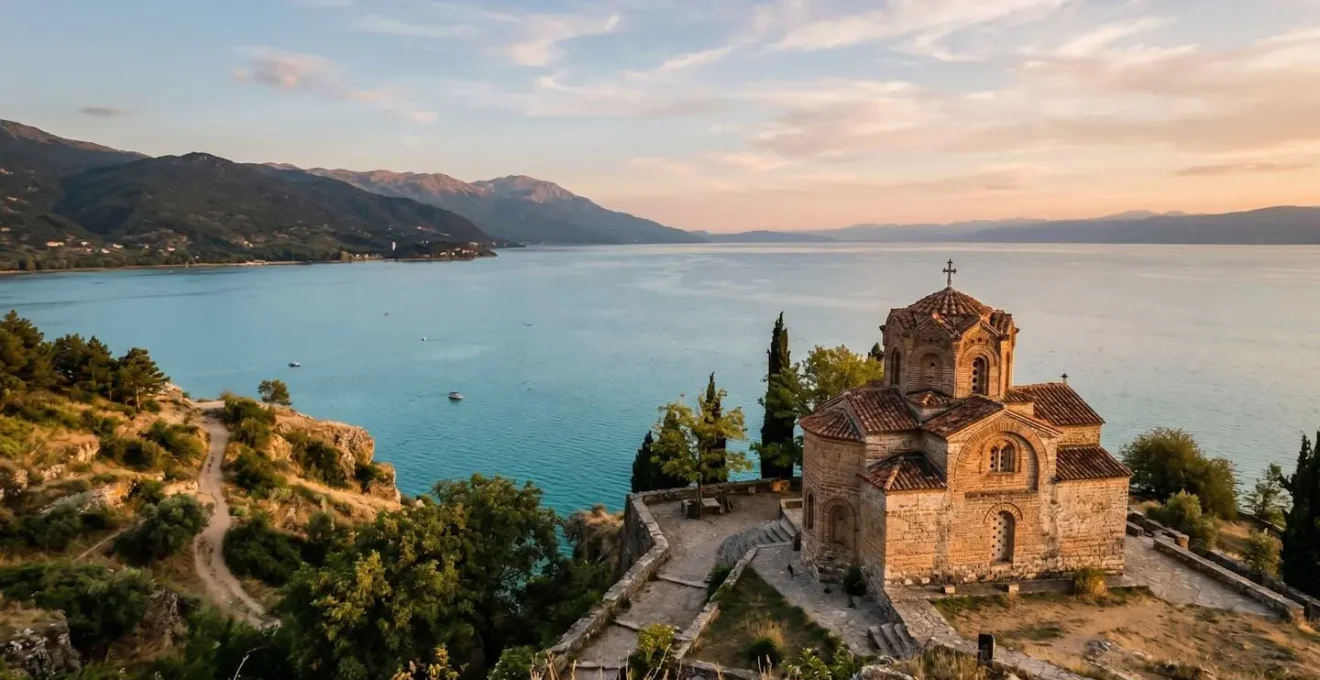
- The Church of St. John at Kaneo: Perched dramatically on a cliff overlooking Lake Ohrid, this is perhaps the most photographed church in Macedonia. While its interior frescoes are more modest, its symbiosis with the landscape is an aesthetic experience in itself.
- The Church of the Holy Mother of God Peribleptos: Built in 1295, its frescoes by artists Michael and Eutychius mark a departure towards a more dynamic and narrative style, a precursor to the Palaiologan Renaissance.
- Plaoshnik: The site of the reconstructed St. Clement’s Monastery, this is considered a sacred place where the Cyrillic alphabet was taught. It is a center of immense cultural and spiritual importance.
- The Icon Gallery: Housed near the Church of the Holy Mother of God Peribleptos, this gallery contains some of the most exquisite and valuable icons in the world, allowing for an up-close appreciation of their spiritual power.
Visiting these five locations provides a comprehensive yet manageable overview of Ohrid’s immense contribution to art history, from grand monumental painting to the intimate, portable devotion of the icon.
How to Plan a Route Visiting the Most Secluded Mountain Churches?
While urban centers like Ohrid and Skopje offer accessible masterpieces, some of Macedonia’s most profound spiritual and artistic experiences are found in seclusion, nestled on remote mountain slopes. Visiting these sites requires more than a simple map; it demands careful planning and a spirit of pilgrimage. The journey itself—often involving winding, unpaved roads—becomes part of the experience, stripping away the trivialities of modern life and preparing the visitor for a more contemplative encounter.
The Church of St. Panteleimon at Nerezi, for example, is located on the slopes of Mount Vodno, just a few kilometers from Skopje. Though close to the capital, it demonstrates the need for specific logistical arrangements. A successful trip to these more isolated locations depends on a few key preparations. Your route should be planned not just by distance, but by road condition and accessibility, which can vary dramatically.
Here are the essential steps for planning your journey:
- Research and Verify: Before setting out, research the current status of each monastery. Is it an active monastic community, a protected museum, or a parish church? Visiting hours, rules, and accessibility can differ significantly.
- Secure Proper Transport: Many mountain sites, including parts of the route to Nerezi, are best reached with a 4×4 vehicle. Do not assume all roads marked on a map are paved or easily navigable with a standard rental car.
- Prepare for the Dress Code: Remote monasteries often enforce the dress code (shoulders and knees covered) more strictly than urban churches. Always have a scarf or wrap with you.
- Learn Basic Courtesies: A few basic Macedonian phrases (“Dobar den” for “Good day,” “Blagodaram” for “Thank you”) can go a long way in showing respect to the monks or caretakers who maintain these sacred sites.
- Time Your Visit: Plan to visit during daylight hours. If it’s an active church, check the schedule for services. Witnessing a liturgy can provide a powerful context for the art that surrounds you, but you must be respectful and unobtrusive.
–
–
–
Planning a route to these secluded churches is an act of intention. It transforms a simple sightseeing trip into a meaningful quest, where the destination and the journey to reach it are equally significant.
What Are the Dress Code Rules for Entering Active Orthodox Monasteries?
Entering an Orthodox monastery or church is more than a tourist activity; it is an act of stepping into a living space of prayer and devotion. The dress code is not an arbitrary set of rules designed to inconvenience visitors, but rather a sign of respect for this sacred atmosphere. While enforcement can vary, adhering to the code is a non-negotiable part of a respectful visit and, in many active monasteries, a prerequisite for entry. The fundamental principle is modesty—clothing should not draw attention to the self but rather allow the visitor to blend into the contemplative environment.
The rules are generally simple and apply to all genders. The primary requirement is to cover one’s shoulders and knees. This means no tank tops, sleeveless shirts, shorts, or short skirts. Trousers or long skirts are appropriate for all. In some of the stricter, more traditional active monasteries, women may also be asked to wear a skirt (often provided at the entrance) and cover their heads with a scarf, especially during a church service. Being prepared is the key to a smooth and respectful experience.
Your Essential Checklist for Monastery Attire
- Assess Your Wardrobe: Before you leave for the day, ensure your primary outfit includes shirts with sleeves (even short sleeves are usually fine) and trousers or a skirt that falls below the knee.
- Pack a Versatile Scarf: The single most useful item is a large, lightweight scarf or pashmina. It can be used to cover your shoulders, wrap around your waist as a makeshift long skirt, or, for women, cover your head if required.
- Choose Respectful Footwear: While there are rarely strict rules on footwear, opt for closed-toe shoes. They are more practical on uneven stone floors and convey a greater sense of respect than beach sandals.
- Observe Gender-Specific Norms: Be aware that in the most traditional monastic communities, women may be expected to cover their hair. Observe what local women are doing, and if in doubt, covering your head is the most respectful option.
- Understand the Context: Rules are often strictest at active, remote monasteries and slightly more relaxed in large, urban cathedrals that see many tourists. However, the baseline of covering shoulders and knees is a universal expectation.
By dressing thoughtfully, you are not just following rules; you are communicating your understanding and respect for a tradition that has sanctified these spaces for centuries. It is a small gesture that opens the door to a much deeper and more welcome experience.
The Photography Mistake That Could Get You Kicked Out of a Church
In the age of the smartphone, it is almost a reflex to capture the beauty we encounter. However, inside a Macedonian church, this reflex must be consciously managed. The single biggest mistake a visitor can make—one that is disrespectful, damaging, and could lead to being asked to leave—is using flash photography. The prohibition is near-universal, yet it is frequently ignored by tourists who are either unaware of or indifferent to the consequences.
The reason for this rule is not about secrecy; it is about preservation. The vibrant pigments of these ancient frescoes are delicate. They have survived for nearly a millennium, but they are fragile. The intense bursts of light from a camera flash cause cumulative and irreversible damage, bleaching the colors and accelerating the deterioration of the plaster. Each flash is a small act of vandalism, erasing a tiny piece of a priceless world heritage. As travel writer Anjaly Thomas candidly noted of her own temptation, “Photography is banned inside most of the churches – but forgive me lord for sneaking a few here and there!” This sentiment highlights the internal conflict many feel, but the rule must be respected.
Beyond the physical damage, photography—especially with a flash—shatters the sacred atmosphere. It transforms a house of prayer into a tourist attraction, a place of quiet contemplation into a backdrop for selfies. The most profound transgression is photographing monks, nuns, or worshippers during prayer. This act violates their privacy and reduces a moment of genuine spiritual connection to a mere spectacle. To photograph ethically in these spaces, consider the following guidelines:
- Never Use Flash: This is the golden rule. There are no exceptions.
- Ask for Permission: Rules vary. Some sites (often museums) may allow non-flash photography, while active parishes may prohibit it entirely. Always look for signs or ask a caretaker.
- Use Appropriate Gear: If photography is permitted, use a camera with good low-light capability (e.g., a fast prime lens) and increase your ISO. Brace yourself against a wall or pew to minimize shake rather than using a disruptive tripod.
- Be Discreet: Avoid loud shutter noises. Focus on architectural details or the play of natural light rather than taking wide shots that include other people.
- Put the Camera Away: The best way to experience these spaces is often with your own eyes. Allow yourself to be present in the moment, to absorb the atmosphere, and to let the art speak to you without the mediation of a lens.
Remember that you are a guest in a sacred space. The best photograph is no substitute for a genuine moment of connection and respect for the centuries of faith that these walls represent.
Key takeaways
- Macedonian frescoes, especially at Nerezi (1164), introduced a powerful emotional realism to art over 140 years before Giotto, challenging the traditional art history narrative.
- This emotional depth stemmed from “theopathy,” a form of theological humanism where the artist and viewer empathetically suffer with the divine, a different root from Italian Renaissance humanism.
- A respectful visit requires practical preparation, including adhering to a modest dress code (shoulders and knees covered) and a strict prohibition on flash photography to preserve the ancient pigments.
–
Integrating the Sacred Gaze: From Tourist to Conscious Observer
We have journeyed from the broad historical context of the Macedonian Renaissance to the intimate, heartbreaking details of the Nerezi *Lamentation*. We have seen how a single fresco can rewrite our understanding of art history and how a lakeside town like Ohrid can serve as a living library of spiritual art. The common thread is a call to look deeper, to move beyond the surface of what is easily seen.
The ultimate value of visiting these Macedonian churches lies not in checking them off a list, but in fundamentally changing the way you see. It is about shifting from the passive glance of a tourist to the active, engaged looking of a conscious observer—what we might call the sacred gaze. This means understanding that the frescoes are not merely decorations but theological arguments, emotional expressions, and invitations to contemplation. It means recognizing that the rules of dress and photography are not restrictions but frameworks for respect that preserve the integrity of the space for everyone.
This approach transforms a vacation into a pilgrimage, whether spiritual, artistic, or intellectual. The goal is no longer simply to see, but to understand. The reward is a connection that transcends time, a dialogue with artists who, a thousand years ago, found a way to paint the human soul. This is the true, essential gift of Macedonia’s Byzantine heritage.
Now, equipped with this new lens of understanding, you are prepared to embark on your own journey. Plan your visit not just as a trip, but as an exploration, and allow the profound emotional power of this art to transform your perspective.