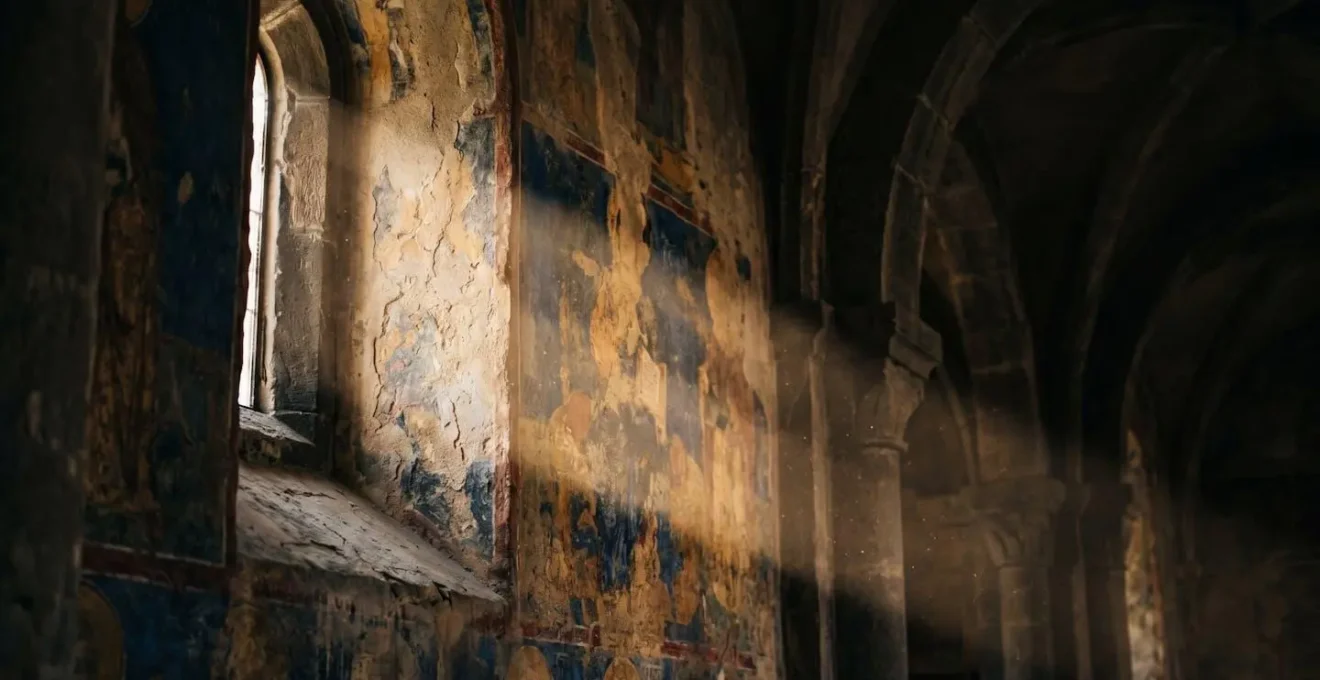
Contrary to the belief that the Renaissance began in Italy with Giotto, its emotional and technical blueprint was forged over a century earlier in the Byzantine churches of Macedonia.
- The 1164 “Lamentation of Christ” at Nerezi displays raw human grief, a ‘humanist shift’ that predates Giotto’s famous Arena Chapel frescoes by 141 years.
- This was not an isolated miracle but the result of the Komnenian Renaissance, a period of intense artistic experimentation where artists tested the formulas for naturalism and pathos.
Recommendation: To truly understand the Renaissance, we must look past Florence and start in the forgotten artistic laboratories of 12th-century Macedonia.
The story of Western art history is often told as a linear progression: a long, static medieval period suddenly bursts into life in 14th-century Italy with the revolutionary work of Giotto di Bondone. We are taught that Byzantine art, which preceded it, was formal, gilded, and emotionally distant—a beautiful but rigid tradition. This narrative credits Giotto with single-handedly breaking these conventions, injecting raw human emotion into religious scenes and paving the way for the Renaissance. But what if this well-known story is missing its entire first chapter? What if the key innovations we attribute to the Italian Renaissance were actually developed, tested, and perfected more than a century earlier in the remote Balkan mountains?
This is the radical proposition offered by the medieval frescoes of Macedonia. These artworks challenge our neat chronological timelines and force a re-evaluation of where the modern artistic sensibility truly began. Far from being a provincial backwater, 12th-century Macedonia was an active artistic laboratory, a place where imperial patronage and theological shifts fueled a profound move toward naturalism and psychological depth. The frescoes found here are not merely a prelude to the Renaissance; they are the emotional blueprint. They demonstrate a sophisticated understanding of human pathos, dramatic composition, and material storytelling that would not be seen again in Europe for over 140 years. To understand these works is to discover the missing prologue to one of art’s greatest revolutions.
This guide delves into the crucial questions surrounding these masterpieces. We will explore the material cost of their iconic colours, compare their artistic merits, and provide a practical guide for seeing them yourself. By examining these frescoes, we will uncover why this small corner of the Balkans holds a monumental key to understanding the full sweep of art history.
Summary: Uncovering the Macedonian Renaissance
- Why Is the Particular Shade of Blue in Frescoes So Expensive and Rare?
- How Does the Nerezi Lamentation Predate Giotto’s Emotions by 140 Years?
- Kurbinovo or St. Naum: Which Monastery Has the Most Impressive Art?
- Why Is Flash Photography Strictly Forbidden Inside Churches?
- How to Plan a “Fresco Route” Driving Itinerary in Western Macedonia?
- How Does the Nerezi Lamentation Predate Giotto’s Emotions by 140 Years?
- How to Read the “Lamentation of Christ” Fresco at Nerezi Monastery?
- Why Are Macedonian Byzantine Churches Essential for Art History Lovers?
Why Is the Particular Shade of Blue in Frescoes So Expensive and Rare?
The deep, celestial blue that backdrops many Macedonian frescoes is more than just a colour; it is a statement of immense wealth, power, and devotion. This specific pigment, known as ultramarine blue, was an artistic luxury of the highest order. Historical records reveal that during the medieval period, ultramarine was valued as highly as gold, making its extensive use a powerful symbol of the patron’s status and the significance of the sacred space. Its rarity and cost were not arbitrary but were directly tied to its extraordinary origins and the arduous process required to create it.
The Silk Road in a Pigment: The Journey of Lapis Lazuli
The sole source of ultramarine was the semi-precious stone lapis lazuli, mined almost exclusively in the treacherous Sar-i-Sang mines of modern-day Afghanistan. As detailed in a study by the Fitzwilliam Museum, this precious cargo traveled thousands of miles along the Silk Road to the markets of Constantinople and, from there, to remote workshops in the Balkans. The extraction process itself was a feat of medieval alchemy. Artists couldn’t simply grind the stone, as it contained impurities like calcite and pyrite. Instead, they had to perform a complex purification, mixing the ground stone with wax, oils, and resins, then kneading the resulting dough in warm water to painstakingly separate the pure blue lazurite particles. This material narrative—a story of global trade, geological rarity, and artisanal mastery—is embedded in every brushstroke, transforming the blue backgrounds from simple settings into testaments of economic and cultural power.
The choice to use this pigment was therefore a deliberate one, meant to evoke the divine and inspire awe. It was the colour of heaven, made from a stone that journeyed across the known world and was refined through a near-magical process. Understanding its cost and rarity is the first step in appreciating the full investment—spiritual, financial, and artistic—that these frescoes represent.
How Does the Nerezi Lamentation Predate Giotto’s Emotions by 140 Years?
The central argument for the revolutionary nature of Macedonian frescoes is found in a direct, startling comparison of dates. The fresco of the “Lamentation of Christ” in the Church of Saint Panteleimon at Nerezi was completed in 1164. Giotto’s famous, and thematically similar, “Lamentation” in the Arena Chapel in Padua was painted around 1305. This creates a documented chronological disruption of 141 years. For over a century before Giotto, artists in Macedonia were already depicting sacred figures with a raw, heart-wrenching humanity that shattered the formal conventions of the time. While traditional Byzantine art often portrayed grief through symbolic gestures, Nerezi presented it as a visceral, personal tragedy.
In the Nerezi Lamentation, the Virgin Mary cradles her dead son, her face contorted in a mask of unbearable sorrow, pressing her cheek against his. The figures are not just icons; they are participants in a profound human drama. Their bodies have weight and volume, and their expressions convey complex psychological states. This was a radical departure from the more serene, ethereal, and symbolic representations common in earlier Byzantine art. The artists at Nerezi chose to emphasize the humanist shift, focusing on the suffering of Christ the man and the grief of his mother.
As art historian Andrew Graham-Dixon notes, the art at Nerezi was a profound step towards realism. He states that the frescoes “had the capacity to change into something more obviously human and realistic, anticipating the West’s emphasis on depicting Christ as a man of flesh and blood by some 150 years.” This wasn’t a minor stylistic tweak; it was a fundamental rethinking of the purpose of religious art, designed to create a direct emotional connection with the viewer. Nerezi provided the emotional blueprint for a new kind of art that valued pathos and psychological truth.
Kurbinovo or St. Naum: Which Monastery Has the Most Impressive Art?
For an art lover traveling through Macedonia, a key question arises: with limited time, where should one focus one’s attention? The monasteries of Kurbinovo and St. Naum, both jewels of the region, offer two very different but equally compelling experiences. The choice between them often comes down to what you seek: a pilgrimage to witness a unique artistic peak or a holistic experience blending art, history, and stunning natural beauty. Kurbinovo is the purist’s choice, while St. Naum captivates with its overall ambiance.
The small, remote church of St. George at Kurbinovo (c. 1191) is home to some of the most daring and surreal frescoes of the period. Its artists pushed the Komnenian style to its limits, creating uniquely elegant and elongated figures that seem to float with a strange, otherworldly grace. The most famous of these is the depiction of the Archangel Gabriel from the Annunciation. As noted by Byzantine art scholars, this work is the pinnacle of a bold local style, notable for its “elegant and elongated figures.” A visit here is an intimate encounter with pure artistic innovation, an experience unadorned by modern tourism infrastructure.
The Monastery of St. Naum, by contrast, is a grand and vibrant complex spectacularly situated on the shores of Lake Ohrid. Its artistic appeal lies not only in its beautiful 16th-century frescoes and a magnificent carved iconostasis but also in the complete spiritual and sensory experience it offers. Here, art is interwoven with the life of the monastery, the history of the saint, and the breathtaking natural setting. The following table breaks down the key differences to help you decide.
| Criteria | Kurbinovo (St. George) | St. Naum |
|---|---|---|
| Primary Appeal | Art Purist’s Pilgrimage | Holistic Spiritual Experience |
| Artistic Style | Uniquely elongated, elegant figures; surreal Macedonian Byzantine style | Beautiful frescoes in traditional style; 16th-century paintings |
| Signature Fresco | Archangel Gabriel from The Annunciation (12th century) – pinnacle of daring local style | Life of St. Naum biblical scenes; exceptional walnut wood iconostasis |
| Setting & Atmosphere | Remote, intimate church requiring dedicated visit | Stunning Lake Ohrid location; peacocks; boat trips to underwater springs |
| Best For | Serious art historians; those seeking rare artistic expressions | Travelers wanting art plus natural beauty; spiritual pilgrims; photographers |
| Accessibility | May require finding key-keeper; more challenging access | Easier access; well-developed visitor infrastructure |
Ultimately, the “most impressive” art depends on the viewer. Kurbinovo offers a concentrated dose of unparalleled stylistic genius, while St. Naum presents a rich tapestry of art, nature, and faith.
Why Is Flash Photography Strictly Forbidden Inside Churches?
The strict “no flash photography” rule enforced in Macedonian churches is not an arbitrary inconvenience for tourists; it is a critical conservation measure rooted in the very chemistry of the frescoes. These thousand-year-old artworks are incredibly fragile, and their greatest enemy is cumulative, irreversible damage. Each burst of a camera flash, seemingly insignificant on its own, contributes to the slow fading and degradation of the ancient pigments.
The intense light from a flash accelerates the chemical reactions that cause pigments to break down. This is especially true for delicate organic-based pigments. Over time, repeated exposure leads to a permanent loss of colour and detail, robbing the frescoes of their vibrancy. This principle of cumulative damage is at the heart of modern conservation science. While a single flash won’t destroy a fresco, thousands of flashes from millions of visitors over the decades will. The ban is a proactive measure to preserve these irreplaceable treasures for future generations, protecting the vital material narrative they contain.
Conservation Lessons from Nerezi’s Past
The history of the Church of Saint Panteleimon at Nerezi serves as a powerful cautionary tale. The frescoes have already endured immense trauma, including an earthquake in 1555. Worse, a “restoration” attempt in 1885 involved completely painting over the original 12th-century masterpieces—a common but devastating practice of the era. These later additions were not removed until 1923. Today, conservators battle ongoing threats from humidity and salt efflorescence, but the most easily preventable threat is light damage. The ban on flash photography also serves a secondary, but equally important, purpose: it preserves the sacred and contemplative atmosphere for which these artworks were created. They were designed to be seen in the soft, dynamic interplay of candlelight and natural light filtering through high windows, not the sterile, flattening glare of a camera flash. To view them in this intended light is to connect more authentically with their original purpose.
By respecting the photography ban, visitors become active participants in the conservation effort. You are not just protecting a painting; you are safeguarding a crucial piece of human history and ensuring that the profound emotions captured by the artists of Nerezi can be experienced for centuries to come.
How to Plan a “Fresco Route” Driving Itinerary in Western Macedonia?
Planning a trip to see Macedonia’s scattered fresco masterpieces requires more than just a GPS; it demands a thoughtful approach to logistics and timing. Unlike visiting a single city museum, this is a journey to remote, often-locked churches where access can be part of the adventure. A well-planned itinerary balances the “must-see” sites with practical considerations like driving times, opening hours, and the potential need to find a local key-keeper. A 3-day route based out of Skopje and Ohrid provides an excellent framework for exploring the region’s most significant works.
A logical approach is to group sites geographically. Starting in Skopje allows for an easy visit to the foundational masterpiece at Nerezi. Then, relocating to Ohrid, a UNESCO World Heritage site in its own right, provides a perfect base for exploring the cluster of churches around the lake and venturing out to the more remote artistic pilgrimage site of Kurbinovo. This structure minimizes driving time and maximizes contemplative viewing time.
Your Action Plan: Verifying Your Custom Fresco Itinerary
- Contact Points: List all churches you plan to visit. For rural or less-visited sites like Kurbinovo, research and list the contact numbers for the local tourist office or a designated key-keeper. Confirm access procedures in advance.
- Logistical Collect: Inventory your plan’s elements. Do you have realistic driving times calculated between sites? Have you noted opening hours and potential closing days (especially for monasteries)?
- Coherence Check: Does the flow of your itinerary make sense? Are you backtracking excessively? Confront your ideal plan with the reality of a map to create the most efficient route.
- Experience Audit: Look at your schedule. Have you allocated at least 45-60 minutes per church for actual viewing, or is it a frantic dash? The goal is contemplation, not just collection. Identify where you can add buffer time.
- Integration Plan: Based on your checks, adjust the itinerary. Prioritize your “must-see” sites for morning visits when you are fresh and the light is often best. Move “nice-to-have” sites to the afternoon or a flexible slot.
Beyond the logistics, consider hiring a specialized art historian guide for at least one day. While general guides are helpful, an expert can unlock the complex iconography and historical context, transforming your viewing from simple admiration into a deep understanding. The best seasons for this trip are late spring (May-June) and early autumn (September-October), offering pleasant weather without the intense summer heat.
How Does the Nerezi Lamentation Predate Giotto’s Emotions by 140 Years?
The startling emotional maturity of the Nerezi frescoes was not an isolated flash of genius but the finest surviving product of a broader cultural and artistic movement known as the Komnenian Renaissance. To understand how Nerezi could predate Giotto, we must understand the fertile ground from which it grew. The 12th century, under the rule of the Komnenos dynasty, was a period of relative stability, economic prosperity, and renewed imperial confidence in the Byzantine Empire. This environment was crucial for fostering artistic innovation.
During this period, there was a significant increase in the construction of churches and monasteries, not just in the capital of Constantinople but throughout the empire’s provinces, including Macedonia. Imperial patrons, such as Alexios Komnenos, a member of the royal family who sponsored the church at Nerezi, invested heavily in these projects. As noted by Byzantine art historians, “The Komnenoi were great patrons of the arts, and with their support Byzantine artists continued to move in the direction of greater humanism and emotion.” This patronage provided both the financial means and the intellectual encouragement for artists to experiment and push beyond established conventions.
The Komnenian Context: A Widespread Humanist Shift
The move towards greater naturalism and emotion was a widespread phenomenon during this era. The prosperity of the Komnenian period, which spanned from 1081 to 1185, fueled a renewed interest in classical models and a deeper theological focus on the human nature of Christ. This “humanist shift” can be seen in various artworks across the empire. Therefore, Nerezi should not be seen as a strange anomaly but as the high-water mark of a prevailing artistic current. It is the most sublime and well-preserved example of a widespread artistic evolution that was actively exploring how to render divine stories with relatable human feeling. This context explains *why* an artistic laboratory like Nerezi could produce such a revolutionary emotional blueprint so early.
In essence, the Komnenian Renaissance created a unique microclimate where artists were empowered to explore the psychological dimensions of faith. Giotto’s revolution did not happen in a vacuum; its foundations were laid over a century before in the workshops and churches of the Byzantine world, with Nerezi standing as its most brilliant testament.
How to Read the “Lamentation of Christ” Fresco at Nerezi Monastery?
To stand before the “Lamentation of Christ” at Nerezi is to witness a masterclass in emotional storytelling. The power of the fresco lies not just in its subject but in its deliberate and sophisticated composition. The artist uses a series of visual strategies to guide the viewer’s eye, build dramatic tension, and create an overwhelming sense of shared grief. Reading the fresco means deconstructing these artistic choices to understand how they work together to create such a profound impact. It is an active, not passive, viewing experience.
The composition is anchored by a dynamic, V-shaped landscape that funnels the viewer’s gaze directly towards the central tragedy. The sloping hills seem to bow down in sorrow, their lines converging on the lifeless body of Christ. This is not a static background but an active participant in the drama. Within this carefully constructed space, the artist arranges the figures to create a cascade of human connections and emotional responses, from the raw agony of Mary to the solemn grief of the disciples.
Analyzing the fresco is a process of paying close attention to both the grand composition and the intimate details. The work’s genius is in its ability to operate on both a monumental and a deeply personal scale. The following steps provide a guide to unlocking its layers of meaning, based on an analysis of its key visual elements.
A Guide to Reading the Nerezi Lamentation
- Observe the V-shaped landscape composition where hillsides sink toward the center, directing your eye to Christ’s body and heightening the drama.
- Study Mary’s face pressed against Christ’s cheek, noting how her eyebrows contract and her lips press together to express unprecedented maternal grief.
- Examine St. John grasping Christ’s right hand while Joseph of Arimathea and Nicodemus kneel at his feet, creating intimate human connection.
- Look upward to the group of angels with outstretched arms flying above the scene against the deep blue sky, forming a celestial chorus of sorrow.
- Analyze how the small, dimly lit architectural space forces an intimate encounter, amplifying emotional power in ways a museum viewing cannot replicate.
Key Takeaways
- Macedonian frescoes are not a footnote but a missing prologue to the Renaissance, with the Nerezi “Lamentation” predating Giotto’s emotional realism by 141 years.
- This “humanist shift” was not an accident but the result of the 12th-century Komnenian Renaissance, which served as an “artistic laboratory” for new forms of expression.
- The art’s meaning is tied to its “material narrative,” from the immense cost of ultramarine blue pigment to the modern-day conservation challenges that dictate visitor rules.
Why Are Macedonian Byzantine Churches Essential for Art History Lovers?
Macedonian Byzantine churches are essential because they shatter the clean, linear narrative of Western art history. They prove that the Renaissance was not a singular event born in Italy but an evolution with deep, complex roots. These churches are more than just repositories of beautiful objects; they are the surviving evidence of an artistic laboratory where the very definition of religious art was being redefined. For any student or enthusiast of art history, they offer a crucial corrective to the established canon, revealing a story of innovation that is richer, more geographically diverse, and more surprising than the standard textbook account.
The period of the Komnenian dynasty, spanning over a century, provided the perfect conditions for this revolution. With imperial patronage flowing into the provinces, artists were empowered to explore a new kind of art—one that sought to touch the heart as well as elevate the soul. They developed the emotional blueprint for depicting pathos, using compositional drama, psychological realism, and a focus on human interaction to make divine stories feel immediate and profoundly personal. The frescoes at Nerezi, Kurbinovo, and other sites are the tangible results of these experiments. They are the crucial link between the formal grandeur of Byzantium and the human-centric drama of the Renaissance.
To ignore them is to miss the fundamental context from which the art of Giotto and his successors emerged. It is to see a revolution without understanding the decades of intellectual and artistic ferment that made it possible. Visiting these churches, or even studying them from afar, is to participate in the rewriting of art history. It is to acknowledge that genius is not confined to a single nation or a single century, and that sometimes the most important stories are found in the places we least expect.
For students and passionate followers of art history, the next logical step is to move beyond the text and engage with these works directly. Begin by tracing the journey of the Komnenian style, comparing the masterpieces of Nerezi with the broader artistic currents of the 12th century to fully appreciate their revolutionary impact.