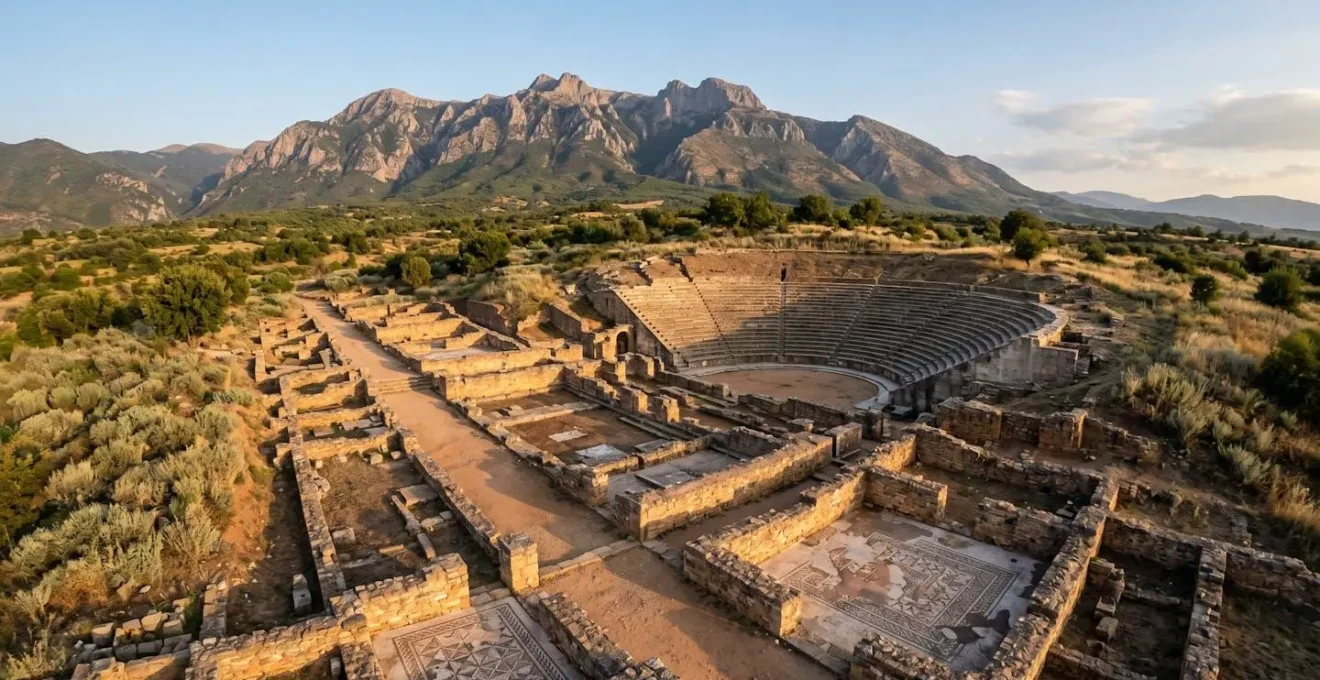
Heraclea Lyncestis is not a separate attraction from Bitola; it is the city’s living foundation, offering an experience far more profound than a simple tour of ruins.
- The site’s most famous features—its mosaics and theatre—are not just static displays but are deeply connected to the seasons and modern cultural life.
- The journey to Heraclea is part of the discovery, a walk through Bitola’s layers of history that prepares you for the ancient world.
Recommendation: Approach your visit not as a tourist ticking a box, but as a guest stepping into the first chapter of our city’s long and elegant story.
As you stroll down our beloved Širok Sokak, past the elegant neoclassical buildings and the inviting hum of cafés, you feel the unique rhythm of Bitola. It’s a city of unhurried grace, a place that carries its history not as a burden, but as a quiet source of pride. Many visitors come with a simple goal: to see the famous ruins of Heraclea Lyncestis, the ancient city founded by Philip II of Macedon. They come to photograph the mosaics and stand in the Roman theatre, ticking a box on their Balkan itinerary.
But to see Heraclea as just a collection of ancient stones is to miss its true essence. It’s easy to read a guidebook and learn the facts, but what if the real magic lies elsewhere? What if the key to truly understanding Bitola is to see Heraclea not as a destination, but as the origin story—the very soul of the city that still echoes in our streets today? This site is more than an archaeological park; it’s a living piece of our identity, a place where the past breathes alongside the present.
This guide isn’t just about what to see. It’s a local’s perspective on how to *experience* Heraclea. We’ll explore the practicalities, of course, but we’ll frame them within the city’s narrative. We’ll walk the path from modern café culture to ancient contemplation, understand why its theatre still hosts concerts under the stars, and discover why this quiet site offers a more intimate connection to history than many of its more famous counterparts. Prepare to see Heraclea Lyncestis not with the eyes of a tourist, but with the heart of an explorer discovering a city’s deepest secret.
In this article, we’ll delve into the essential questions and insider knowledge that will transform your visit from a simple sightseeing trip into a memorable journey into Bitola’s ancient soul.
Summary: A Deeper Look into Bitola’s Ancient Heart
- When Are the Heraclea Mosaics Uncovered for Public Viewing?
- How to Walk from Bitola City Center to Heraclea Without Getting Lost?
- Why Is the Ancient Theatre of Heraclea Still Used for Concerts Today?
- The Opening Hours Mistake That Most Tourists Make on Mondays
- Heraclea vs Stobi: Which Site Offers Better Photography Opportunities?
- When Are the Heraclea Mosaics Uncovered for Public Viewing?
- How Did Bitola Earn the Nickname “City of Consuls”?
- Why Should Bitola Be Your Second City Break in North Macedonia?
When Are the Heraclea Mosaics Uncovered for Public Viewing?
This is the most critical piece of information for planning your visit. The magnificent floor mosaics of Heraclea Lyncestis, with their vibrant depictions of the natural world, are the site’s crown jewels. However, they are not visible year-round. To protect these priceless 4th and 5th-century masterpieces from the harsh winter weather, they are carefully covered with sand for a significant part of the year.
The viewing season is a precious window. The mosaics are typically uncovered for public viewing from May to October. This period aligns with the best of our Pelagonian weather, allowing you to experience their full glory under the warm sun. Arriving outside of this window means you will see the layout of the basilicas and other structures, but the intricate tesserae work—the very heart of Heraclea’s artistic legacy—will be hidden from view, sleeping beneath its protective layer.
Therefore, timing is everything. Planning your trip within this timeframe is not just recommended; it’s essential for a complete Heraclea experience. According to the Bitola City Guide, this seasonal display ensures the long-term preservation of what makes our ancient city so unique. Visiting in late spring or early autumn often provides the most comfortable temperatures and beautiful light for appreciating these ancient artworks.
How to Walk from Bitola City Center to Heraclea Without Getting Lost?
Forget the taxi. The journey to Heraclea is not a mere transfer; it’s a narrative experience, a 30-minute pilgrimage through the layers of Bitola’s history. Your starting point is the famous Širok Sokak, our city’s vibrant pedestrian artery. Begin at Magnolia Square, with the proud statue of Philip II of Macedon—the founder of Heraclea—as your send-off. From here, your path is a straight line south, a journey that gradually peels back the centuries.
As one travel writer beautifully described it, this walk is a deliberate decompression from modern café culture to archaeological contemplation. You’ll first traverse the City Park, a tranquil green space where locals gather. Leaving the park, you enter quieter residential streets lined with modernist-era houses, a stark contrast to the consular elegance of Širok Sokak. Your landmark is the Petar Miloshevski Football Stadium; keep it on your left as you continue south. The final 15 minutes are a peaceful stroll that allows your mind to quiet, preparing you for the ancient world you are about to enter. The arrival at the gate feels earned, a true discovery rather than a simple stop.
The route is simple: from Magnolia Square, walk straight down the main pedestrian street, through the park, and continue straight south past the stadium. There are no complex turns, just a straight path that doubles as a timeline of our city’s architectural soul. You’re not just walking to a ruin; you’re walking through the story that leads to it.
Why Is the Ancient Theatre of Heraclea Still Used for Concerts Today?
Standing in the ancient theatre of Heraclea, you’re not just in a relic of the past; you’re in one of Bitola’s most cherished contemporary venues. Built by the Romans in the 2nd century AD, this theatre was designed for more than just spectacle. It was engineered for performance, and that engineering is so brilliant that it continues to serve its original purpose almost two millennia later. The secret lies in its masterful design, which creates near-perfect natural acoustics.
As an architectural analysis of Roman theatre structures points out, “the semicircular form enhances the natural acoustics.” The tiered stone seating (the *cavea*) isn’t just for seating an audience; each row acts as a sound-diffusing surface, scattering sound waves evenly throughout the space. The orchestra and the stage building (*scaenae frons*) work together to reflect and project the performers’ voices and music towards the audience with remarkable clarity. This means that even an unamplified voice from the stage can be heard clearly at the very top row. It’s a testament to the incredible sophistication of Roman engineering.
This living history is what makes Heraclea so special. During the summer, especially as part of the Bitola Cultural Summer Festival (Bit-Fest), the theatre comes alive with concerts, plays, and performances. To sit on those ancient stones, under the stars, and listen to music echoing just as it did for Roman citizens is to feel the unbroken thread of history that connects us to this place. It’s a powerful reminder that Heraclea is not a dead city; its ancient soul is still very much alive.
The Opening Hours Mistake That Most Tourists Make on Mondays
Here is a piece of local advice that can save you from major disappointment. Many visitors, eager to explore Heraclea, arrive on a Monday morning only to find the gates closed. This is a common pitfall, rooted in a standard operational protocol for many cultural institutions throughout North Macedonia and the wider Balkan region.
Like many state-run museums and archaeological sites, Heraclea Lyncestis has traditionally observed Monday as a closing day. This day is typically reserved for essential maintenance, cleaning, and conservation work that cannot be done when the site is open to the public. While opening hours can sometimes vary, it is a very risky gamble to plan your visit for a Monday. Always assume it may be closed and verify with the NI Institute and Museum Bitola if your itinerary is inflexible.
So, what should you do if your only day in Bitola is a Monday? Don’t despair! This is the perfect opportunity to explore the other facets of our city’s rich history. You can visit the Bitola Museum, which is housed in a magnificent building and holds many of the most delicate artifacts excavated from Heraclea itself. Alternatively, dedicate the day to a deep dive into the “City of Consuls” era by exploring the stunning consular architecture of Širok Sokak or wandering through the atmospheric Ottoman-era Old Bazaar, where you’ll find the Atatürk Memorial Room.
Heraclea vs Stobi: Which Site Offers Better Photography Opportunities?
For the avid photographer, North Macedonia offers two premier archaeological sites: Heraclea Lyncestis and Stobi. While both are historically significant, they offer vastly different photographic experiences. Stobi, located at the confluence of two rivers, is known for its monumental scale—dramatic columns, expansive boulevards, and a grander sense of architectural ruin. It’s impressive, but it’s also the more popular and crowded of the two sites.
Heraclea, on the other hand, offers something far more precious for a photographer: intimacy and detail. The key difference is the quality and accessibility of the mosaics. Heraclea’s are simply exceptional, with vibrant colors and intricate animal motifs that provide endless opportunities for stunning detail shots and abstracts. The low-lying position of the site also creates a beautiful, raking golden hour light in the late afternoon that makes the tesserae gleam.
This contrast is perfectly summarized in the following comparison, based on numerous visitor experiences.
| Photography Aspect | Heraclea Lyncestis | Stobi |
|---|---|---|
| Mosaic Detail Shots | Exceptional—intricate animal motifs, vibrant tesserae colors, accessible viewing platforms | Good but less varied in subject matter |
| Architectural Grandeur | Moderate—compact theatre, basilica foundations | Superior—dramatic columns, expansive paved boulevards, monumental scale |
| Golden Hour Quality | Excellent—low-lying position creates raking afternoon light that makes mosaics gleam | Excellent—elevated theatre offers sunrise/sunset vantage over river confluence |
| Crowd Levels | Low—often solitary experience, clean shots without people | Higher—more popular, may require incorporating visitors into compositions |
| Mountain Backdrop | Yes—Mount Baba visible from site | River valley landscape |
| Shade Availability | Limited but more than Stobi | Minimal shade |
Perhaps the most compelling argument for Heraclea is the solitude. As one travel photographer noted after his visit, the ability to explore for hours without encountering another soul is a rare gift.
Travel photographer recounts spending two to three hours at Heraclea Lyncestis without encountering a single tourist, allowing unrestricted photographic access to the mosaics and theatre. The visitor noted the stark contrast with Albania’s Butrint National Park, which sees constant crowds despite similar historical significance, and emphasizes that Heraclea’s emptiness creates rare opportunities for clean architectural shots and intimate documentation of 2,000-year-old details without modern intrusions.
– An Adventurous World, What is Heraclea Lyncestis
Ultimately, if your goal is to capture epic, wide-angle shots of grand ruins, Stobi might be your choice. But if you seek the soul of a place, the texture of history, and the peace to create truly unique and intimate photographs, Heraclea Lyncestis is, without a doubt, the superior destination.
When Are the Heraclea Mosaics Uncovered for Public Viewing?
We’ve established the crucial viewing window of May to October, but it’s worth understanding the ‘why’ behind this seasonality. As a local guide, I can tell you this isn’t an arbitrary schedule; it’s a careful act of stewardship that speaks to how deeply we value our heritage. The mosaics of Heraclea are incredibly fragile, composed of thousands of tiny stone cubes, or *tesserae*.
The primary enemy of these ancient floors is the freeze-thaw cycle of our continental winters. When water seeps between the tesserae and freezes, it expands, pushing the cubes out of their original lime mortar bedding. Over time, this process would lead to the complete disintegration of these masterpieces. The layer of sand that covers them during the winter acts as an insulating blanket, protecting them from moisture and extreme temperature fluctuations. It’s a low-tech but highly effective conservation method passed down through generations of custodians.
The process of uncovering and re-covering the mosaics is a delicate operation undertaken by the experts at the NI Institute and Museum Bitola. It’s a time of celebration in the spring when they are revealed again to the sun, and a time of careful preservation in the autumn when they are put to rest. Understanding this cycle adds a layer of appreciation to your visit. You’re not just seeing an artifact; you’re witnessing the result of a continuous, conscious effort to preserve the living history of this place for future generations.
How Did Bitola Earn the Nickname “City of Consuls”?
While Heraclea represents Bitola’s ancient foundations, another key chapter of our city’s story is much more recent and explains the elegant European architecture you see all along Širok Sokak. This is the story of how Bitola became “The City of Consuls” during the final centuries of the Ottoman Empire.
From the 19th century until the Balkan Wars in 1913, Bitola (then known as Monastir) was a vital political, economic, and military center in the Ottoman Balkans. Its strategic importance was so great that over a dozen European countries, including Great Britain, France, Austria-Hungary, and Russia, established diplomatic missions here. This influx of diplomats, merchants, and officers transformed the city into a cosmopolitan hub of culture and influence.
The historical reason is stated perfectly in official documentation:
It has been known since the Ottoman period as ‘The City of the Consuls’ since many European countries had consulates in Bitola
– BH Field School, Bitola and Ancient city of Heraclea Lyncestis
These consulates were housed in the magnificent neoclassical buildings that still define our city’s character. The consuls brought with them European fashions, culture, and architecture, earning Bitola its reputation as the most “European” city in the region. This period gave us our piano traditions, our photography pioneers like the Manaki brothers, and the refined atmosphere that sets Bitola apart. So, as you walk from the consular palaces to the Roman ruins, you are tracing the two great peaks of our city’s long and distinguished history.
Key Takeaways
- Heraclea Lyncestis offers a rare, intimate experience with world-class mosaics and a living Roman theatre, largely free of crowds.
- The walk from Bitola’s city center to the site is an essential part of the journey, taking you through the city’s historical layers.
- Practical planning is crucial: visit from May to October to see the mosaics and avoid Mondays to ensure the site is open.
Why Should Bitola Be Your Second City Break in North Macedonia?
Many travelers to North Macedonia start and end their journey in Skopje. And while the capital has its own monumental charm, to truly understand the soul of our country, you must venture south to Bitola. If Skopje is the grand, reconstructed capital, then as one writer aptly put it, “Bitola is the elegant, authentic, and soulful heart.” It offers a different, perhaps more intimate, Macedonian experience.
Heraclea Lyncestis is the anchor of this experience, grounding the city in a history that predates nations and empires. But Bitola is also the perfect basecamp for exploring the entire Pelagonia region. The city’s relaxed pace, excellent cafés, and rich consular history provide a comfortable and culturally stimulating home base from which to launch daily adventures into some of our country’s most spectacular natural and historical landscapes.
From here, the pristine wilderness of Pelister National Park is on your doorstep, the traditional wine-making villages await, and the poignant history of the World War I Macedonian Front is just a short walk away. Bitola isn’t just a stopover; it’s a destination in its own right, a place to slow down, immerse yourself, and discover a side of Macedonia that is both ancient and elegantly modern.
Action Plan: Using Bitola as Your Pelagonian Basecamp
- Explore Pelister National Park: Visit North Macedonia’s oldest national park, established in 1948, known for its rare Molika pine, glacial “Pelister Eyes” lakes, and wildlife.
- Discover Dihovo Village: Take a short drive to this traditional mountain settlement to experience artisanal wine production and authentic rural Macedonian hospitality.
- Day Trip to Lake Prespa: Explore the transnational lake and its unique apple orchard agricultural traditions, shared with Greece and Albania.
- Cross-Border Excursion to Florina, Greece: For a comparative cultural perspective, visit Greek Macedonia via the nearby Medzitlija border crossing.
- Reflect at the WWI French Military Cemetery: Pay respects at this poignant historical site and the Memorial d’Orient, commemorating the Macedonian Front.
So when you plan your Macedonian journey, look beyond the capital. Come to Bitola to walk in the footsteps of kings and consuls, to feel the pulse of living history in a Roman theatre, and to discover the elegant, authentic, and soulful heart of our country, starting with its ancient foundations at Heraclea Lyncestis.
Frequently Asked Questions about Why Include Heraclea Lyncestis in Your Bitola Itinerary?
What are Heraclea Lyncestis opening hours?
Heraclea Lyncestis opens at 9:00 and typically closes in the early evening. It’s best to arrive early to beat crowds and secure optimal photography light.
Is the site closed on specific days?
Many state-run cultural sites across North Macedonia and the Balkan region follow the Monday closure protocol for maintenance, though this should be verified with the NI Institute and Museum Bitola.
What’s the alternative if Heraclea is closed?
Visit the Bitola Museum which houses artifacts from Heraclea, explore the consular architecture on Širok Sokak, or tour the Ottoman-era Old Bazaar and Atatürk memorial room.