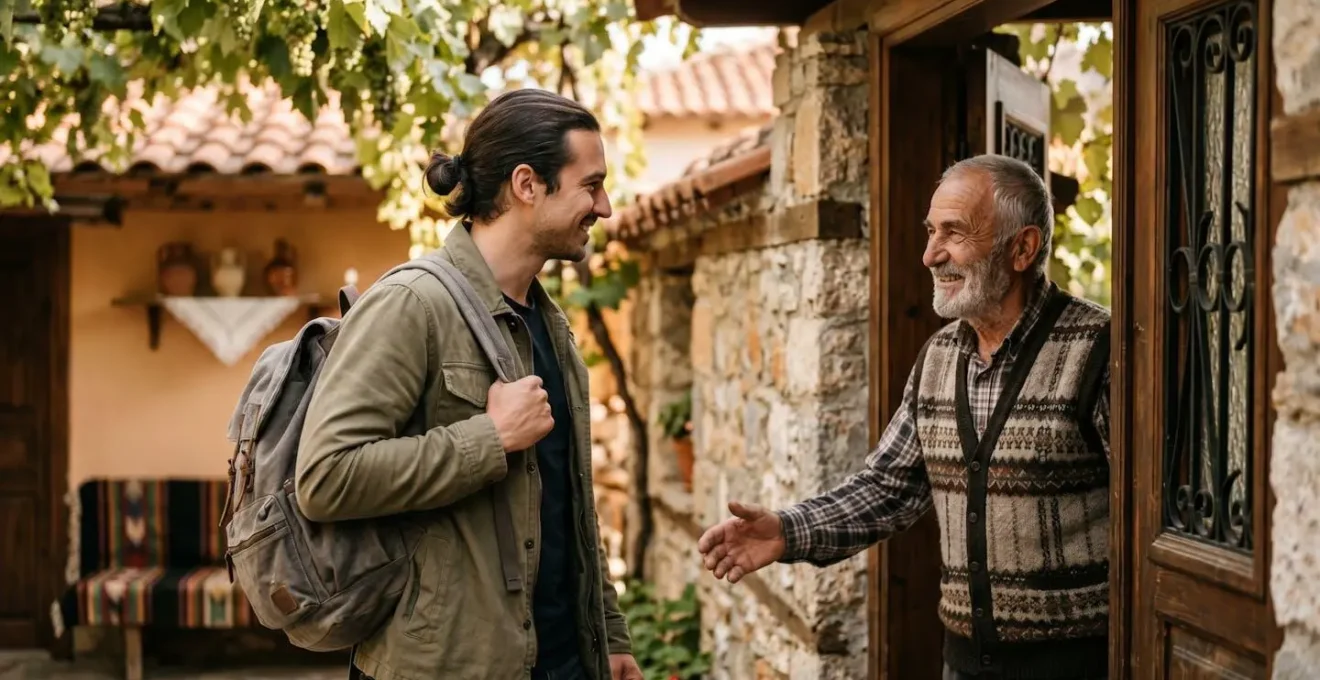
The overwhelming generosity you’ll encounter in North Macedonia isn’t just ‘friendliness’—it’s a deeply ingrained social code of honor, and understanding it is the key to unlocking the most profound and secure solo travel experience of your life.
- Spontaneous invitations are tests of trust and opportunities for genuine connection, not just casual offers.
- Treating a guest well is a reflection of a host’s honor, making hospitality a serious, heartfelt affair.
Recommendation: Instead of defaulting to polite refusal, learn the specific cultural language of acceptance and polite boundary-setting. It will transform you from a tourist into an honored guest.
As a solo traveler, and especially as a woman, you’ve likely built a set of finely-tuned defenses. You learn to politely decline, to keep a safe distance, to manage expectations. You’re told to be cautious, to blend in, to not draw too much attention. Then you arrive in North Macedonia, and within a day, every rule you’ve learned is turned on its head. A shopkeeper you’ve known for five minutes might invite you for coffee. A family might insist you join them for a meal. This isn’t just friendliness; it’s a different operating system for human connection.
Many guides will tell you that Macedonians are “hospitable” and that the country is “safe.” While true, these statements barely scratch the surface. They don’t prepare you for the intensity, the sincerity, and the beautiful complexity of this welcome. The real key to not just surviving but thriving here as a solo traveler isn’t about reinforcing your boundaries, but about learning the local way to navigate them. It’s about understanding that this generosity is part of a cultural social code, a system of honor and reciprocity that has been perfected over centuries.
This guide isn’t about where to go; it’s about *how to be*. It’s a decoder for the unspoken rules of Macedonian hospitality. By understanding the ‘why’ behind the endless food, the spontaneous invitations, and the royal treatment, you’ll gain the confidence to embrace these moments, turning potential anxiety into the most authentic and heartwarming connections of your travels.
To help you navigate this beautiful cultural landscape, we’ve structured this guide to address the most common situations and questions you’ll encounter. From decoding that first coffee invitation to understanding the rituals of a home-cooked meal, here’s what we’ll cover.
Summary: A Solo Traveler’s Guide to the Macedonian Welcome
- How to React When a Local Invites You for Coffee After 5 Minutes?
- Why Is Treating Guests Like Royalty a Matter of Honor Here?
- Rakija or Wine: What Gift Should You Bring When Visiting a Macedonian Home?
- The Politics Mistake to Avoid Discussing at a Macedonian Dinner Table
- How to Politely Refuse a Third Serving of Food Without Offending Your Host?
- How to React When a Local Invites You for Coffee After 5 Minutes?
- The Communication Mistake: How to Set Expectations with Macedonian Hosts?
- How to Drink Turkish Coffee Like a Local in North Macedonia?
How to React When a Local Invites You for Coffee After 5 Minutes?
It will happen. You’ll be asking for directions, admiring something in a shop, or simply looking a little lost, and a local will say, “Come, let’s have a coffee.” For many Western travelers, this sets off alarm bells. Is it a scam? What do they want? In North Macedonia, 99.9% of the time, the answer is simple: they want to share a moment with you. This invitation is the first step in a cultural ritual that can transform a stranger into a guest. Reacting correctly is your first opportunity to step inside the real culture.
Your default “no, thank you” reflex is your enemy here. The key is to pause and genuinely assess the situation. Is the invitation accompanied by a warm smile and sustained eye contact? These are cues of a heartfelt offer. If you have 30 minutes to spare, accepting is the best way to show respect and openness. An enthusiastic “I’d love to!” will be met with genuine delight. If you truly can’t, the trick is to decline with specific regret and a counter-proposal, like “That is so kind! I’m just on my way to meet a friend, but perhaps tomorrow morning?” This shows you value the offer, even if you can’t accept it at that moment.
Case Study: From Lost with a Map to Welcomed with Wine
One solo traveler’s account perfectly illustrates this phenomenon. While standing on a street in Skopje with a map, she was quickly approached by locals. Within minutes, the offer of directions escalated into a welcoming glass of wine at a nearby hostel and an invitation for tea from an apartment owner who then spent time explaining the town’s history. She noted that all the locals spoke fluent English and went out of their way to assure her that traveling alone, even at night, was perfectly safe. This spontaneous cascade of generosity shows how quickly a moment of vulnerability can lead to genuine connection and a deep sense of security.
Why Is Treating Guests Like Royalty a Matter of Honor Here?
Once you accept an invitation, whether for a quick coffee or a full-blown dinner, you’ll notice a shift. The hospitality is not casual; it is intentional and abundant. Your host will give you the best seat, offer you the first and best pieces of food, and relentlessly check on your comfort. This isn’t just about being nice; it’s a demonstration of a deeply ingrained cultural value system where the guest’s treatment is a direct reflection of the host’s honor.
This concept is rooted in centuries of tradition across the Balkan region. There’s a powerful saying that encapsulates this entire philosophy. According to a comprehensive guide on Balkan customs, “Guest is a sacred person”. This single phrase explains everything. When you are a guest, you are under the host’s protection and care. Your well-being becomes their responsibility. This is why a host may seem almost offended if you refuse food or don’t appear to be comfortable. It’s not a personal failing on your part, but in their cultural context, it can feel like a failure on theirs.
Understanding this honor code is liberating. It reframes their intense generosity not as pressure on you, but as an expression of their own identity and pride. Your role as a guest is simple but important: to receive graciously. By allowing them to take care of you, you are giving them a gift—the opportunity to demonstrate their honor. This is the heart of the host-guest dynamic in North Macedonia.
Rakija or Wine: What Gift Should You Bring When Visiting a Macedonian Home?
If you’re invited to a Macedonian home for a planned meal, arriving empty-handed is a cultural misstep. While your presence is always the main event, bringing a small gift is a crucial act of reciprocity and respect. It shows that you understand the effort they are putting in and that you value their invitation. But what to bring? The choice of gift can send a subtle message.
The story of a Macedonian Ambassador’s mother perfectly captures the depth of this hosting culture. She made her very first airplane journey all the way to Tokyo for the sole purpose of preparing an authentic, from-scratch Macedonian meal for guests. This illustrates the profound sense of duty to provide the best for a guest. A bottle of local wine (like Vranec) or a good quality Rakija (fruit brandy) is almost always a safe and appreciated choice. Chocolates or a dessert are also excellent, especially if there are children in the family. If you bring flowers, tradition dictates bringing an odd number. But perhaps the most memorable gift you can give is a small, thoughtful souvenir from your own country. It’s personal, unique, and a wonderful conversation starter.
The context of the invitation matters, as shown in the table below. For a spontaneous coffee, your gratitude is the only gift required. For a planned dinner, a little more thought is expected.
| Gift Type | Planned Invitation | Spontaneous Invitation | Family with Children | Cultural Impact |
|---|---|---|---|---|
| Souvenir from Your Country | Excellent | N/A (you won’t have it) | Excellent | Most memorable and personal |
| Bottle of Rakija or Wine | Very Good | N/A | Good | Traditional and expected |
| Flowers (odd number) | Good | N/A | Good | Customary but ensure odd count |
| Chocolates | Good | N/A | Excellent (for children) | Safe and appreciated |
| Your Presence & Gratitude | Expected baseline | Fully Acceptable | Expected baseline | Core expectation for spontaneous visits |
The Politics Mistake to Avoid Discussing at a Macedonian Dinner Table
The conversation is flowing, the food is delicious, and you feel a wonderful connection with your new friends. In this moment of camaraderie, you might be tempted to bring up a topic you read about in the news, perhaps about the country’s name or its relationship with its neighbors. This would be a mistake. The dinner table is a sanctuary of hospitality, and there are certain topics that are best left outside.
Balkan history is incredibly complex, and modern politics are deeply intertwined with this history. Subjects like the Prespa Agreement (the resolution of the “name issue” with Greece), ethnic relations within the country, or historical claims with neighboring nations are not light dinner conversation. They are sensitive, often personal, and can carry a heavy emotional weight for people who have lived through the region’s recent history. As an outsider, it’s nearly impossible to grasp the full nuance, and a well-intentioned question can inadvertently cause discomfort or division.
As one cultural guide wisely advises, it’s best to steer clear of these conversational minefields. As the Balkan Holidays Cultural Guide states in their “Balkans 101: Complete Guide Through Balkan Customs”:
If you are going into a discussion with Balkan local, forget politics – as this is very sensitive topic. Any other topic is more than welcome. If you are a sports fan – you will enjoy conversation with our folks as there will be many comparisons between your country and ours.
– Balkan Holidays Cultural Guide, Balkans 101: Complete Guide Through Balkan Customs
So, what should you talk about? Anything else! Family, travel, music, the beauty of Lake Ohrid, and especially football are all fantastic “safe harbor” topics. The best technique, if a sensitive subject does come up, is to acknowledge its complexity and gently pivot. A simple “That sounds like a very complex history. What I’m really fascinated by is the story behind this amazing dish…” works wonders.
How to Politely Refuse a Third Serving of Food Without Offending Your Host?
You’ve eaten a delicious and hearty meal. You’re full, content, and deeply grateful. Then, your host approaches with the serving dish, insisting you have a second, or more likely, a third helping. This is the moment of truth for many travelers, a delicate dance of navigating generosity. A simple “No, thank you, I’m full” is often not enough and can be met with concerned questions about whether you liked the food.
Remember the honor code: your host’s primary goal is to ensure you are well-fed and happy. Your refusal must be framed in a way that confirms their success as a host, rather than negating it. The key is to praise, then proclaim. Start with an over-the-top compliment: “This is honestly the most delicious [dish name] I have ever tasted in my life!” Then, follow up by proclaiming your physical inability to continue: “…but I am so completely full that I couldn’t possibly manage another bite. You’ve fed me too well!” This approach turns your refusal into the ultimate compliment.
Other gentle but firm techniques work well too. Placing your hand over your plate as they approach is a clear but polite non-verbal cue. You can also try self-deprecating humor: “You are far too generous, and my stomach is far too small!” These interactions are an expected part of the meal, which, according to Macedonian etiquette guidelines, can last at least 2 hours. A host fully expects to offer you more than you can eat, so your polite insistence on being full is a normal part of the ritual. The goal is to leave the table with both you and your host feeling happy and successful.
How to React When a Local Invites You for Coffee After 5 Minutes?
We’ve discussed the initial, tactical response to that spontaneous coffee invitation. But let’s look deeper. That single moment is more than just a potential 30-minute social interaction; it’s the gateway to the entire experience this article is about. For a solo traveler, especially a woman focused on safety and genuine connection, understanding the long-term potential of that “yes” is crucial. This isn’t about accepting every offer, but recognizing which ones are the seeds of real friendship.
When you move past the initial surprise and accept the coffee, you are signaling more than just availability. You are signaling trust. In a culture that values this so highly, your trust is repaid with an outpouring of warmth and a protective sense of inclusion. The conversation that follows will likely be personal and inquisitive—not to be nosy, but to understand who you are and to find common ground. This is the process of being woven into the local social fabric, even for a short time.
The most important step, if the connection feels genuine, comes at the end. Don’t let the moment evaporate. The “4-Step Response Framework” for these invitations includes a vital final step: exchanging contact information naturally. As you part ways, saying something like, “I have really enjoyed this conversation. Could we connect on WhatsApp or Instagram to stay in touch?” is not forward; it’s appreciative. It validates the connection and transforms a fleeting travel moment into a potential friendship. This is how a single coffee can lead to a home-cooked meal the next day, or a friend for life on the other side of the world.
Key takeaways
- Macedonian hospitality is an ‘honor code,’ not just friendliness; your gracious acceptance is a gift to your host.
- Navigate generosity by learning to refuse food politely with praise and to set gentle, proactive boundaries for your solo time.
- A spontaneous coffee invitation is a cultural gateway; embracing it can transform you from a tourist to an honored guest and friend.
The Communication Mistake: How to Set Expectations with Macedonian Hosts?
The sheer intensity of Macedonian hospitality can be overwhelming. A host might feel it’s their duty to entertain you 24/7, to plan your every meal, and to accompany you everywhere. While this comes from a place of immense kindness, it can clash with the very reason you’re traveling solo: for freedom, spontaneity, and moments of quiet reflection. The biggest communication mistake is assuming your need for alone time is obvious. It’s not. You must communicate it, gently but clearly.
This is where proactive communication becomes your most important tool. The error is waiting until you feel smothered to say something. The solution is to set expectations early and cheerfully. When you first meet your host, you can say something like: “I am so excited to be here and I love meeting people, but I should tell you, I’m also a classic solo traveler who enjoys waking up early to wander alone with my camera. Please don’t ever feel you have to entertain me!” This frames your solitude as part of your character, not a rejection of their company.
When you need to decline an offer, use the “It’s me, not you” script. Instead of “I don’t want to go,” try “That sounds wonderful, thank you! I’m actually completely exhausted from my hike today and just need a quiet evening to read, but I would love to another time.” This focuses on your needs (rest) rather than their offer. Carving out this personal time is essential to prevent your own “hospitality burnout” and allows you to return to your hosts refreshed and genuinely happy to engage.
Your action plan: Proactive Boundary-Setting with Hosts
- Early Communication: From the start, explain your travel style. “I love to wander alone sometimes, so please don’t feel you need to entertain me constantly.”
- ‘It’s Me, Not You’ Script: Decline offers by focusing on your needs. “I’m exhausted and need a quiet night, but thank you for the amazing offer!”
- Explicit Solo Time: Announce your need for solitude clearly. “I’m going to take a long walk by myself this afternoon to clear my head.”
- Daily Plan Alignment: Check in each morning. “I’m excited for today! Do you have plans, or shall I go explore the bazaar on my own?” This prevents misunderstandings.
- Gratitude Reinforcement: Always pair a boundary with gratitude. “You are the kindest host. I’m so grateful for this quiet moment to recharge.”
How to Drink Turkish Coffee Like a Local in North Macedonia?
In North Macedonia, coffee is not just a caffeine delivery system; it’s a social institution. Specifically, ‘Tursko kafe’ (Turkish coffee) is a ritual meant to be savored. It’s the lubricant for long conversations, the centerpiece of a visit, and the punctuation mark at the end of a good meal. Drinking it like a local is the final piece of the cultural puzzle, and it’s much more than just taking a sip. The way coffee is prepared and consumed is so significant that, as documented in Macedonian culinary traditions, it symbolizes hospitality, friendship, and social gathering all in one small cup.
The first rule is that you don’t add sugar after it’s served. It’s brewed with the sugar, so you must state your preference beforehand. Your choices are: ‘Gorko’ (bitter/no sugar), ‘Sredno’ (medium sweet), or ‘Slatko’ (very sweet). The second rule is to sip, never gulp. This coffee is meant to last, facilitating a conversation of at least 20-30 minutes. After it’s served, wait a minute for the fine grounds to settle at the bottom of the cup before you take your first sip.
Finally, embrace the fun of the fortune-telling ritual, or ‘Gledanje na Kafe’. When you’ve finished your coffee, you’ll be instructed to turn your cup upside down on the saucer and let it cool. A friend or family member may then offer to “read” the patterns left by the coffee grounds on the inside of the cup. Don’t worry about the accuracy of the predictions; view it as it’s intended—a playful, social activity that strengthens bonds and creates a shared, lighthearted moment. Participating respectfully is a wonderful way to show you’re engaged in the culture, not just observing it.
Embracing these cultural nuances is the key to transforming your solo trip into an unforgettable immersion. By moving beyond a tourist’s perspective and adopting the mindset of a gracious guest, you open yourself up to a level of warmth and connection that will not only make you feel incredibly safe but will fundamentally change how you see the world.