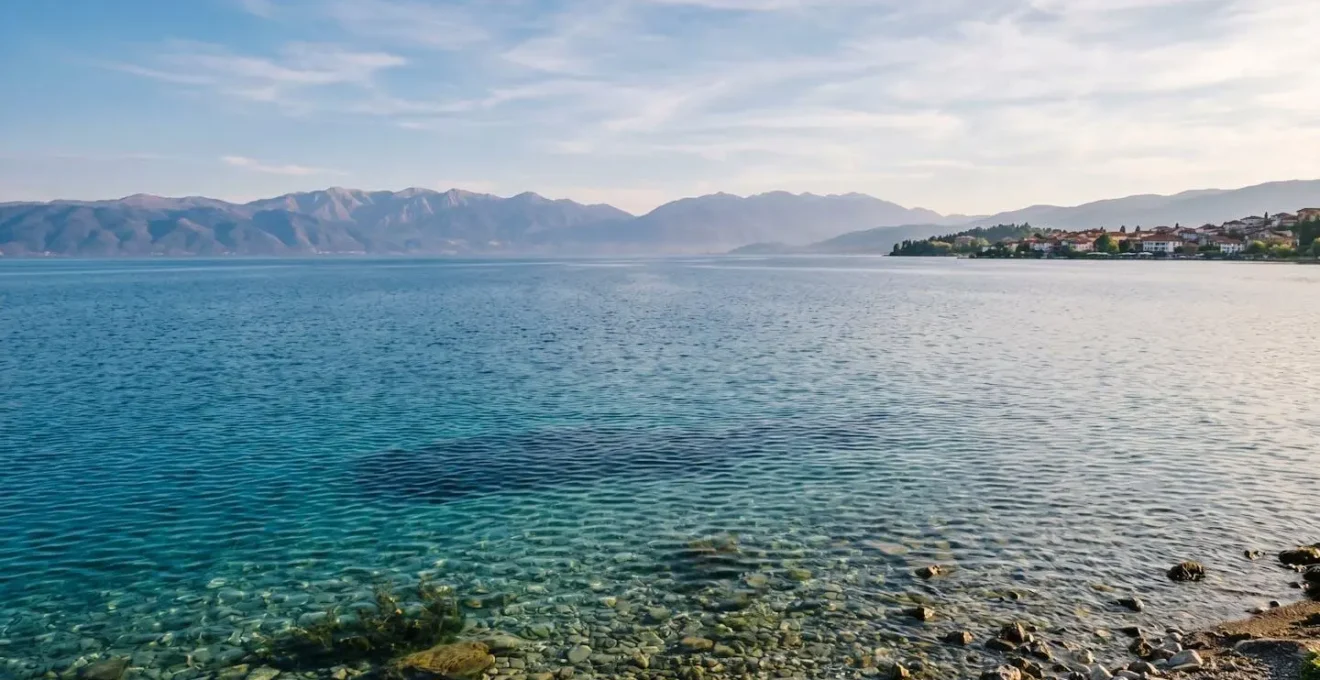
Lake Ohrid’s UNESCO status isn’t just for its beauty; it recognizes the lake as a living evolutionary museum, one of the most important biological reserves in Europe.
- Its immense age and geological isolation have created a sanctuary for over 200 species found nowhere else on Earth, including prehistoric “living fossils.”
- Visiting responsibly means moving beyond generic eco-advice to actively protecting its unique, fragile biology from modern threats like chemical pollution and habitat disturbance.
Recommendation: Treat your visit not as a vacation, but as a temporary guardianship. Your every action, from the sunscreen you wear to the boat tour you choose, directly impacts a globally significant, ancient ecosystem.
When you first lay eyes on Lake Ohrid, the word “ancient” feels viscerally true. Nestled between the mountains of North Macedonia and Albania, its vast, impossibly clear waters seem to hold stories from the dawn of time. It’s no surprise this is a UNESCO World Heritage site. Most guides will tell you it’s for the stunning Byzantine churches, the charming old town, or the simple fact that it’s one of Europe’s oldest and deepest lakes. While true, this barely scratches the surface. As a biologist who has spent countless hours studying its ecosystem, I can tell you the real reason for its protected status is far more profound and fragile.
The common advice for responsible tourism—”don’t litter,” “respect the culture”—is essential, but for Ohrid, it’s dangerously incomplete. This isn’t just another beautiful destination; it is a living laboratory for evolution. The true value of Ohrid lies beneath the surface, in its unique chemistry and in the strange and wonderful life forms that have been evolving in isolation for over a million years. But what if the very things we do to enjoy its beauty—swimming with sunscreen, taking a standard boat tour, seeking out the perfect photo—are inadvertently threatening the very essence of its UNESCO designation?
This guide offers a different perspective. We will move beyond the platitudes to explore the scientific “why” behind responsible tourism at Lake Ohrid. We will uncover the secrets of its age, the vulnerability of its most famous inhabitants, and how you can actively participate in its preservation. This is your guide to visiting Ohrid not just as a tourist, but as an informed guardian of one of the planet’s most precious natural heirlooms.
To help you navigate this unique ecosystem, we’ve structured this guide to explore the lake’s geological origins, its singular biodiversity, and the practical steps you can take to ensure your visit supports, rather than subverts, its conservation.
Summary: A Deeper Dive Into Lake Ohrid’s UNESCO Heritage
- Why Is Lake Ohrid Considered One of the Oldest Lakes in Europe?
- How to Choose an Eco-Friendly Boat Tour on Lake Ohrid?
- Lake Ohrid vs Lake Como: Which Offers a Better Cultural Experience for Less?
- The Swimming Mistake That Could Disturb the Endemic Ohrid Trout
- Where to Find the Best Sunset Spot Overlooking the Church of St. John at Kaneo?
- Why Is Lake Ohrid Considered One of the Oldest Lakes in Europe?
- Why Is the Flora of Galicica Considered Unique in Europe?
- Which National Park in North Macedonia Fits Your Hiking Style?
Why Is Lake Ohrid Considered One of the Oldest Lakes in Europe?
The term “ancient lake” is often used in travel brochures, but for Lake Ohrid, it’s a profound geological reality that underpins its entire existence. Unlike most of the world’s lakes, which are relatively fleeting phenomena formed by glacial activity and disappearing within millennia, Ohrid is a tectonic lake. It was born from a dramatic sinking of the earth’s crust, a process that began long before the Ice Ages shaped the rest of the continent. Scientific research using sediment core drilling has confirmed the lake has a continuous history stretching back at least 1.3 million years, a fact that makes it a “living museum” of geological and evolutionary history.
This immense age and stability are the first pillar of its UNESCO status. While glaciers scoured and reshaped other parts of Europe, Lake Ohrid remained a stable, isolated sanctuary—a geological refugium. Its formation is tied to the movement of tectonic plates, creating a deep, graben-style basin that continues to slowly deepen today. The lake is fed primarily by underwater springs, most notably the pristine waters that travel underground from the higher-elevation Lake Prespa through the limestone massif of Galičica Mountain.
This unique hydrogeology creates a closed, stable, and nutrient-poor (oligotrophic) environment. This very stability over such an immense timescale is the secret ingredient that allowed unique evolutionary processes to unfold, completely distinct from the rest of Europe. Its age is not just a number; it’s the foundational canvas upon which its unparalleled biological story is painted.
How to Choose an Eco-Friendly Boat Tour on Lake Ohrid?
Gliding across Lake Ohrid’s crystalline surface is a quintessential experience, but not all boat tours are created equal. From a biological standpoint, your choice of vessel and captain has a direct and measurable impact on the lake’s fragile health. The iconic clarity of Ohrid’s water is due to its oligotrophic state—it’s naturally low in nutrients, which prevents algal blooms. The exhaust fumes, oil residue, and noise from older, poorly maintained boat engines introduce pollution that threatens this delicate balance.
An eco-friendly tour prioritizes the lake’s health over speed or convenience. The gold standard is a tour in a traditional wooden boat, propelled by a silent electric motor or, for the most authentic experience, by oars. These methods eliminate chemical and noise pollution entirely. If choosing a motorized vessel, it’s crucial to ask about the engine. Modern 4-stroke engines are significantly cleaner and quieter than the highly polluting 2-stroke engines still used by some operators. A responsible captain will be proud to discuss their equipment and their commitment to conservation.
Furthermore, a truly “eco” tour is also educational. The best guides are passionate locals who can point out not just the famous churches, but also the locations of critical underwater springs (visible as disturbances on the surface), the nesting sites of protected birds (from a respectful distance), and the history of the lake’s unique ecosystem. They are guardians of the lake’s story, not just its taxi drivers.
Choosing a small, family-run operation often means your money directly supports the local community and the preservation of traditional boat-building crafts. Before you step aboard, use a simple checklist to ensure you’re making a choice that honors the lake.
Your 5-Point Checklist for a Responsible Boat Tour
- Engine Inquiry: Ask the captain directly, “Is your engine electric or a 4-stroke?” Prioritize these over older, polluting 2-stroke models. A proud, responsible captain will welcome the question.
- Waste Policy: Visually confirm there is a bin on board and ask, “Where does the trash go?” The only correct answer is that all waste is brought back to shore for proper disposal.
- Wildlife Protocol: Inquire about their approach to nature. “How close do you get to bird nesting areas?” Ensure they commit to maintaining a respectful distance from wildlife.
- Local Ownership: Support smaller, locally-owned boats. Ask, “Is this a family business?” Your fee is more likely to stay within the community and support its heritage.
- Educational Value: Opt for insight over a simple ride. Ask, “Can you tell me about the lake’s ecosystem?” A knowledgeable guide enhances the experience and signals a deeper connection to the lake.
–
–
–
Lake Ohrid vs Lake Como: Which Offers a Better Cultural Experience for Less?
For travelers seeking a European lakeside escape, Italy’s Lake Como is often the default benchmark, synonymous with luxury, glamour, and celebrity villas. Lake Ohrid, while sharing a dramatic mountain-meets-water beauty, offers a profoundly different and, for many, more enriching cultural experience—at a fraction of the cost. The comparison is less about which is “better” and more about what kind of value you seek: polished luxury or raw, living history.
Where Como offers Renaissance grandeur and meticulously curated tourist experiences, Ohrid presents a tapestry of Byzantine history and deep-rooted spirituality that feels woven into the very stones of the city. This is not a polished theme park of the past; it’s a place where ancient traditions are still part of daily life. You can purchase an exquisite, handcrafted filigree pendant directly from an artisan whose family has practiced the craft for generations, hearing their personal story for less than the cost of a branded trinket in Bellagio.
The financial difference is stark, allowing for deeper cultural immersion. A full-day boat excursion exploring monasteries and fishing villages on Ohrid might cost what you’d pay for an hour on a water taxi in Como. A delicious dinner of fresh-caught Ohrid trout and local Vranec wine can be enjoyed for the price of a single aperitivo on the Italian shores. As the travel writers at Time Out aptly put it when highlighting Ohrid as an affordable alternative:
all without Lombardy’s staggering price tags
– Time Out Travel Writers, Time Out
This affordability isn’t about being “cheap”; it’s about accessibility. It allows for longer stays, more interactions with local businesses, and a journey focused on genuine connection rather than budget management. The following table, based on recent travel cost analyses, highlights this crucial difference in value.
| Experience Type | Lake Como (Italy) | Lake Ohrid (North Macedonia/Albania) | Value Difference |
|---|---|---|---|
| Upscale dinner for two | €80-€150+ | €22-€55 | 60-70% more affordable |
| Artisan handmade item | €100-€300+ (luxury brand boutiques) | €20-€80 (direct from local filigree artisan with personal story) | More personal connection, 70-80% lower cost |
| Full-day boat excursion | €80-€200 per person | €10-€25 per person | Fraction of the cost with similar scenic value |
| Beach lounger rental (full day) | €30-€60 | €4-€15 | 80-85% savings |
| Cultural atmosphere | Curated luxury, Renaissance grandeur, polished tourist experience | Living Byzantine history, spiritual depth, raw authenticity, fewer crowds | Different values: ‘less’ commercialization = ‘more’ genuine human connection |
| Visitor density | High commercialization, celebrity tourism hotspot | Eastern European popularity but internationally under-the-radar | Significantly less crowded, especially off-peak |
The Swimming Mistake That Could Disturb the Endemic Ohrid Trout
Plunging into the cool, clear waters of Lake Ohrid is an irresistible temptation on a warm day. However, for a biologist, this simple act is fraught with responsibility. You are not just entering a lake; you are entering the exclusive, ancient habitat of the Ohrid trout (Salmo letnica). This iconic fish is not just a local delicacy; it is an endemic relict, a species that has survived and evolved in this lake for over a million years. It is also, according to recent environmental reports, officially classified as an endangered species due to overfishing and habitat degradation.
The most significant mistake a swimmer can make is contributing to the chemical pollution of the trout’s environment. The biggest culprits are sunscreen, insect repellent, and body lotions. When you swim, these products wash off your skin and release a cocktail of chemicals into the water. In a vast ocean, this might be a drop in the bucket, but in a closed, oligotrophic lake system like Ohrid, the impact is magnified. These chemicals disrupt the water’s delicate chemistry, harm the microscopic organisms at the base of the food chain, and can directly affect sensitive species like the trout, particularly in their spawning areas.
The responsible approach is to minimize your chemical footprint completely. If you must use sunscreen, choose a biodegradable, reef-safe formula and apply it at least 30 minutes before swimming to allow it to bind to your skin. Better yet, opt for UV-protective clothing like a rash guard. Avoid wearing any insect repellent, perfume, or lotion when you plan to swim. By being mindful of what is on your skin, you are actively helping to protect the water quality that has sustained the Ohrid trout for millennia.
- Avoid critical spawning zones: Stay away from areas near river inlets (especially near the St. Naum springs) and underwater spring fields during the breeding season (October-February), where trout lay their eggs.
- Eliminate your chemical footprint: Use UV protective clothing or apply reef-safe, biodegradable sunscreen at least 30 minutes before entering the water.
- Skip the repellents and lotions: Never wear DEET-based repellents, perfumes, or body lotions that wash off and harm the lake’s delicate balance.
- Use designated swimming areas: Stick to established beaches rather than swimming near the rocky shorelines where trout often feed and seek shelter.
- Embrace the cold spots: When you swim through sudden temperature drops, you’re experiencing the vital underwater springs. Observe these areas but avoid lingering or kicking up sediment.
Where to Find the Best Sunset Spot Overlooking the Church of St. John at Kaneo?
The image of the 13th-century Church of St. John at Kaneo, perched precariously on a cliff above the turquoise lake, is the enduring symbol of Ohrid. Capturing it at sunset is a pilgrimage for photographers and romantics alike. But the “best” spot isn’t just about the perfect angle; it’s about finding a place where you can experience the moment with reverence and without contributing to the erosion and degradation of this sacred, historic site.
While many tourists crowd the small platform directly in front of the church, a more breathtaking and responsible vantage point exists. To find it, take the wooden boardwalk that winds along the cliff base from the old town towards Kaneo beach. Just before you reach the church, you’ll see a small, often overlooked dirt path that switchbacks up the forested hill behind the church. This path leads to a series of small, natural clearings in the woods above. From here, your view is elevated. You are looking slightly down at the church, with its terracotta roof and stone walls bathed in the golden hour light, set against the vast expanse of the lake and the distant, hazy silhouette of the Albanian mountains.
This spot is superior for several reasons. Firstly, it removes you from the crowds, allowing for a more contemplative, personal experience as the sky shifts from gold to lavender. Secondly, you are on a stable, forested hillside rather than the fragile cliff edge, minimizing your physical impact. From a biologist’s perspective, you’re also less likely to disturb the cliff-dwelling flora and fauna. The key is to stay on the established path and find a clearing that offers a view without needing to trample new ground. The most magical moments often come from the quiet anticipation, watching the light change and feeling the deep, peaceful history of the place settle around you.
Remember to bring a small flashlight for the walk back down after the last light has faded. The reward for your small effort is a view and an experience that feel truly earned—a private audience with one of the most beautiful scenes in the Balkans, enjoyed in a way that helps ensure it will be there for generations to come.
Why Is Lake Ohrid Considered One of the Oldest Lakes in Europe?
We’ve established that Lake Ohrid’s immense age is its defining characteristic. But the true miracle, and the second pillar of its UNESCO status, is not just that the lake survived, but what survived *within* it. Its long, uninterrupted history of geological isolation turned it into an evolutionary island. While the rest of Europe was subject to waves of extinction and migration, the species within Lake Ohrid were left to their own devices, evolving in splendid isolation for over a million years. The result is an explosion of unique life forms—a biodiversity hotspot of global significance.
This is where the term “living fossils” becomes a tangible reality. The lake is home to over 200 endemic species, meaning they are found here and nowhere else on the planet. This includes everything from microscopic diatoms and algae to worms, crustaceans, and, most famously, fish like the Ohrid trout. Many of these species are relicts from the Tertiary period, their closest relatives having gone extinct millions of years ago. The humble Ohrid sponge (Ochridaspongia rotunda) is one such example—a freshwater sponge that has remained virtually unchanged for 30 million years.
Each of these endemic relicts tells a story of survival. They are a living, breathing connection to a prehistoric world. Protecting Lake Ohrid, therefore, is not just about preserving a beautiful landscape; it’s about safeguarding a unique genetic library. It is a profound responsibility, as the extinction of an Ohrid-specific species is not a local loss, but a global one. The disappearance of even the smallest endemic snail means the final chapter of a multi-million-year evolutionary story has been erased forever. This is the heavy, beautiful weight that comes with its ancient heritage.
Key Takeaways
- Lake Ohrid is more than scenery; it’s a ‘living laboratory’ where 1.3 million years of uninterrupted evolution can be studied.
- Your personal impact is magnified here; the lake’s ‘oligotrophic’ (nutrient-poor) clarity is extremely sensitive to chemical inputs from sunscreen and pollution.
- The true value of an Ohrid visit lies in protecting its authenticity—choosing local, eco-conscious operators over convenient, potentially damaging alternatives.
Why Is the Flora of Galicica Considered Unique in Europe?
Looming between Lake Ohrid and its sister, Lake Prespa, is the imposing limestone ridge of Galičica National Park. To the casual observer, it’s a beautiful mountain. To a biologist, it is a crucial piece of the puzzle that makes this region so unique. The flora of Galičica is considered one of the most diverse in Europe for a reason rooted in a concept I call hydro-geological duality. The mountain acts as a massive climatic and biological barrier, creating two distinct worlds on its flanks.
As the official UNESCO documentation notes, this geographical feature is the key to its biodiversity. The western side, facing Lake Ohrid, enjoys a milder, quasi-Mediterranean climate influenced by the large body of water. The eastern side, facing the higher and more continental Lake Prespa, experiences harsher, colder conditions. This creates an incredible variety of micro-habitats in a very small area.
the mountain ridge of Galičica acts as a barrier, with its western flank influenced by Lake Ohrid’s quasi-Mediterranean climate and its eastern flank by Lake Prespa’s continental climate
– UNESCO Galicica National Park Documentation, Biodiversity Studies
Like the lake, the mountain also served as a critical Ice Age refugium. While glaciers covered much of Europe, the deep canyons and protected slopes of Galičica provided a sanctuary for plant species that went extinct elsewhere. This has resulted in a staggering concentration of plant life, with over 1,000 species recorded, many of which are endemic relicts from the Tertiary period. Walking its trails is like moving through a living botanical museum, where species from the Mediterranean, Central Europe, and Asia Minor coexist.
Case Study: Ramonda serbica, The Resurrection Flower of Galicica
Ramonda serbica, known locally as the ‘resurrection flower,’ exemplifies Galicica’s unique flora. This endemic plant possesses the extraordinary ability to survive complete dehydration—losing up to 95% of its water content—and revive fully within hours when moisture returns. Found clinging to the limestone cliffs and deep karstic canyons of Galicica, this species survived the Ice Ages in these protected micro-refugia when similar plants went extinct across Europe. Its survival strategy mirrors the resilience of the entire Galicica ecosystem: isolated, protected by geography, and adapted to extremes. The flower serves as a living metaphor for the park’s role as a ‘double refugium’—a sanctuary that protected species both from glacial advances and from human impact, creating Europe’s most diverse mountain flora within a remarkably small geographic area.
Which National Park in North Macedonia Fits Your Hiking Style?
While the Ohrid region is a world unto itself, North Macedonia’s commitment to conservation extends to other spectacular national parks, each offering a distinct personality for the avid hiker and nature lover. Choosing the right park depends on what you seek: solitude, family-friendly exploration, or deep scientific immersion. Galičica, with its unique flora and lake views, is the obvious choice for botany enthusiasts, but Mavrovo and Pelister offer equally compelling, yet different, experiences.
Mavrovo National Park is the largest of the three and is the realm of the solitude seeker. It’s a land of high-altitude ridges, vast alpine meadows, and the highest peaks in the country, including Mount Korab. This is the territory of the critically endangered Balkan lynx, and the park’s remoteness offers a sense of true wilderness that is hard to find in modern Europe. For those willing to tackle challenging trails, the reward is unparalleled solitude and dramatic, sweeping vistas.
In contrast, Pelister National Park is perfect for the family naturalist. It’s defined by its ancient Molika pine groves, a five-needle pine that is another Balkan endemic. The park features more accessible trails, including gentle paths leading to its famous glacial lakes, known as “Pelister’s Eyes.” It’s an ideal setting for educational nature walks, seasonal berry foraging, and introducing younger hikers to the joys of the outdoors in a less intimidating environment.
Each park has its own “Leave No Trace” focus, tailored to its specific ecosystem. In Mavrovo, it’s about maintaining a respectful distance from potential lynx habitats. In Pelister, it’s a zero-tolerance policy for waste around its pristine glacial lakes. And in Galičica, it’s the absolute necessity of staying on the trail to protect fragile endemic plants that may exist only in a few square meters of specific limestone soil. This comparative guide can help you match your hiking persona to the perfect park.
| Hiker Persona | Best Park Match | Signature Trail Experience | Hike with Purpose Add-On | Park-Specific Leave No Trace Focus |
|---|---|---|---|---|
| The Solitude Seeker (remote high-altitude, minimal crowds) | Mavrovo National Park | Remote ridges of Korab Mountain (2764m, highest in North Macedonia), pristine alpine meadows, Balkan lynx territory | Visit traditional ‘bačilo’ (shepherd mountain hut) for homemade cheese tasting, learn about transhumance culture | Wildlife distance protocol—maintain 100m from lynx habitat signs, stay on marked trails in lynx corridors |
| The Family Naturalist (gentle paths, accessible beauty) | Pelister National Park | Forest trails through ancient Molika pine groves, accessible paths to ‘Pelister’s Eyes’ glacial lakes (Big and Small Lake) | Seasonal wild berry foraging with local guide (blueberries, raspberries), nature identification walks | ‘Pack it in, pack it out’ rule strictly enforced at popular glacial lakes—zero waste tolerance in pristine alpine zone |
| The Botany & Geology Buff (unique ecosystems, scientific interest) | Galicica National Park | Karst limestone landscapes with 1000+ plant species, endemic flora micro-habitats, ridge trail between two ancient lakes (Ohrid and Prespa) | Guided endemic species identification walk, visit traditional village for insight into ethnobotanical plant uses | Stay strictly on trails to protect fragile karst flora—many endemic species exist only in specific limestone soil pockets |
Your visit to the Ohrid region is an opportunity to step into a deeper story. By understanding the science behind the beauty, your choices transform from simple tourist decisions into meaningful acts of conservation. You become a participant in the lake’s future, a guardian of its ancient past. Embrace this role. Ask questions, tread lightly, and carry the story of this living museum with you. The most valuable souvenir you can take from Lake Ohrid is a profound appreciation for its fragile, irreplaceable life, inspiring you to protect it for the next million years.