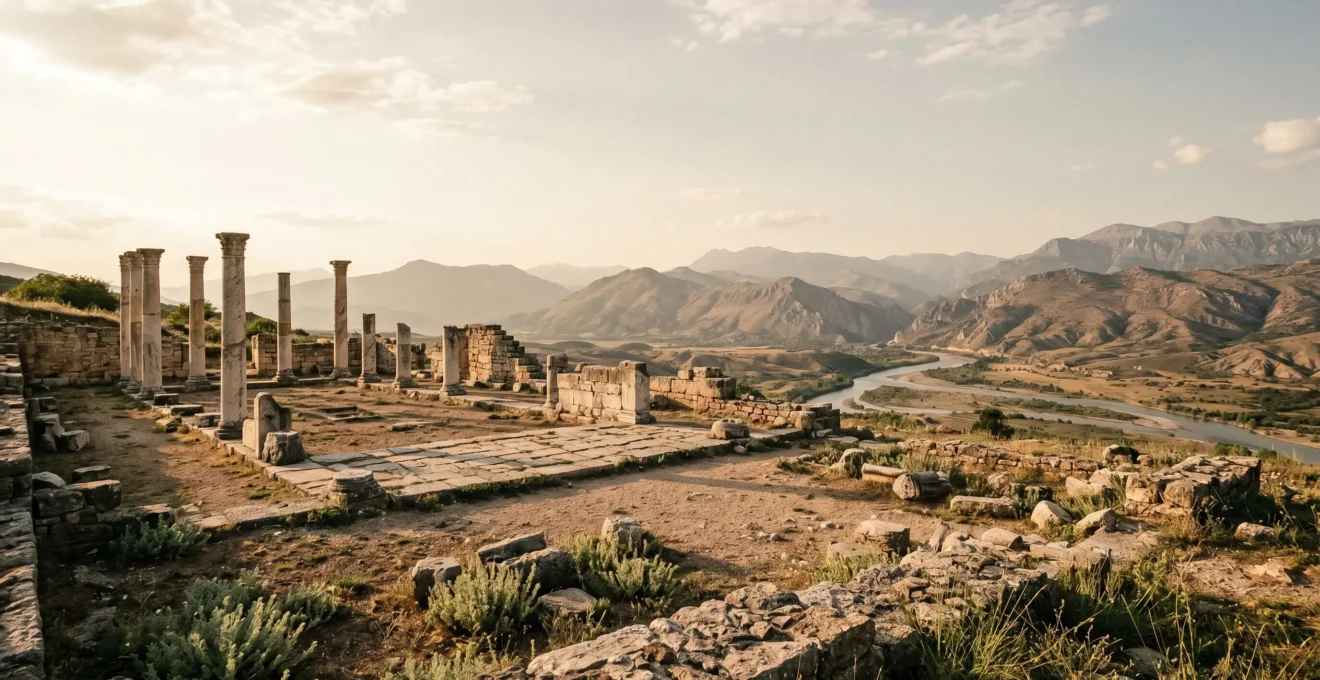
Viewing North Macedonia’s Roman ruins isn’t about just seeing them, but learning to *read* them.
- Each site, from the mighty Via Egnatia to Stobi’s urban layout, tells a strategic story that goes far beyond a simple collection of stones.
- Mosaics are not just art; they are complex texts of faith and craftsmanship that demand careful, informed viewing and ethical exploration.
Recommendation: Shift from a tourist’s mindset to a historian’s, using the practical frameworks in this guide to transform your visit into an intellectual expedition.
Standing amidst the sun-bleached stones of an ancient city in North Macedonia, one feels the profound weight of history. For the passionate enthusiast of antiquity, the experience is palpable. Yet, many travel guides offer little more than a checklist: see the theatre, photograph the columns, and move on. They tell you *what* to see, but rarely *how* to see it, leaving you with a collection of photos but a shallow understanding of the vibrant world that once thrived there. The common advice focuses on logistics—opening times and ticket prices—but overlooks the very essence of the place.
We are often told to “imagine what it was like,” but without the right tools, our imagination defaults to cinematic clichés of toga-clad senators. This approach misses the deeper narrative embedded in the very layout of the streets, the materials used in a rebuilt wall, or the symbolic menagerie laid out in a mosaic floor. What if the key to unlocking these sites wasn’t just to look, but to learn how to read them? What if you could decipher the story told by a paved road, a covered mosaic, or the confluence of two rivers?
This guide is built on that premise. It provides the intellectual framework to move beyond passive observation and engage in active interpretation. We will not simply list ruins; we will learn to analyze them. We’ll start with the grand strategic artery of the Via Egnatia that fed the region, then zoom into specific sites to practice our new skills. We will learn to make informed choices, protect the heritage we admire, and decode the artistic masterpieces that lie at our feet. By the end, you won’t just have visited Roman Macedonia; you will have begun to understand it.
This article provides a structured approach for the discerning traveler. Below is a summary of the key areas we will explore, designed to equip you with the perspective of a classical archaeologist on the ground.
Summary: A Scholar’s Itinerary to Roman Macedonia
- Why Was the Via Egnatia Crucial for the Roman Empire’s Expansion?
- How to Visit Scupi Archaeological Site Without a Guided Tour?
- Stobi or Heraclea: Which Roman Site Should You Prioritize on a Short Trip?
- The Walking Error That Damages Ancient Mosaics at Archaeological Sites
- When to Visit Stobi to Avoid the Blistering Midday Summer Heat?
- Why Are the Peacock Mosaics in Stobi Considered Masterpieces?
- When Are the Heraclea Mosaics Uncovered for Public Viewing?
- How to Plan a Day Trip to Stobi Archaeological Site from Skopje?
Why Was the Via Egnatia Crucial for the Roman Empire’s Expansion?
To understand the Roman presence in the Balkans, one must first understand the Via Egnatia. It was not merely a road; it was the primary artery of Roman military, commercial, and administrative power in the region. Built in the 2nd century BCE, it connected the Adriatic coast (at Dyrrachium, modern-day Durrës) to Byzantium (later Constantinople), serving as a land-bridge between Rome and its burgeoning eastern territories. This engineering marvel was the backbone of Roman expansion, enabling the rapid movement of legions to quell rebellions and secure frontiers. For a historian, its path is a map of Roman strategic priorities.
The sheer scale of the project underscores its importance. Historical records suggest the Via Egnatia covered approximately 1,120 kilometers (696 miles), a testament to the empire’s ambition and engineering prowess. Along its route, cities like Lychnidus (Ohrid), Heraclea Lyncestis, and Stobi flourished, transforming from local settlements into vital hubs of commerce and culture. They were the nodes on a network that transported not only goods and soldiers but also ideas, technologies, and beliefs. Tracing the remnants of the Via Egnatia today is to follow the very footsteps of Roman influence spreading across the peninsula.
For the modern explorer, identifying sections of this ancient highway offers a profound connection to the past. It’s an exercise in strategic topography, understanding why the road follows a particular valley or bypasses a certain mountain. Here is how you can trace its path through North Macedonia:
- Begin your exploration near the Lake Ohrid area, where the Via Egnatia passed through the ancient city of Lychnidus (modern Ohrid) after crossing the formidable Jablanica mountains.
- Visit Heraclea Lyncestis near Bitola, which was a major station, or mansio, on the route, boasting significant preserved infrastructure directly linked to the road.
- Discover the archaeological site of Stobi, strategically located at the confluence of the Vardar and Crna rivers, making it a critical trading hub that drew life from the Via Egnatia.
- For the truly dedicated, use detailed mapping apps to search for original paved sections near the ancient city of Philippi, where remnants of the Roman road are still visible.
How to Visit Scupi Archaeological Site Without a Guided Tour?
Visiting Scupi, the predecessor to modern Skopje, offers a fascinating lesson in what archaeologists call stratigraphic thinking—the ability to read the layers of a site to understand its history. A self-guided tour, armed with a little knowledge, can be more rewarding than a standard tour, as it trains your eye to spot the clues yourself. Scupi’s story is one of foundation, catastrophic destruction by an earthquake in 518 CE, and subsequent adaptation. The challenge and reward of a visit lie in identifying evidence of these distinct phases.
Your primary goal is not just to see the ruins, but to question them. As you walk through the Roman theater, look closely at the building materials. Are they uniform, or do you see recycled blocks, columns, and inscriptions embedded in later walls? This is tangible evidence of survivors rebuilding with salvaged materials after the earthquake. In the Christian basilica area, look for architectural transitions. Can you identify where a pagan temple might have once stood before being repurposed for the new faith? These are the silent stories that a trained eye can uncover. The remnants of water pipes from the ancient aqueduct are not just plumbing; they speak to the complex urban planning of a city supporting a large population.
To conduct your own archaeological survey of Scupi, follow this methodical approach:
- Getting There & Orientation: Take bus number 21 from the center of Skopje. After getting off at the last station, a 15-minute walk toward the local graveyard will lead you to the entrance. This short journey helps you appreciate the site’s location outside the modern city core.
- The Theater—A Lesson in Recycling: Start at the Roman theater. Your mission here is to find evidence of post-earthquake reconstruction. Look for mismatched stones and repurposed architectural elements in the orchestra section, a clear sign of hurried rebuilding.
- The Basilica—A Tale of Transition: Move to the Christian basilica area. Here, your focus should be on architectural clues that show the shift from paganism to Christianity. Look for floor plans that suggest an earlier structure was integrated into the church’s design.
- The Aqueduct—Engineering Lifeblood: Search for the terracotta remnants of water pipes near the residential quarter. Try to trace their path and imagine the complex system required to supply the city with fresh water.
- The Details—Beyond the Obvious: Finally, document the subtle details often missed: the specific style of column capitals (Doric, Ionic, Corinthian?), fragments of inscriptions, and different masonry techniques. These small elements are the vocabulary of Roman construction.
Stobi or Heraclea: Which Roman Site Should You Prioritize on a Short Trip?
For the traveler with limited time, choosing between Stobi and Heraclea Lyncestis can be a difficult decision. Both offer spectacular insights into Roman life in Macedonia, but they present very different experiences. The choice is not about which site is “better,” but which site better aligns with your specific interests as a historical explorer. Do you wish to understand the grand scale of Roman urban planning, or do you prefer an intimate encounter with world-class mosaic art? Answering this question is key to a satisfying visit.
Heraclea Lyncestis, near Bitola, is renowned for its breathtaking 6th-century mosaics in the Great Basilica. They are considered among the finest in the Balkans, so artistically and culturally significant they are featured on the national currency. The site is compact, easily digestible in an hour or two, making it perfect for art history enthusiasts and those who appreciate intricate detail. Its well-preserved theater also adds to its charm. However, much of its urban fabric remains unexcavated.
Stobi, on the other hand, is all about scale and context. As a sprawling city of immense strategic and commercial importance at a river confluence, it offers a more complete picture of Roman urban life. With its extensive street grid, residential quarters, multiple basilicas, and a large theater, Stobi allows you to wander and feel the layout of an entire ancient metropolis. While its mosaics are also magnificent, particularly the famous peacock motifs, the primary allure of Stobi is the immersive experience of a large, complex archaeological park. It rewards those who are fascinated by urban planning, social structure, and the sheer logistics of ancient city life.
To aid your decision, consider this matrix, which frames the choice based on different traveler profiles and priorities. This approach allows you to select the site that will provide you with the most intellectually stimulating experience.
| Criterion | Stobi | Heraclea Lyncestis |
|---|---|---|
| Best for Art History Enthusiasts | Episcopal Basilica mosaics, peacock motifs | ⭐ Great Basilica’s 6th-century mosaics (on 5,000 denar note) |
| Best for Urban Planning Buffs | ⭐ Extensive street layout, 25,000 sqm excavated area, residential quarters | Compact site, limited urban infrastructure visible |
| Best for Photographers | ⭐ Sunset views at river confluence, dramatic columns, less crowded | Well-preserved theater, intimate mosaic close-ups |
| Best for Families with Kids | ⭐ Explorable theater, ‘prison’ ruins, larger site for wandering | Shorter visit (1 hour), easier navigation, less walking |
| Off-Season Advantage | ⭐ Always visible – theater, columns, mosaics under shelters | Mosaics covered with sand Nov-Apr for freeze protection |
| Distance from Skopje | 80 km south (1 hour) | 170 km south (2.5 hours via Bitola) |
| Visit Duration | 2-3 hours recommended | 1-1.5 hours sufficient |
The Walking Error That Damages Ancient Mosaics at Archaeological Sites
It is perhaps the most common and heartbreaking mistake made by well-intentioned visitors at archaeological sites: walking directly on exposed ancient mosaics. What seems like a harmless act, a desire to get a closer look, is in fact a significant contributor to the irreversible destruction of these fragile masterpieces. Understanding the science behind this damage is the first step toward practicing ethical exploration and becoming a true custodian of the heritage you have traveled so far to admire. The issue is not one of a single footstep, but of the cumulative effect of thousands.
The damage occurs on a microscopic level. Each step, no matter how light, exerts pressure on the delicate tesserae (the small cubes of stone or glass). This pressure weakens the ancient mortar bed that has held them in place for centuries. Vibrations travel through the floor, further loosening adjacent tesserae. Over time, this leads to dislodged pieces that can be inadvertently kicked away and lost forever. Furthermore, substances from our footwear—dirt, oils, and chemicals—can stain and accelerate the chemical deterioration of the stones and pigments.
Case Study: The Cumulative Impact of Foot Traffic
A 2021 heritage management study analyzing tourism impacts on archaeological sites provides the scientific backing for these warnings. The research documented that foot traffic is a primary cause of cumulative damage to mosaic tesserae, not through single catastrophic events, but through persistent pressure and vibration. The study highlights that many visitors are simply unaware of the damage they cause, underscoring the need for clear communication. Conservation professionals stress that archaeological sites have a “carrying capacity”—a maximum number of visitors they can sustain before serious, permanent damage occurs to these irreplaceable materials.
Adopting a code of conduct is not about limiting your experience, but enhancing it by ensuring these wonders survive for future generations. It shifts your role from a passive consumer to an active participant in preservation.
Your checklist for ethical exploration
- Never walk directly on exposed mosaics—always use the designated walkways and observation platforms, even if it means a less direct photo.
- Avoid using a camera flash when photographing mosaics. The cumulative effect of thousands of intense light bursts can contribute to the fading of ancient pigments over decades.
- Refrain from leaning on ancient walls or columns for support or for a photo. Your body weight applies structural pressure that can destabilize fragile, ancient masonry.
- Keep tripods and selfie sticks collapsed or in your bag when near delicate surfaces to prevent accidental scratches, chips, or impacts.
- Practice non-invasive photography: use a telephoto lens to capture stunning details from a safe and respectful distance, preserving the integrity of the site.
When to Visit Stobi to Avoid the Blistering Midday Summer Heat?
A successful archaeological expedition is as much about planning and logistics as it is about historical knowledge. At a sprawling, exposed site like Stobi, one of the most critical logistical factors is the sun. The intense Balkan summer heat can be more than just uncomfortable; it can be dangerous and can cut your exploration short. Visiting during the midday peak in July or August means contending with temperatures that can easily soar above 35°C (95°F), making it impossible to fully appreciate the site. A strategic approach to timing is therefore essential.
The ideal time to visit Stobi is during the spring (April-May) and autumn (September-October) shoulder seasons. During these months, the weather is typically pleasant, and the landscape is often greener and more beautiful. According to experienced travelers who know the site well, the ideal temperature range at Stobi is between 15-22°C (59-72°F), which allows for hours of comfortable walking and exploration. If you must visit during the summer, planning your day around the sun’s movement is not just a suggestion—it’s a necessity for a successful trip.
A heat-evasion itinerary involves treating the site’s geography and structures as tools for climate control. Shaded areas, covered mosaic houses, and the on-site museum become strategic retreats during the hottest parts of the day. This is not about seeing less; it’s about seeing the site intelligently. Here is a proven itinerary for a summer visit:
- 8:00-10:00 AM (Cool Start): Begin your day in the most exposed eastern section of the site. Explore the Roman Theater and the expansive, open basilica complexes while the morning temperatures are still comfortable.
- 10:00-11:30 AM (Seeking Shade): As the sun climbs, move toward the partially shaded areas. This is the perfect time to visit the Episcopal Residence and the House of Parthenius, where the magnificent mosaics are protected under modern shelters.
- 11:30 AM-1:00 PM (Structural Retreat): Head to the Theodosian Palace area, which offers more structural shade from its remaining walls. You can also explore the small on-site museum during this time.
- 1:00-3:00 PM (Peak Heat—Strategic Rest): This is the hottest period. Retreat to the visitor center café. Rehydrate (it is crucial to bring at least 2 liters of water per person), review your site map, and plan the final phase of your visit.
- 3:00-5:00 PM (Golden Hour Exploration): As the heat subsides and the afternoon light softens, venture out again. This is the best time to photograph the “prison” structure and the Synagogue Basilica. End your day by capturing the sunset over the river confluence.
Why Are the Peacock Mosaics in Stobi Considered Masterpieces?
Within the ruins of Stobi’s Episcopal Basilica lies one of the great treasures of Late Roman art: the peacock mosaics. To the casual observer, they are beautiful decorative elements. To the historian, they are a profound text, rich with the symbolic language of Early Christianity. To dismiss them as mere decoration is to miss their true genius. Their status as masterpieces derives from a perfect synthesis of three elements: technical virtuosity, rich iconography, and their role within the sacred space they adorn.
The technical skill, known as opus tessellatum, is breathtaking upon close inspection. The artists used thousands of tiny, hand-cut cubes of stone and glass in a surprisingly varied palette to create flowing lines and subtle gradations of color. This wasn’t simply coloring by numbers; it was painting with stone, creating effects of light, shadow, and texture that give the animals and geometric patterns a vibrant, lifelike quality. The sheer labor involved speaks to the immense resources and importance of the basilica.
However, it is the iconography that elevates the mosaics from craft to high art. The peacock, the central motif, was a powerful and widely understood symbol in Early Christian thought. Drawing on older pagan beliefs that the peacock’s flesh did not decay, Christians adopted it as a potent symbol of immortality and resurrection. A pair of peacocks drinking from a kantharos (a large two-handled cup) symbolized believers partaking in the Eucharist and gaining eternal life. Flanked by deer, birds, and intricate geometric patterns, these peacocks were not just fauna; they were a sermon in stone, a constant visual reminder to the faithful of the core tenets of their new religion. They transformed the floor of the basilica into a symbolic paradise, a foretaste of the eternal life promised to believers.
When Are the Heraclea Mosaics Uncovered for Public Viewing?
The magnificent floor mosaics of Heraclea Lyncestis present a unique challenge for the traveler: their visibility is not guaranteed. For conservation reasons, these 6th-century masterpieces are often covered with a protective layer of sand during the winter months, typically from November to April. This practice is essential to shield the delicate tesserae and their ancient mortar bed from the destructive freeze-thaw cycle of Balkan winters. While this is a responsible act of preservation, it can lead to disappointment for unaware visitors. The key is to have a strategy for confirmation before you go.
The cultural significance of these mosaics cannot be overstated. The central panel of the narthex of the Great Basilica, depicting a complex Christian allegory with deer, trees, and birds centered on a Eucharistic kantharos, is a national treasure. In fact, its importance is so profound that the Great Basilica’s 6th-century mosaic is so culturally significant that it appears on the 5,000 Macedonian denars banknote. This is the ultimate testament to its value in the nation’s historical identity, making a successful viewing all the more rewarding. Relying on outdated guidebook information is a recipe for failure; a real-time information strategy is required.
Here is a five-step plan to maximize your chances of seeing the Heraclea mosaics in their full glory:
- Social Media Reconnaissance: Before your trip, search for the “Heraclea Lyncestis” location tag on Instagram and other social platforms. Recent photos posted by other visitors are the most reliable, real-time indicator of whether the mosaics are currently exposed.
- Consult the Travel Community: Check recent posts on online travel forums like TripAdvisor or the Lonely Planet Thorn Tree. Post a question or look for trip reports from travelers who have visited within the last few weeks. The community is often eager to share up-to-date conditions.
- Go to the Local Source: Email or call hotels or established tour operators in the nearby city of Bitola. They are in a prime position to have current, accurate information directly from the site.
- Understand the “Why”: Internalize that the sand covering is not an inconvenience, but a crucial conservation technique. Understanding this helps manage expectations and fosters an appreciation for the preservation efforts.
- Develop a Plan B: If you confirm the mosaics are covered, do not cancel your visit. Heraclea has much more to offer. Focus your attention on the remarkably well-preserved Roman theater, hunt for Latin and Greek inscriptions on stone blocks, and plan a visit to the Bitola Museum, which houses many artifacts excavated from the site.
Key takeaways
- To truly understand the Roman sites in North Macedonia, one must first grasp the strategic importance of the Via Egnatia, the road that gave them life and purpose.
- Prioritize your visit between Stobi and Heraclea based on your specific historical interests—urban planning versus mosaic art—rather than convenience alone.
- Embrace the role of a custodian by practicing ethical exploration, most importantly by understanding the scientific reasons why you must never walk on ancient mosaics.
How to Plan a Day Trip to Stobi Archaeological Site from Skopje?
Planning a day trip from Skopje to Stobi is an excellent way to immerse yourself in North Macedonia’s Roman past. Located just 80 kilometers south via the modern A1 motorway (approximately a 1-hour drive), the site is easily accessible. However, a truly memorable trip goes beyond simple transportation. By framing your day trip around a specific theme or “research question,” you can elevate the experience from a simple outing to a focused exploration. This approach allows you to connect Stobi to the wider historical and cultural landscape of the region.
Instead of a single, one-size-fits-all itinerary, consider which narrative you wish to follow. Are you interested in the region’s ancient and modern role in winemaking? Or perhaps you want to compare Roman architectural styles across different sites? Thinking thematically makes the journey as meaningful as the destination. For transportation, hiring a private taxi for the day (negotiable around €60-80) offers maximum flexibility and the potential for a driver who can share local historical context. Alternatively, the public bus system offers a more adventurous and budget-friendly option.
Here are three themed day trip itineraries from Skopje to inspire your planning:
- Route 1 – The “Wine & Ruins” Itinerary: This classic pairing connects Stobi’s ancient history with the Tikveš wine region it sits in. Depart Skopje at 8 AM to arrive at Stobi for a morning exploration (9:30 AM-12:00 PM). Afterward, proceed to a local winery like Tikveš Vineyards for a traditional lunch and a tasting of regional grape varieties like Vranec and Smederevka. This route explores the continuity of agriculture and culture from antiquity to the present day.
- Route 2 – The “Roman Immersion” Itinerary: For the dedicated archaeology buff, combine a morning at Stobi with an afternoon visit to the fortress site of Bargala, located east of Štip. This allows for a comparative study of two major sites, both featuring significant Early Byzantine mosaics, but with very different settings and layouts.
- Route 3 – The “Via Egnatia Trail” Itinerary: This route focuses on Stobi’s role as a major hub on the great Roman road. Drive south on the A1, making stops to view any visible sections of the original Roman road near the Gradsko junction. After exploring Stobi, those with ample time and energy could even continue south to Heraclea Lyncestis to see another major point on the Via Egnatia, possibly staying overnight in Bitola.
Armed with this new perspective on how to read the landscape, interpret the art, and plan your movements, your journey into North Macedonia’s ancient past will not be just a visit, but a true intellectual expedition. The stones have stories to tell, and now you have the tools to listen.