The true Ottoman legacy in North Macedonia isn’t just in its monuments, but in the invisible socio-economic systems that still organize daily life.
- Urban spaces like the Old Bazaar follow an organic, human-scale logic of Ottoman guild systems, contrasting sharply with modern monumentalism.
- Cultural identity is deeply infused with Turkish loanwords for concepts of commerce, daily life, and even specific emotions like merak.
Recommendation: To truly understand the country, learn to recognize these foundational patterns in everything from architecture and food to social interactions.
For the first-time visitor to Skopje, the capital of North Macedonia, the city presents a striking paradox. Crossing the iconic Stone Bridge from the monumental, neo-classical grandeur of Macedonia Square into the Old Bazaar (Čaršija) feels like stepping through a portal in time. The scale shifts from colossal statues to human-sized alleyways; the materials from polished marble to weathered cobblestone and timber. Many travelers recognize this as the “Ottoman part” of the city, a living museum preserved from an empire that ruled this region for centuries. The influence seems obvious—in the minarets that dot the skyline, the scent of grilled kebabs, and the intricate patterns of filigree jewelry.
However, focusing only on these visible artifacts is to see merely the surface of a much deeper cultural inheritance. The common understanding often stops at listing shared foods like burek or noting architectural styles. But what if the most profound legacy of the Ottoman era isn’t in the stones of its mosques, but in the invisible social and economic software that continues to run beneath modern Macedonian life? The real key to understanding this influence lies not in what the Ottomans built, but in *why* and *how* they built it—the logic of their urban planning, the structure of their commercial guilds, and the very concepts they introduced to the local language to describe the world.
This analytical guide moves beyond a simple travelogue. It deconstructs the Ottoman blueprint that shaped modern North Macedonia. We will explore the socio-economic reasons behind architectural forms, identify the systemic Turkish influence in culinary traditions, decode the linguistic borrowings that color daily speech, and trace the physical and cultural pathways of the empire’s legacy. This is a journey into the foundational DNA of a nation, revealing how a 500-year history continues to define its present.
The following sections provide a structured analysis for the curious traveler, breaking down the key pillars of this enduring Ottoman influence. Each part is designed to equip you with the knowledge to see beyond the picturesque and understand the intricate systems at play.
Summary: The Ottoman Blueprint in North Macedonia
- Why Do Ottoman Houses in Ohrid Have Wider Upper Floors?
- How to Identify Turkish Influence in Traditional Macedonian Dishes?
- Must-Visit Mosques: Which Ones Are Open to Non-Muslim Tourists?
- The Common Words Error: Which “Macedonian” Phrases Are Actually Turkish?
- How to Trace the Ottoman Footsteps from Skopje to Bitola efficiently?
- How to Identify Turkish Influence in Traditional Macedonian Dishes?
- Why Is the Architecture of Skopje Old Bazaar So Different from the City Center?
- How to Navigate Skopje Old Bazaar Without Falling for Tourist Traps?
Why Do Ottoman Houses in Ohrid Have Wider Upper Floors?
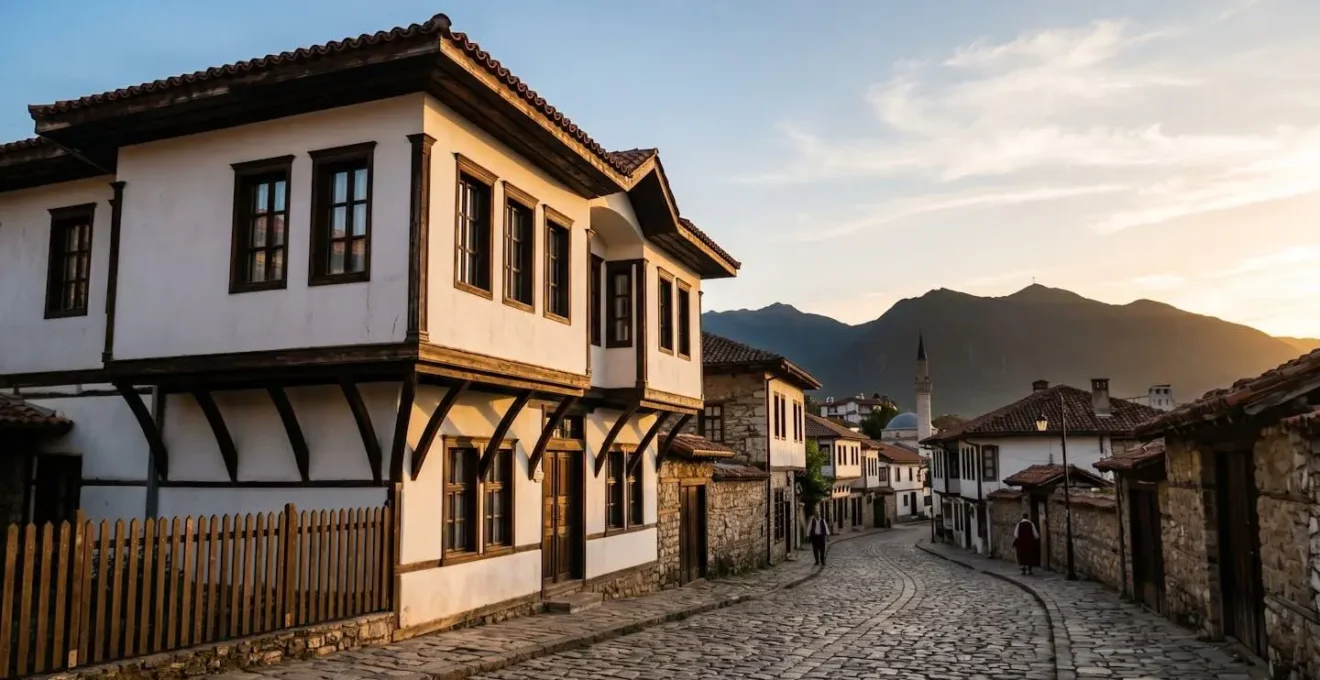
The characteristic architecture of old Macedonian towns like Ohrid, with upper floors projecting over the narrow streets below, is not merely an aesthetic choice. It is a direct physical manifestation of Ottoman urban, social, and economic principles. During the empire’s rule, which spanned over 500 years from the late 14th century to 1913, urban planning was organic. Streets were narrow, winding, and followed the natural topography. This efficient use of space was crucial, especially on hillsides like those in Ohrid.
The wider upper floors, known as ‘cumba’ or bay windows, were an ingenious solution to a multi-faceted problem. Firstly, property taxes were often calculated based on the ground-floor footprint of a building. By cantilevering the upper stories, a family could maximize their living space without increasing their tax burden. Secondly, it provided a social function. The enclosed upper levels offered privacy for the family, particularly the women of the household, while the projecting windows still allowed them to observe the life of the street below. This separation of public (street) and private (home) space was a core tenet of Ottoman residential design.
This paragraph introduces the concept of the Ottoman house’s projecting upper floors. To fully appreciate the engineering and texture of this design, the following image provides a detailed view.
As the image illustrates, the use of timber framing was essential for this cantilevered construction. The structural design created a distinctive urban landscape of covered passages and intimate, shaded streets, a stark contrast to the wide, open boulevards of modern city planning. This architectural signature is a direct result of a pragmatic response to the legal, social, and geographical constraints of the time.
Case Study: The Robevi House, Ohrid
The Robevi House (1863-1864) in Ohrid is a prime example of this architectural logic. Now housing the National Museum, this wealthy merchant’s residence showcases the quintessential Ottoman residential style. Its multi-story timber construction features prominent overhanging upper floors and an enclosed courtyard. The design reflects the need to build on a limited hillside plot, which led to the creation of narrow streets, some of which are even covered by houses built directly overhead, forming unique tunnel-like passages that are a hallmark of the old town.
How to Identify Turkish Influence in Traditional Macedonian Dishes?
The connection between Macedonian and Turkish cuisine goes far deeper than the shared presence of dishes like kebabs and baklava. The Ottoman legacy is embedded in the fundamental culinary techniques and flavor profiles that define the region’s gastronomy. To the analytical eye, this influence is a system, not just a list of borrowed recipes. It can be identified by looking for specific preparation methods that were disseminated throughout the empire.
One key marker is the method of slow-cooking in earthenware vessels. The iconic Macedonian dish tavče gravče (baked beans) is a perfect example; its name derives from the clay pot, or tavče, it is cooked in, which itself comes from a Turkish word. Another hallmark is the use of layered filo pastry, a technique central to Ottoman baking, evident in savory pies like burek and zelnik. The widespread practice of charcoal grilling for meats (skapara) and the classic pairing of tangy yogurt with grilled or slow-cooked meats are also direct imports from Ottoman culinary culture. Finally, the prevalence of sweets featuring walnuts or pistachios in a sugar syrup, such as baklava and tulumba, makes the link undeniable.
Beyond the food itself, the rituals surrounding consumption also carry a heavy Ottoman imprint, particularly concerning coffee. As Wikipedia contributors note in an article on Macedonian cuisine:
Coffee has played an important role in the lifestyle and culture of the region. The serving and consumption of coffee has had a profound effect on betrothal and gender customs, political and social interaction, prayer, and hospitality customs.
– Wikipedia contributors, Macedonian cuisine article on Wikipedia
This demonstrates that the influence extends from the kitchen into the very fabric of social life, turning food and drink into a medium for cultural expression.
Must-Visit Mosques: Which Ones Are Open to Non-Muslim Tourists?
The mosques of North Macedonia are among the most visible and significant monuments of the Ottoman period. For the non-Muslim traveler, they are not only accessible but also offer profound insights into the empire’s religious, social, and artistic life. Generally, most historic mosques are open to visitors outside of prayer times. Key sites include the Mustafa Pasha Mosque in Skopje, a classic example of 15th-century Ottoman architecture, and the Painted Mosque in Tetovo, which is celebrated for its unique and vibrant decorations.
The Mustafa Pasha Mosque, built in 1492, represents the grand, imperial style, with its large dome, slender minaret, and elegant portico. It stands as a testament to the early establishment of Ottoman power in the region. In contrast, the Painted Mosque in Tetovo offers a lesson in cultural syncretism.
Case Study: The Painted Mosque of Tetovo (Šarena Džamija)
The Painted Mosque, originally built in 1438 and reconstructed in 1833, is an anomaly in the world of Ottoman religious architecture. Its exterior and interior walls are covered in vibrant, intricate paintings featuring floral, geometric, and even landscape motifs. This decorative scheme is a departure from traditional Ottoman design, showcasing a remarkable blend of Ottoman and European Baroque influences, likely executed by local artists. It demonstrates how the empire’s structures often adapted to and incorporated local artistic traditions, creating unique hybrid styles rather than imposing a monolithic aesthetic.
When visiting these sacred spaces, observing proper etiquette is essential for a respectful experience. These guidelines are not just about rules, but about understanding the space’s function as an active place of worship.
Action Plan: Respectful Mosque Visitation
- Timing is key: Plan your visit between prayer times. The best windows are typically from 8 am to 12 pm or from 1:30 pm to 3:30 pm to avoid disrupting worship.
- Dress for respect: Modest dress is required. Ensure your shoulders and knees are covered. Women must also cover their hair; it is wise to bring your own scarf as not all mosques provide them.
- Footwear protocol: Shoes must be removed before entering the prayer hall. Wearing slip-on shoes makes this process much easier.
- Maintain a quiet demeanor: Inside the prayer halls, speak in whispers or remain silent, as individuals may be praying at any time.
- Understand the context: Recognize that the mosque was often the center of a pious foundation (waqf), a complex that could include a school (madrasa), library, or public kitchen, serving the entire community.
The Common Words Error: Which “Macedonian” Phrases Are Actually Turkish?
One of the most profound and intimate forms of Ottoman influence is linguistic. The Macedonian language is saturated with Turkish loanwords (Turkisms), which have been so thoroughly integrated that many speakers do not perceive them as foreign. This goes far beyond food items; these words structure the language of commerce, daily life, and even abstract emotional concepts. As academic researchers from a study on the subject state, “All the Balkan languages, especially the Macedonian language, enriched their lexical fund with a large number of Turkish loanwords” across all domains of life.
Recognizing these words is like uncovering a hidden layer of history in everyday conversation. For instance, the word for market, pazar, is Turkish, as are the words for a shop (dükkân) and a tradesman or guild (esnaf). This reflects the Ottoman introduction of a structured bazaar economy. In the home, words like avlija (courtyard) and sokak (street or alley) are of Turkish origin. The influence is perhaps most subtle and powerful in abstract concepts. The word merak describes a unique feeling of blissful, leisurely enjoyment, while sevdah denotes a state of passionate longing or melancholy—emotions for which the Slavic lexicon had no direct equivalent.
This linguistic heritage is written not just in dictionaries but also into the very architecture and signage of historic districts, where the visual culture reflects this fusion.
A systematic way to identify these loanwords is to group them by theme. Doing so reveals the specific areas of life where Ottoman systems had the most impact:
- Commerce & Crafts: ‘pazar’ (market), ‘dükkân’ (shop), ‘esnaf’ (guild/tradesman)
- Home & Daily Life: ‘čaška’ (cup), ‘avlija’ (courtyard), ‘sokak’ (street/alley)
- Food & Drink: ‘burek’ (filled pastry), ‘čorba’ (soup), ‘rakija’ (brandy), ‘kafe’ (coffee)
- Abstract Concepts: ‘merak’ (blissful enjoyment), ‘sevdah’ (passionate longing), ‘inat’ (stubborn pride)
- Architecture: ‘cumba’ (bay window), ‘sahat-kula’ (clock tower), ‘han’ (caravanserai)
How to Trace the Ottoman Footsteps from Skopje to Bitola efficiently?
Tracing the Ottoman legacy across North Macedonia can be done efficiently by following the old imperial trade and military routes. A journey from Skopje to Bitola, with a key detour to Tetovo, creates a logical and historically rich itinerary. This route connects the former administrative and commercial hubs of the empire in the region, revealing a network of interconnected sites rather than isolated monuments.
A practical, multi-day approach allows for an in-depth exploration. Begin in Skopje’s Old Bazaar (Čaršija), the largest and most well-preserved in the Balkans. Dedicate a day to exploring its network of streets, which are still organized by the old guild system. Here you can find the Mustafa Pasha Mosque (1492) and several historic hans (caravanserais) like the Kapan Han and Suli An, which once provided lodging and security for traveling merchants. These structures were the backbone of Ottoman commerce.
From Skopje, a day trip to nearby Tetovo is essential. This allows a visit to the aforementioned Painted Mosque and the Arabati Baba Tekke, a sprawling dervish monastery founded in 1538. This complex is one of the best-preserved examples of a Sufi lodge in Europe and provides a window into the mystical dimensions of Ottoman Islam. The final leg of the journey leads to Bitola, known during the Ottoman era as the “City of Consuls.” Here, the influence is more 19th-century, seen in the elegant townhouses along the Širok Sokak pedestrian boulevard. Heritage records document over 500 Ottoman-era houses from the 19th and early 20th century in Bitola, showcasing a later, more European-influenced imperial style. It was also a key military center, home to the academy where Mustafa Kemal Atatürk, the founder of modern Turkey, studied.
Between these cities, a traveler should look for the remnants of Ottoman infrastructure that tied the empire together: stone bridges (kameni most), clock towers (sahat-kula) to standardize prayer times, and the ruins of other hans along the old roads.
How to Identify Turkish Influence in Traditional Macedonian Dishes?
While the previous section identified Ottoman influence through specific cooking techniques, a deeper level of analysis involves understanding the culture and context of consumption. The Ottoman legacy is not just in how food is made, but where it is eaten, when, and with whom. To truly identify this influence, one must move from the kitchen into the social arena of the čaršija (bazaar), the han (inn), and the home.
The first step is to look for establishments that specialize in a single type of dish, a practice rooted in the Ottoman guild system (esnaf). Instead of a restaurant with a vast menu, seek out a kebabdžilnica (a shop specializing in kebabs) or a burekčilnica (a burek bakery). These specialized eateries are often family-run for generations and are where locals eat. This is a direct continuation of the Ottoman model where artisans and food producers were grouped by their specific craft.
The second step is to understand the social role of certain venues. The historic hans (caravanserais) in the bazaars, with their quiet inner courtyards, are the most authentic places to experience Turkish coffee (turksko kafe). The ritual of its preparation—slowly boiled in a copper pot (džezve)—and consumption is a social institution. It is an act of hospitality and a medium for conversation, a world away from a quick espresso. Experiencing coffee in this setting connects you directly to a centuries-old social tradition. Similarly, seeking out a traditional tea house (čajdžilnica) offers another glimpse into this leisurely, social pace of life inherited from the Ottoman era.
Finally, pay attention to the combination of flavors in a meal. The pervasive use of mint with meats, parsley as a garnish, and the inclusion of pickled vegetables (turšija) as a side to rich, fatty dishes are all part of the Ottoman flavor palate. It’s a system of balancing tastes that is consistently applied across many different dishes, revealing a coherent culinary philosophy.
Why Is the Architecture of Skopje Old Bazaar So Different from the City Center?
The dramatic architectural chasm between Skopje’s Old Bazaar (Čaršija) and its modern city center is the result of two distinct historical trajectories colliding at the Vardar River. The Čaršija is a product of 500 years of slow, organic Ottoman development, while the city center is a testament to two cataclysmic 20th and 21st-century events: a devastating earthquake and a controversial nation-building project.
The Old Bazaar’s layout is a direct reflection of Ottoman urban and commercial life. Its winding, narrow streets, low-rise buildings, and integrated spaces for crafts, commerce, and worship created a human-scaled, pedestrian-focused environment. The logic was functional and community-oriented, with guilds (esnaf) grouped together and life revolving around the mosque, the han, and the workshop. This organic growth over centuries resulted in the intricate, maze-like district we see today.
The modern city center, however, was almost entirely wiped out by the catastrophic 1963 earthquake. As a Wikipedia article on the country’s architecture notes, “The earthquake destroyed 80% of the city.” The subsequent reconstruction was an international effort, led by modernist architects like Japan’s Kenzo Tange, who envisioned a futuristic city of concrete, wide boulevards, and Brutalist structures. This created the first major stylistic break. Then, in the 2010s, the “Skopje 2014” project superimposed another layer, erecting dozens of monumental statues and neo-classical and Baroque-style buildings. This project aimed to construct a new national identity rooted in antiquity, creating a monumental, symbolic landscape directly at odds with the functional, organic nature of the Ottoman bazaar. The following table highlights this fundamental dichotomy:
| Feature | Ottoman Old Bazaar (Čaršija) | Modern City Center (Skopje 2014) |
|---|---|---|
| Urban Planning | Organic, winding streets following terrain; human-scaled | Wide boulevards, large open squares; monumental scale |
| Architectural Style | Ottoman (15th-19th century): timber, stone, overhanging floors | Neoclassical & Brutalist mix (post-1963 earthquake reconstruction) |
| Function | Commerce-focused: craft guilds, hans, mosques integrated | Nation-building symbolism: government buildings, monuments, statues |
| Materials | Wood, adobe plaster, stone; natural, locally-sourced | Concrete, marble, polished stone; modern industrial |
| Sensory Experience | Smells of coffee & grilled meat; artisan sounds; cobblestones | Fountain sounds; visual monumentality; polished marble surfaces |
Key Takeaways
- Ottoman influence is a systemic blueprint, not just a collection of artifacts, shaping urban logic, social rituals, and language.
- Distinctive architectural forms, like overhanging houses and bazaar layouts, were pragmatic solutions to specific social and economic needs of the time.
- The deepest and most enduring influence is linguistic and conceptual, embedding Turkish terms for commerce, daily life, and emotion into the modern lexicon.
How to Navigate Skopje Old Bazaar Without Falling for Tourist Traps?
Navigating Skopje’s Old Bazaar (Stara Čaršija) to find authentic experiences requires looking beyond the main thoroughfares and applying a critical eye. The bazaar is a living commercial district, not just a museum, and as such, it contains both genuine artisans and vendors of mass-produced souvenirs. The key to avoiding tourist traps lies in understanding the bazaar’s original organizing principle: the guild system (esnaf).
Historically, streets were dedicated to specific crafts. While this system has faded, remnants still exist. To find authenticity, your first step is to venture into the smaller side alleys, away from the main path connecting the Stone Bridge to the Bit Pazar. Look for streets where artisans are still at work. Seek out the coppersmiths, the traditional slipper makers (papudžii), and the leather workers. A crucial sign of a genuine artisan is the integration of their workshop and retail space; if you can see the tools and watch the craft being practiced, you are in the right place. Ask about the process and look for the subtle imperfections—uneven glazing on pottery or visible tool marks on leather—that indicate a handmade item versus a uniform, imported one.
This same principle applies to food. The most prominent cafes on the main drags often cater primarily to tourists. For an authentic meal, follow the local crowds. Find the small, often unassuming kebabdžilnici where office workers and families are queued up. For genuine Turkish coffee, step into the courtyard of a historic han. The experience is not just about the product but the context. As a case study, the preservation model of similar historic districts shows that maintaining this authentic character is vital.
Principle of Authenticity: The Old Bazaar Preservation Model
Historic commercial districts like the Old Bazaar in Ohrid, which has preserved its 15th-century stone shops and cobblestones, serve as a model. Their success in attracting culturally curious travelers lies in balancing heritage preservation with economic vitality. This is achieved by supporting traditional crafts like the famous Ohrid pearl workshops and filigree jewelry studios. By prioritizing genuine local craftsmanship over imported goods, these districts maintain their authentic character and provide a sustainable economic base for artisans, a principle that can be used to identify authenticity in Skopje’s larger bazaar.
To apply this analytical lens to your travels, the next logical step is to consciously look for these foundational Ottoman patterns in the urban fabric, culinary choices, and daily rituals you encounter. This transforms travel from simple observation into an act of cultural and historical discovery.