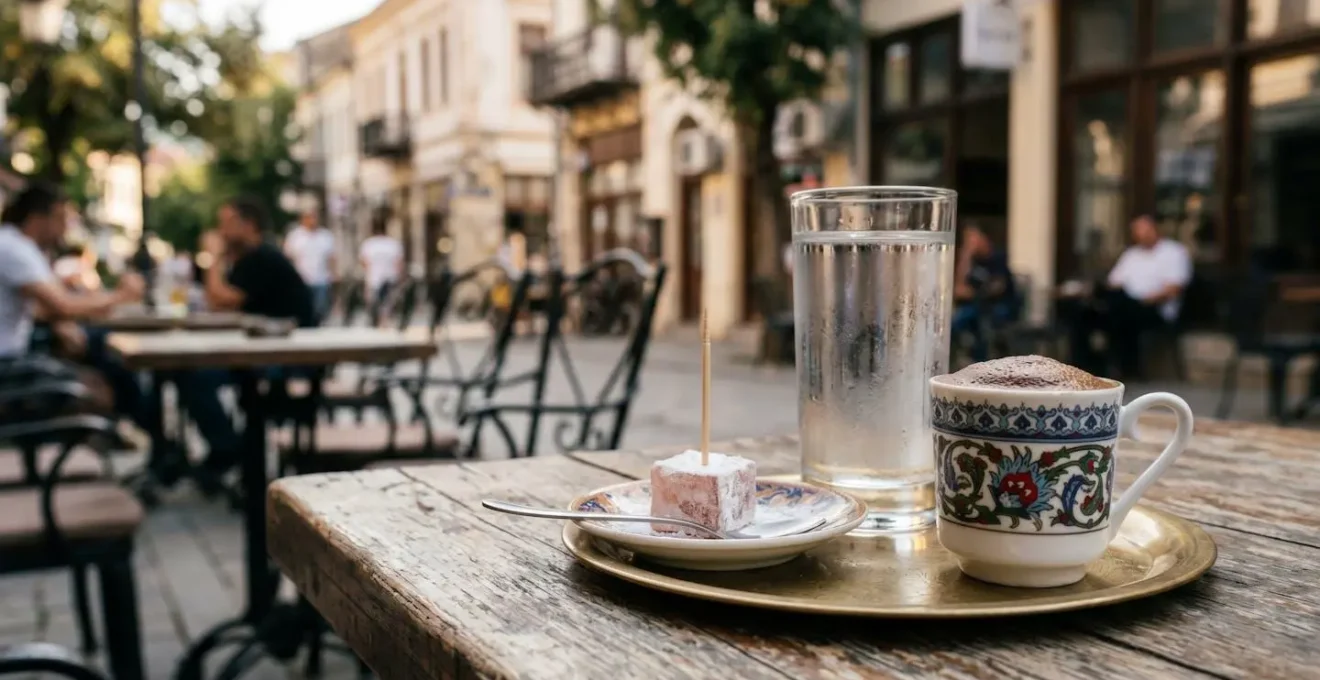
Drinking Turkish coffee in North Macedonia is less about the drink and more about mastering the art of ‘merak’—the Balkan ritual of slow, deliberate pleasure.
- The ritual involves a specific choreography: water to cleanse the palate, coffee to be sipped slowly, and grounds left for fortune-telling.
- Ordering requires declaring your sweetness level (Gorko, Sredno, Slatko) before it’s brewed, a crucial detail for blending in.
Recommendation: Embrace the unhurried pace; the goal isn’t to finish the coffee, but to prolong the moment of connection and conversation.
The aroma hits you first—a potent, earthy cloud of roasted beans and cardamom that hangs in the air of every Balkan café, or kafaana. In North Macedonia, coffee is not a quick fuel stop on the way to somewhere else; it is the destination. While many guides will give you the basic instruction to “not drink the grounds,” they miss the fundamental soul of the experience. This isn’t just about consuming a beverage; it’s about participating in a cultural performance, a shared Ottoman heritage that has blossomed into a uniquely Macedonian ritual of slowness and connection.
The real secret isn’t found in the brewing technique, but in understanding a single, untranslatable word: merak. It’s a concept signifying a deep, soulful pleasure derived from the small, simple joys of life—like the unhurried act of drinking coffee. This is not a routine; it is a ritual. It’s the feeling of having all the time in the world, even if it’s just for the twenty minutes it takes to savor a tiny, powerful cup.
But if this experience is a performance, then there is a choreography to learn. The true mistake isn’t just drinking the sludge at the bottom; it’s rushing the process, misunderstanding the props, and missing the cues. This guide is your map to the sensory blueprint of Macedonian coffee culture. We’ll explore not just the “how,” but the deep-seated “why” behind every element, from the accompanying glass of water to the whispers of the future hidden in the dregs of your cup.
To truly understand how to drink coffee like a local, we will delve into the essential steps and their hidden meanings. This journey will cover the precise etiquette of the serving ritual, the art of ordering, and the social significance of where and when you enjoy your cup, transforming you from a mere tourist into a genuine participant in the art of merak.
Summary: A Guide to the Slow Ritual of Macedonian Coffee
- Why Is Turkish Coffee Served With Water and Turkish Delight?
- The Drinking Mistake That Leaves You With a Mouthful of Grounds
- Tasseography Basics: What Does It Mean If You See a Bird in Your Cup?
- Morning or Afternoon: When Is the Most Socially Acceptable Time for Coffee?
- How to Order Your Coffee Sweetness Level correctly in Macedonian?
- Why Is Turkish Coffee Served With Water and Turkish Delight?
- Why Is Drinking Coffee on Shirok Sokak a Status Symbol?
- Why Should Bitola Be Your Second City Break in North Macedonia?
Why Is Turkish Coffee Served With Water and Turkish Delight?
When your coffee arrives, it’s rarely alone. This small, potent brew is presented as a trio, a complete sensory package. The glass of water and the sweet cube of Turkish delight (lokum) are not mere afterthoughts; they are integral instruments in the ritual’s orchestra, each with a distinct, practical role. The water serves a primary function: to cleanse your palate. Before you take your first sip of the rich, intense coffee, a sip of cool water wipes away any lingering flavors, allowing you to appreciate the full, unadulterated complexity of the brew. It’s a reset button for your taste buds.
The Turkish delight, on the other hand, acts as a bookend. Some prefer to eat it before the coffee, using its sweetness to prepare the palate for the coffee’s traditional bitterness. Others save it for the end, a sweet finale to a powerful experience. There is no strict rule, only personal preference. This entire serving method—the coffee, water, and sweet treat—is more than just a tradition; it is a recognized symbol of hospitality and refinement. In fact, this specific ritual was recognized by UNESCO as a key part of the Intangible Cultural Heritage of Humanity, underscoring its importance in social occasions.
Understanding this functional trio is the first step in moving beyond simply drinking coffee to truly experiencing it. It’s about preparing yourself for the taste, engaging with it fully, and concluding the moment with intention. Each element is a cue in the cultural choreography, guiding you through a richer, more authentic experience.
The Drinking Mistake That Leaves You With a Mouthful of Grounds
Every local in North Macedonia has witnessed it: the tourist who, unfamiliar with the unfiltered nature of Turkish coffee, tilts their head back and drains the cup to the last drop. The result is always the same—a grimace, a cough, and a mouth full of thick, gritty sediment. This is the cardinal sin of Turkish coffee consumption. That dark, dense layer at the bottom of the cup, known as talog, is not meant to be consumed. It is the foundation of the brew, the source of its depth, but its purpose in the cup is fulfilled once the liquid above it is gone.
This paragraph introduces the visual cue for stopping. To avoid the dreaded mouthful of grounds, you must become a student of the cup’s internal landscape. The coffee should be sipped slowly, allowing the fine particles to remain settled. As you drink, you’ll notice the liquid becoming thicker, the texture shifting from velvety smooth to slightly grainy. This is your signal to stop.
As the illustration shows, there is a clear demarcation between the drinkable coffee and the dense layer of talog. Locals navigate this by instinct, feeling the change in viscosity and weight. For a newcomer, the key is patience. Sip, don’t gulp. Pause between sips. Let the cup rest. The goal is to enjoy the rich, aromatic liquid that floats above the sediment. The talog is not waste; it simply has another, more mystical purpose that comes after the drinking is done.
Tasseography Basics: What Does It Mean If You See a Bird in Your Cup?
Once you’ve respectfully finished the liquid portion of your coffee, the ritual enters its second, more mystical phase: tasseography, or the art of fortune-telling with coffee grounds. This practice isn’t a modern gimmick; historical sources suggest coffee fortune-telling first appeared in the Ottoman Empire around the 1500s, evolving into a cherished social pastime. The shapes and symbols left by the talog are believed to offer glimpses into the drinker’s past, present, and future. It’s a playful, intuitive practice that deepens the social connection of sharing coffee.
So, what if you see a bird? Generally, a bird is a positive omen, symbolizing news, messages, or a journey. A bird in flight might suggest good news arriving soon, while a perched bird could mean a period of waiting before a message is received. However, the interpretation is deeply personal and contextual. The true art lies in the conversation and shared storytelling that emerges from interpreting the shapes together with friends.
Before any reading can begin, the cup must be properly prepared. This involves a simple but specific set of actions that turn the remaining coffee grounds into a canvas for interpretation. Following these steps is part of the fun and demonstrates a respect for the tradition.
Your Action Plan: Preparing the Cup for a Reading
- Leave a small amount of liquid and grounds in your cup after drinking. This is crucial for the grounds to be able to move and create patterns.
- Swirl the cup three times—right to left if you’re right-handed, left to right if you’re left-handed—to evenly coat the interior with the remaining grounds.
- Place the saucer firmly over the top of the cup, then, in one swift, confident motion, flip both upside down and place them on the table.
- Make a wish as you place the inverted cup down. For added specificity, you can place a ring on the cup’s base for relationship questions or a coin for financial matters.
- Wait for 5 to 10 minutes. This allows the excess liquid to drain onto the saucer and the grounds to cool and set, solidifying the final patterns for the reading.
Morning or Afternoon: When Is the Most Socially Acceptable Time for Coffee?
In North Macedonia, the question isn’t *if* you will have coffee, but *when* and *with whom*. The time of day dictates the social meaning of the ritual. A morning coffee, often enjoyed shortly after waking, can be a more personal, quiet affair. It’s the gentle jolt that starts the day, sometimes taken at home or at a quiet neighborhood kafaana before the world gets busy. It’s a moment of personal merak, a solitary preparation for the day ahead.
The true social spectacle, however, is the popladnevno kafe—the afternoon coffee. Beginning around midday and often stretching for hours, this is the main event. It’s a deeply ingrained social institution, a time to leave work behind, meet with friends, catch up on gossip, debate politics, and simply be seen. This is not a quick break; it is a leisurely, unhurried engagement that forms the backbone of the Macedonian social day. The sheer number of cafés, with over 5,000 such establishments across the country, is a testament to the centrality of this ritual.
As the golden afternoon sun bathes the café terraces, you’ll see tables filled with people of all ages engaged in animated conversation, the air thick with chatter and the clinking of tiny porcelain cups. To be invited for an afternoon coffee is to be invited into someone’s social circle. To participate is to embrace the slow, relational rhythm of Macedonian life. While you can certainly drink coffee at any time, the afternoon is when the drink is most deeply woven into the social fabric of the nation.
How to Order Your Coffee Sweetness Level correctly in Macedonian?
Walking into a kafaana and confidently ordering your coffee is a rite of passage for any visitor wanting to feel like a local. But here, the most critical decision is made before the coffee even touches the heat. Unlike espresso or filter coffee where sugar is an afterthought, with Turkish coffee, the sugar is boiled together with the coffee and water in the džezve (pot). This means you must declare your preferred sweetness level at the moment of ordering. Adding sugar later is not just a faux pas; it’s a logistical impossibility that disrupts the texture and flavor.
To order like a pro, you need just three essential words. Your server will likely ask, “Kakvo kafe?” (What kind of coffee?). Your response will be one of the following:
- Gorko (Горко): Bitter, with no sugar at all. This is the traditionalist’s choice, allowing the pure, unadulterated flavor of the coffee to shine. Pronounced: ‘GOR-ko’.
- Sredno (Средно): Medium sweet, with a balanced amount of sugar. This is a popular and safe choice if you’re unsure. Pronounced: ‘SRED-no’.
- Slatko (Слатко): Sweet, for those who enjoy a noticeably sugary brew. This can often signal a celebratory mood. Pronounced: ‘SLAT-ko’.
To complete the phrase, you would say, “Ve molam, edno [sweetness level] kafe” (Please, one [sweetness level] coffee). For example: “Ve molam, edno gorko kafe.” This simple phrase will earn you an appreciative nod. And what about milk? The answer is a firm but polite no. Adding milk is anathema to the Turkish coffee experience, as it would clash with the rich flavor profile and the unique, thick texture created by the brewing method.
Why Is Turkish Coffee Served With Water and Turkish Delight?
Beyond the practical, sensory functions we’ve discussed, the presentation of water and Turkish delight carries a much deeper, symbolic weight. This trio is a silent language of hospitality, a core pillar of Macedonian culture. When a host serves you coffee accompanied by water, they are not just offering refreshment; they are making a statement. It says, “Welcome. I am prepared for you. My home is your home.” In a land where hospitality is paramount, offering water is the first, non-negotiable gesture of welcome.
Furthermore, the unhurried nature of the ritual is encoded in this offering. The water signals that there is no rush. It invites you to settle in, to cleanse your palate not just once, but between sips, to prolong the experience and the conversation. It transforms the act of drinking coffee from a simple transaction into a shared, timeless moment. The presence of the water is a physical manifestation of merak—it provides the space and time for pleasure to unfold.
The lokum, or Turkish delight, adds another layer to this symbolic conversation. It represents the “sweetness” of the interaction—sweet talk, sweet company, a sweet welcome. It is a gesture of generosity and friendship. By presenting these three items together, the host communicates a rich tapestry of social cues: “I welcome you, I have time for you, and I hope our time together is pleasant.” To understand this is to understand that you are not just being served a drink; you are being initiated into a social contract of mutual respect and shared time.
Key takeaways
- Coffee in North Macedonia is a ritual of slow pleasure (‘merak’), not a quick caffeine fix.
- Respect the thick grounds (‘talog’) at the bottom of the cup—they are for fortune-telling, not for drinking.
- Your coffee’s sweetness (Gorko, Sredno, or Slatko) must be declared when you order, as it is brewed with the coffee.
Why Is Drinking Coffee on Shirok Sokak a Status Symbol?
In the elegant city of Bitola, coffee culture reaches its zenith on Shirok Sokak (Wide Street). This beautiful, pedestrianized boulevard, lined with neoclassical buildings and buzzing cafés, is more than just a place to get a drink; it’s a stage. To sit at an outdoor table on Shirok Sokak is to see and be seen, a practice deeply rooted in the city’s unique history as a major diplomatic and cultural center during the Ottoman era. It was known as the “City of Consuls,” and the legacy of that cosmopolitan, European-influenced past is palpable.
The act of promenading and leisurely sitting in cafés is a direct inheritance from that time. As Macedonia Tourism notes in its historical profile of the city:
Bitola was once a diplomatic hub of the Ottoman Balkans, second only to Thessaloniki. The culture of promenading and leisurely sitting in cafés is a direct legacy of the cosmopolitan, diplomatic era.
– Macedonia Tourism, Bitola: City of Consuls historical profile
Today, this tradition continues as a form of social currency. The afternoon coffee on Shirok Sokak is intertwined with the evening korzo, a ritual stroll where residents dress in their finest to walk the boulevard. Securing a prime table at a popular café is a display of social standing. It’s about demonstrating you are connected, you have time for leisure, and you are an active participant in the city’s vibrant social life. It’s performance, pleasure, and politics all swirled into one tiny, powerful cup.
Why Should Bitola Be Your Second City Break in North Macedonia?
While most visitors to North Macedonia first land in the bustling capital of Skopje, the savvy traveler seeking a more authentic and relaxed cultural immersion should look south to Bitola. As North Macedonia’s second-largest city, it offers a distinctly different energy—one that swaps administrative urgency for an unhurried, elegant charm. If Skopje is the country’s fast-paced heart, Bitola is its soulful, artistic mind.
The primary reason to choose Bitola for a second city break is to experience this profound shift in pace. Life here is not lived by the clock, but by the rhythm of the sun and the social calendar of the kafaana. It is the undisputed capital of merak. Where Skopje impresses with monumental statues and grand-scale reconstruction, Bitola captivates with its preserved neoclassical and Ottoman architecture, its vibrant artistic community, and a palpable sense of history that feels lived-in, not curated. The entire city feels like an invitation to slow down, to walk, to observe, and to participate.
The contrast between the two cities highlights exactly what makes Bitola special. It’s not just a place with a different aesthetic; it offers a fundamentally different way of experiencing North Macedonian culture, one that is less about ticking off sights and more about soaking in an atmosphere.
This comparative table, based on insights from sources like guides dedicated to Macedonian travel, illustrates the distinct character of each city:
| Characteristic | Skopje (Capital) | Bitola (Coffee Capital) |
|---|---|---|
| Pace of Life | Fast-paced, administrative center | Unhurried, leisurely ‘merak’ culture |
| Coffee Culture | Modern cafés, quick espresso | Traditional 2-hour coffee ritual on Shirok Sokak |
| Architectural Character | Mixed modern & reconstructed | Elegant neoclassical & Ottoman blend |
| Tourist Atmosphere | Crowds, traffic jams | Walkable, vibrant yet relaxed |
| Primary Draw | Museums, monuments, nightlife | Slow culture, café promenading, Heraclea ruins |
| Evening Tradition | Varied entertainment | Korzo (evening stroll), slow dining |
Ultimately, Bitola offers a journey back in time to a more gracious, deliberate way of living. So, when you plan your trip to North Macedonia, make time for its second city. Find a seat on Shirok Sokak, order your coffee, and settle in for the performance. Don’t just visit the country—experience its soul.