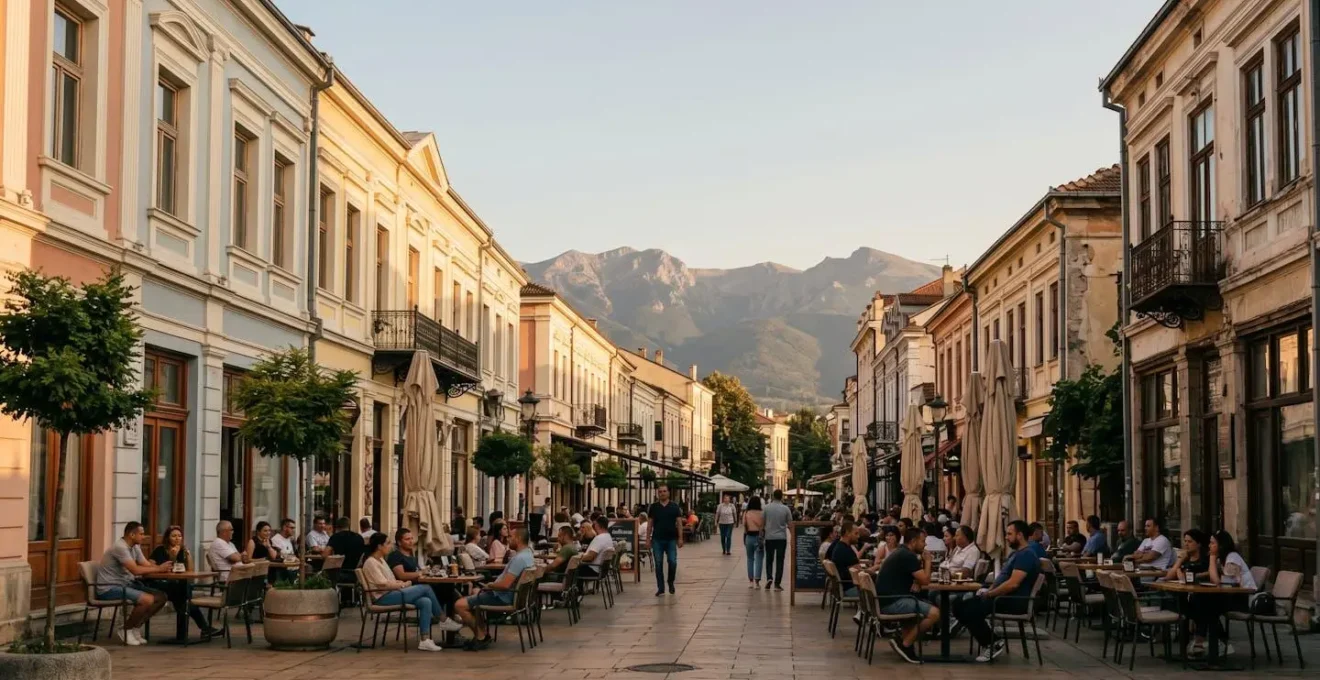
Bitola isn’t just North Macedonia’s second city; it’s the nation’s cultural soul, offering a state of mind, not just a destination.
- It trades Skopje’s frantic, modern monument-building for an effortless, aristocratic elegance rooted in centuries of history.
- Its vibrant coffee culture on Shirok Sokak is a sophisticated social art form, a theatre of daily life.
Recommendation: For a truly authentic experience, skip the capital’s clichés and discover the relaxed pace and deep-rooted heritage of North Macedonia’s true European heart.
For the discerning traveller, the allure of a capital city can sometimes feel like a well-worn cliché. You arrive, tick off the main sights, jostle with crowds, and leave feeling like you’ve seen the brochure but missed the story. In North Macedonia, many visitors follow this script in Skopje, marveling at the colossal statues and grand facades of its recent, and rather controversial, “Skopje 2014” project. It is, by all accounts, an experience. But what if the country’s authentic spirit, its deep, European soul, resides elsewhere?
What if the key to understanding this nation lies not in its manufactured monuments, but in the quiet confidence of its former diplomatic heart? This is the promise of Bitola. While Skopje shouts its identity from newly-built rooftops, Bitola whispers its history from every neoclassical balcony and cobblestone. It doesn’t need to try so hard. This city, once a cosmopolitan hub of Balkan trade and diplomacy, invites you to a different kind of travel—one that values poise over pomp, and conversation over commotion. This guide is an argument for choosing depth over dazzle, for making Bitola not just a side trip, but the main event.
This article will explore the unique character that sets Bitola apart. We’ll delve into the rituals that define its social life, uncover the history that earned its prestigious nickname, and provide the practical advice that turns a good trip into an unforgettable one. Prepare to see North Macedonia from a more refined perspective.
Summary : A Guide to Bitola, North Macedonia’s Aristocratic Heart
- Why Is Drinking Coffee on Shirok Sokak a Status Symbol?
- How Did Bitola Earn the Nickname “City of Consuls”?
- Bitola vs Skopje: Which City Offers a More Relaxed Vibe?
- The Parking Mistake That Leads to Fines in Bitola Center
- Where to Experience the Best Nightlife in Bitola on a Friday?
- How Did Bitola Earn the Nickname “City of Consuls”?
- When Are the Heraclea Mosaics Uncovered for Public Viewing?
- Why Include Heraclea Lyncestis in Your Bitola Itinerary?
Why Is Drinking Coffee on Shirok Sokak a Status Symbol?
To understand Bitola, you must first understand Shirok Sokak. And to understand Shirok Sokak, you must understand the profound importance of coffee. In Bitola, ordering a macchiato is not a simple transaction for caffeine; it’s a declaration of intent. It means you are participating in the city’s primary social ritual, an unhurried performance of seeing and being seen known locally as ‘gledanje’. This isn’t about rushing through a morning fix; it’s about claiming a strategic table at a prestigious café and letting the afternoon unfold at a pace dictated by conversation, not clocks.
The choice of café, the company you keep, and the very act of lingering for hours over a single drink are all subtle indicators of one’s social standing. It’s a daily theatre played out on the city’s main pedestrian artery. As one local guide puts it, this street is the city’s grand stage. The following observation from the Bitola City Guide captures this sentiment perfectly:
Shirok Sokak is our version of Parisian Champs Elysees…That’s where all citizens meet daily, as friends, business partners, casual passengers, and love couples.
– Bitola City Guide, Shirok Sokak Article
This culture is embodied in the bustling life of the street’s most popular establishments. The ritual is everything. You don’t just drink coffee; you perform the art of leisure, a skill that seems to have been perfected here over generations, turning a simple beverage into a potent symbol of status and belonging.
The Daily Ritual at Café Pajton
Café Pajton exemplifies Bitola’s coffee culture as the busiest cafe on Shirok Sokak. Tables and comfy chairs are packed close together, creating an intimate yet public atmosphere. Most visitors come to nurse a drink, smoke, and chat for hours. The cafe serves as a social theatre where locals engage in the ritual of ‘gledanje’ – seeing and being seen – reflecting one’s social standing through the choice of venue and company. It’s a living diorama of the city’s social hierarchy, all playing out over espresso.
How Did Bitola Earn the Nickname “City of Consuls”?
Bitola’s air of quiet aristocracy isn’t an affectation; it’s a birthright. The nickname “City of Consuls” harks back to a golden age, from the decline of the Ottoman Empire through the early 20th century, when this city was a major political and commercial powerhouse in the region. Unlike the more provincial Skopje of the time, Bitola—then known as Monastir—was the administrative center of a vast vilayet (province) and a crucial hub on the Via Egnatia trade route.
This strategic importance attracted the attention of European powers. To manage their interests, protect their citizens, and keep a close eye on the volatile Balkans, nations established official diplomatic missions. At its zenith, the city hosted a remarkable number of foreign representations. In fact, historical records show that the city was home to 12 consulates from different European countries, including Britain, France, Austria-Hungary, and Russia. This diplomatic presence transformed Bitola into a cosmopolitan and modern European city.
The consuls and their entourages brought with them not just political influence, but also culture, fashion, and, most visibly, architecture. The grand neoclassical and Belle Époque buildings that still line Shirok Sokak and the surrounding streets were built during this era, intended to project the power and sophistication of their respective nations. This architectural legacy is the most tangible reminder of Bitola’s glorious past, a physical testament to a time when it was the most important city in the region. It’s a history that is worn with a quiet, confident pride.
As you stroll through the city, you are walking through the corridors of Balkan history. Each elegant facade tells a story of intrigue, commerce, and culture, cementing Bitola’s identity as a city of enduring, understated grandeur—a stark contrast to the modern constructions of the capital. This consular heritage is not just a nickname; it is the very DNA of the city.
Bitola vs Skopje: Which City Offers a More Relaxed Vibe?
The choice between Bitola and Skopje is a choice between two fundamentally different philosophies of life. Skopje, with its frenetic energy and forest of bronze statues, is a city in a hurry. It’s performative, eager to impress, constantly reminding you of its (recently constructed) grandeur. It’s a city you *tour*. Bitola, on the other hand, is a city you *inhabit*. It offers not a checklist of sights, but a change of pace.
The vibe here is one of unhurried elegance. The daily rhythm is not dictated by tour bus schedules but by the slow, deliberate promenade along Shirok Sokak. While Skopje’s center can feel like a theme park of antiquity, Bitola’s historic core is a living, breathing organism. The magnificent consular-era buildings are not just photo opportunities; they are apartment buildings, shops, and cafes, seamlessly integrated into the fabric of daily life. This is the difference between a manufactured history and a lived one.
Where Skopje’s atmosphere can feel transactional, Bitola’s is relational. The goal isn’t to see as much as possible, but to experience one thing—a coffee, a conversation, a stroll—as fully as possible. The city is eminently walkable, encouraging a slower, more observant mode of exploration. There is a palpable sense of community and a deep-seated confidence that is the hallmark of old-world charm. It doesn’t need to prove its worth with monumental projects; its value is self-evident in the poise and grace of its daily life. If Skopje is a loud, ambitious declaration, Bitola is a quiet, self-assured statement of class.
The Parking Mistake That Leads to Fines in Bitola Center
Bitola’s relaxed atmosphere can be deceptive, especially when it comes to parking. For all its old-world charm, the city has a very modern and efficient system for dealing with parking violations. The biggest mistake a visitor can make is assuming that a quiet-looking street in the center is a free-for-all. Local enforcement is famously strict, and the dreaded ‘Pajak’ (пајак), or “spider” tow truck, is a common sight, promptly removing incorrectly parked vehicles.
The city center is divided into color-coded zones, typically Zona A (Red) for the most central, short-term spots, and Zona B (Blue) for surrounding areas. The system relies on SMS payments tied to your vehicle’s license plate, and failure to pay or overstaying your time will almost certainly lead to a fine or, worse, a trip to the impound lot. This can quickly turn a pleasant day into a bureaucratic nightmare. However, navigating the system is simple once you know the steps, and it’s a small price to pay for the privilege of exploring the heart of the city.
By understanding and respecting this local system, you avoid a common tourist pitfall and show respect for the local order. It’s a practical skill that allows you to blend in and enjoy the city’s walkability without worrying about your car. The following checklist breaks down the process, ensuring your visit remains stress-free.
Your Action Plan: The Bitola SMS Parking Guide
- Identify your parking zone: Look for signage on the street indicating Zona A (Red) or Zona B (Blue).
- Send the SMS: Compose a message to the number displayed on the sign. The format is typically your full license plate number (no spaces) followed by the zone code (e.g., ‘BT1234AB ZONAA’).
- Wait for confirmation: You will receive an SMS reply confirming your payment, parking duration, and expiry time. Do not leave your vehicle until you have this confirmation.
- Beware the ‘Pajak’: Be mindful of the tow truck. Local enforcement is swift, and incorrectly parked cars are towed without hesitation.
- Use the free parking hack: For a stress-free option, park in residential areas about a 10-minute walk from the center. It’s safe, free, and reinforces the city’s fantastic walkability.
Where to Experience the Best Nightlife in Bitola on a Friday?
As dusk settles on a Friday, Bitola undergoes a subtle transformation. The leisurely pace of the afternoon gives way to a vibrant, convivial energy. The city’s nightlife isn’t a chaotic frenzy but a structured, multi-stage ritual that unfolds across its historic streets. Forget the sprawling, anonymous super-clubs of other cities; Bitola offers a more intimate and varied experience, with distinct paths for every type of evening adventurer.
A crucial element of the pre-party ritual is the ‘Krug’ (the circle or lap). Around 10 or 11 PM, you’ll see groups of friends, dressed for the evening, walking leisurely laps up and down Shirok Sokak. This isn’t aimless wandering; it’s a social parade, a chance to see and be seen, greet acquaintances, and decide on the next move. It’s the ‘gledanje’ of the daytime, simply adapted for the night. A key tip for visitors is to understand the local timeline: dinner is often at 9 PM, bars get busy around 11 PM, and clubs only truly come alive after 1 AM. Pacing is everything.
Whether you’re looking for a quiet craft beer, a sophisticated cocktail, or a place to dance until dawn, Bitola’s layout makes it easy to curate your perfect Friday night. The Old Bazaar offers hidden gems with traditional or alternative music, while Shirok Sokak is the epicenter of stylish bars and people-watching. Each itinerary offers a different facet of the city’s social life.
For the party-goer, a typical Friday might start with cocktails at a trendy bar near Café Pajton between 10 PM and midnight before joining the ‘Krug’ ritual. The night then culminates in one of Bitola’s nightclubs around 1 AM. The chill seeker might prefer starting with a craft beer in a quiet Old Bazaar tavern before moving to a laid-back cafe on Shirok Sokak for people-watching. The culture vulture can enjoy a traditional ‘kafana’ with live folk music before exploring the hidden courtyard venues and basement bars of the Old Bazaar for a more alternative scene.
How Did Bitola Earn the Nickname “City of Consuls”?
Beyond the bricks and mortar, the title “City of Consuls” represents a legacy of ideas, influence, and individuals who shaped history from within Bitola’s borders. The presence of European diplomats didn’t just alter the city’s skyline; it infused it with a cosmopolitan spirit and placed it at the center of the “Eastern Question.” This was a city where global events were debated and futures were forged, a status that attracted the best and brightest from across the Ottoman Empire.
Perhaps no single figure better illustrates this than Mustafa Kemal Atatürk, the founder and first president of modern Turkey. Before he was a statesman, he was a young cadet enrolled at the prestigious Ottoman military academy housed in what is now the Museum of Bitola. His time here, from 1896 to 1899, was formative, exposing him to Western ideas and military strategies circulating in this diplomatic hub. To walk the halls of this building is to walk in the footsteps of a man who would go on to reshape the map of the modern Middle East.
This tangible connection to such a pivotal historical figure elevates Bitola’s consular heritage from a quaint historical footnote to a story of profound global significance. It is a major reason why the city remains a site of pilgrimage for many Turkish visitors today. It proves that Bitola was not merely a passive observer of history but an active crucible where identities and ideologies were forged.
The Atatürk Connection: A Legacy Preserved
The Museum of Bitola, housed in the old Bitola Barracks (1848), preserves the legacy of its most famous student: Mustafa Kemal Atatürk. The dedicated memorial room is a poignant tribute, displaying official documents, photographs, and even a wistful, unrequited love letter from a local girl named Eleni Karinte. This artifact, in particular, offers a touchingly human insight into the life of the future statesman. This personal and historical connection makes Bitola a unique pilgrimage site and adds a powerful geopolitical dimension to the city’s consular heritage, linking its past directly to the creation of a modern nation-state.
Key takeaways
- Bitola’s coffee culture is a sophisticated social ritual, where the act of lingering on Shirok Sokak is a symbol of status.
- The city’s “Consular” past is not just history; it defines its elegant neoclassical architecture and enduring European atmosphere.
- Bitola offers a deliberate, relaxed, and authentic urban experience that stands in stark contrast to the frantic pace of Skopje.
When Are the Heraclea Mosaics Uncovered for Public Viewing?
The magnificent floor mosaics of Heraclea Lyncestis are the site’s crowning glory, but their viewing is a seasonal privilege. To protect the delicate ancient tesserae from the harsh Balkan winter, the mosaics are covered with layers of sand and burlap for several months of the year. Timing your visit is therefore crucial to witness these masterpieces in their full splendor. This is a primary consideration for any traveler wanting the full Heraclea experience.
The main viewing window is typically from late May to early October. During this period, the mosaics of the Great Basilica and other key areas are fully exposed to the public. Arriving outside of this window, particularly from November to April, means you will find the main attractions protected under their winter covering. While the site itself remains open and impressive, you will miss its most famous feature. For those traveling on the cusp of the season, such as in early May or late October, it is highly advisable to verify the status of the mosaics directly with the Bitola Museum or the Heraclea Lyncestis site office before making the trip.
Even if the mosaics are covered, a visit is not entirely in vain. The impressive Roman theatre, the ruins of the bathhouses (thermae), and the on-site museum, which contains excellent replicas and other artifacts, are open year-round. For a lucky few, visiting during the uncovering process in late spring or the covering in early autumn offers a unique chance to witness archaeological conservation in action, a fascinating spectacle in its own right.
Why Include Heraclea Lyncestis in Your Bitola Itinerary?
Just a short drive from the city center lies Heraclea Lyncestis, a site that is far more than just a pile of old stones. To include Heraclea in your itinerary is to peel back the layers of history itself. This is not just a Roman ruin; it is a masterclass in the historical strata of Macedonia, a place where you can physically walk from the Hellenistic world of Alexander the Great’s father into the heart of the Roman Empire and then into the dawn of Christianity.
The site’s story begins in antiquity, as it was founded in the 4th century BC by Philip II of Macedon, Alexander’s ambitious father. Its strategic location on the Via Egnatia, the great Roman road connecting the Adriatic and Aegean seas, ensured its prosperity. Under the Romans, it flourished, boasting a grand theatre, bathhouses, and porticos. Later, as the empire embraced Christianity, Heraclea became an important episcopal seat, with grand basilicas built over the pagan foundations. This remarkable transition is visible everywhere on site.
But the true reason Heraclea is unmissable lies in its breathtaking floor mosaics. Dating from the late 5th and 6th centuries, these are among the finest examples of early Christian art in the world, rivalling more famous examples in Italy. The main mosaic in the Great Basilica is a complex and vibrant tapestry of symbolism, depicting a Christian vision of paradise with dozens of animals, both real and mythical, drinking from a fountain of life that flows from the mouths of deer. It is a stunning artistic achievement that provides a direct, colourful link to the faith and worldview of the city’s ancient inhabitants. Visiting Heraclea is not about seeing a ruin; it’s about understanding the deep, layered, and artistically rich history that underpins the entire region.
Heraclea’s Layered History as a Living Museum
Heraclea Lyncestis offers a masterclass in historical layering. Founded by Philip II of Macedon, it became a powerful Roman colony on the Via Egnatia, later refurbished by Emperor Hadrian. In the early Christian era, it flourished as an Episcopal seat. A visit allows you to physically walk through these transitions, from the Roman baths and a 3,000-seat theatre to the spectacular late 5th-century Christian floor mosaics, which depict complex scenes like the Garden of Eden and are considered artistic masterpieces.
Your journey into the heart of North Macedonia shouldn’t end with a checklist of sights. It should begin with an experience. Explore Bitola, embrace its unhurried rhythm, and discover the elegant soul of a nation for yourself.