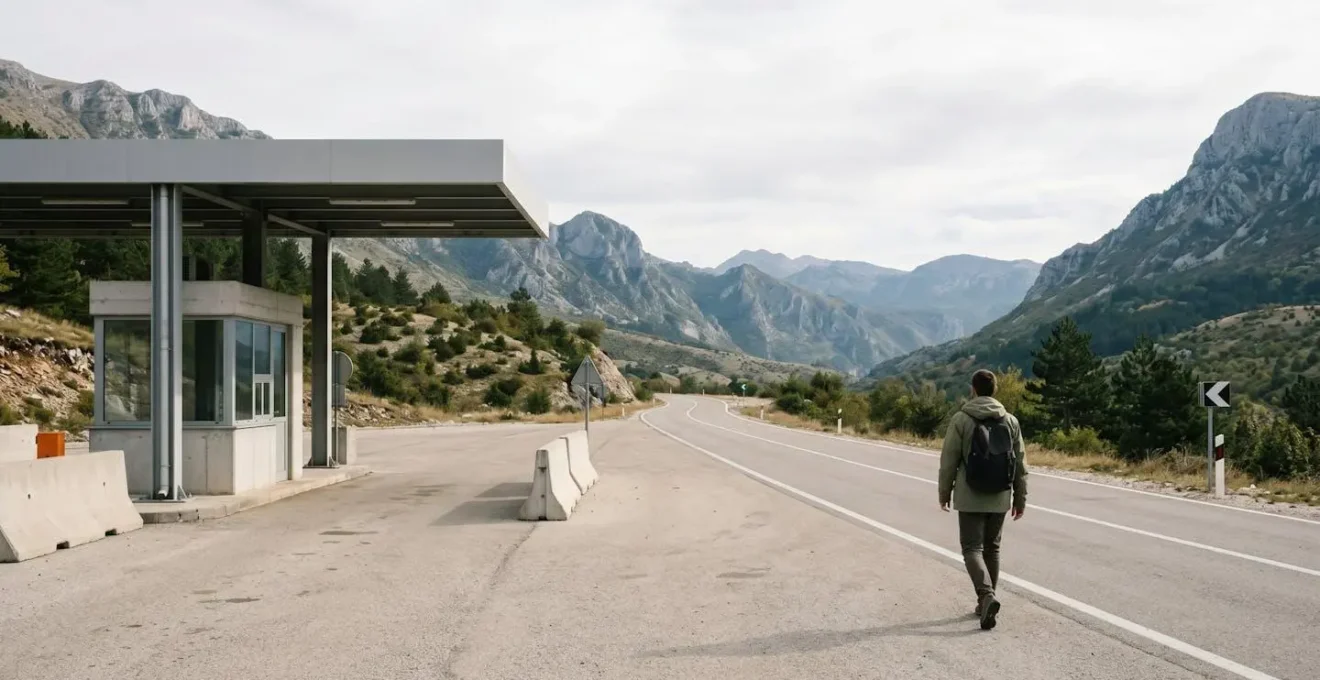
For digital nomads and long-stay travellers, North Macedonia’s visa-free policy is a gateway to the Balkans, but navigating its unwritten rules is critical to avoid fines and entry denials.
- The mandatory 24-hour police registration (the ‘white card’) is not optional; it’s the cornerstone of a legal stay outside of hotels.
- Understanding the ‘rolling’ 180-day limit and the triggers for tax residency are non-negotiable for anyone staying longer than a typical holiday.
Recommendation: Treat your 90-day stay not as an extended vacation, but as a mini-immigration process. Proactive compliance is the only strategy to ensure a smooth, trouble-free experience.
The allure of North Macedonia is undeniable for British digital nomads and retirees. A stunning country with a low cost of living, it serves as a perfect non-Schengen base for exploring the Balkans. The promise is simple: stay for up to 90 days without a visa. However, many discover too late that this simplicity is deceptive. The internet is filled with basic advice about the 90/180 day rule, but this barely scratches the surface of the on-the-ground reality.
Most guidance fails to address the real-world challenges: the crucial difference between staying in a hotel versus an Airbnb, the specific passport errors that lead to immediate entry denial at Skopje Airport, or how a long-term lease can unexpectedly trigger tax obligations. These are not minor details; they are the tripwires that can transform a Balkan dream into a bureaucratic nightmare of fines, frustrating border crossings, and legal ambiguity.
But what if the key wasn’t just knowing the rules, but understanding the system behind them? This guide adopts a different approach. We will move beyond the platitudes and dissect the specific points of bureaucratic friction that most long-stay visitors encounter. This is not just a list of regulations; it’s a strategic field guide to proactively manage your legal footprint in North Macedonia, ensuring your 90-day stay is as seamless and productive as you planned.
This article will provide a clear, step-by-step breakdown of the most critical aspects of a long-term stay. We will cover everything from the mandatory police registration and passport discipline to car rental traps and the nuances of tax residency, empowering you with the knowledge of a seasoned immigration consultant.
Summary: Navigating Your 90-Day Stay in North Macedonia
- Why You Must Register With Police Within 24 Hours if Avoiding Hotels?
- How to Calculate Your Rolling 180-Day Limit for Balkan Travel?
- Skopje or Sofia: Which Is Better for Remote Workers on a Budget?
- The Passport Error That Can Get You Denied Entry at Skopje Airport
- When Does Your Long Stay Trigger Tax Residency in North Macedonia?
- How to Calculate Your Rolling 180-Day Limit for Balkan Travel?
- Are Snow Chains Mandatory on All Mountain Roads in Winter?
- How to Rent a Car in North Macedonia Without Hidden Fees?
Why You Must Register With Police Within 24 Hours if Avoiding Hotels?
This is arguably the most critical, yet frequently overlooked, rule for long-stay visitors in North Macedonia. While hotels and hostels handle this registration for you automatically upon check-in, the responsibility falls squarely on your shoulders if you opt for an Airbnb, a private apartment, or stay with friends. Failure to comply is not a minor administrative oversight; it is a violation of immigration law.
The registration process results in a small, stamped paper known as the “white card” (or ‘bela karta’). This document is your legal proof of residence. Without it, you are technically staying in the country illegally. While you may not be asked for it during your stay, it is often required upon exiting the country. Border officials can and do check for it, and its absence can lead to significant problems, including hefty fines ranging from 600 to 1,000 euros and potential difficulties re-entering the country in the future.
The process itself is simple, free, and takes minutes. You, along with your landlord or host, must visit the nearest police station with your passport. The officer records your details and issues the white card. Insisting your landlord assists with this is a good way to vet their legitimacy. A host who refuses or claims it’s unnecessary is a major red flag. For a digital nomad planning a 90-day stay, this ‘white card’ obligation is the first and most important act of compliance.
How to Calculate Your Rolling 180-Day Limit for Balkan Travel?
For UK and other non-EU citizens, North Macedonia allows a visa-free stay of “90 days within any 180-day period.” This phrase is the source of much confusion. It does not mean you can stay for 90 days, leave for a day, and then return for another 90. It operates on a rolling basis, which is a concept every long-term traveller in the Balkans must master.
Imagine a calendar that only looks backwards from today’s date over the last 180 days. At any given moment, the total number of days you have spent in North Macedonia within that 180-day window cannot exceed 90. This is crucial because North Macedonia, along with neighbours like Albania and Kosovo, is outside the Schengen Area. Each country has its own independent 90/180 day clock. This allows for strategic “visa runs” and the creation of a travel loop, often called the “Balkan Triangle,” to extend your time in the region legally.
Understanding this principle is fundamental. It means that every day you spend in the country, you use up one of your 90 days. But every day, an old day from 180 days ago “falls off” the back of the calendar, potentially freeing up a day. It is a constant calculation, not a fixed reset. Miscalculating this can lead to overstaying, which carries serious consequences.
This constant passage of time requires diligent tracking. While the concept may seem abstract, its practical application is what separates a savvy nomad from one who faces issues at the border. The key is not to think of your 90 days as a static block, but as a fluid allowance that must be managed continuously throughout your travels in the region.
Skopje or Sofia: Which Is Better for Remote Workers on a Budget?
The Skopje vs. Sofia debate is a classic dilemma for digital nomads looking for a Balkan base. While Sofia, Bulgaria has historically been a more established hub, Skopje is rapidly gaining a reputation for its incredible affordability and emerging nomad scene. For the budget-conscious remote worker, the choice is becoming clearer. Recent analysis has confirmed this, with Skopje ranking as the number one cheapest capital in Europe for digital nomads.
The primary driver is the significantly lower cost of living. A one-bedroom apartment in Skopje’s city centre can be half the price of a similar one in Sofia. Daily expenses, from public transport to eating out, are also noticeably cheaper. However, the decision isn’t just about cost. It involves weighing infrastructure, community, and visa logistics. Sofia has a larger, more developed network of coworking spaces and a more established expat community. Its entry into the Schengen zone in 2024 changes the visa calculation for those also travelling within the EU.
The following table breaks down the key differences to help you make an informed decision based on your priorities as a remote worker.
| Factor | Skopje, North Macedonia | Sofia, Bulgaria |
|---|---|---|
| Average Monthly Rent (1-bed, city center) | €275 (~$289) | €400-500 |
| Visa/Registration Process | 24-hour police registration required (free, 5 minutes) | EU resident card holders: simplified process |
| 90/180 Day Rule Status | Non-Schengen (independent 90-day allowance) | Schengen (part of the unified travel area) |
| Visa Run Proximity | Close to Pristina (Kosovo), Tirana (Albania) | Close to Belgrade (Serbia), Edirne (Turkey) |
| Internet Speed & Reliability | Surprisingly fast, mobile data affordable with excellent coverage | Fast and stable, well-established infrastructure |
| Coworking Spaces | Limited but growing | Multiple established coworking spaces (Bansko influence) |
| English Prevalence | Moderate; friendly locals | Good; growing expat community |
| Ideal Stay Duration | 1 week to 1 month maximum (limited activities) | 1-3 months (more variety, larger city) |
Ultimately, Skopje is the undisputed winner for maximizing a tight budget, especially for shorter stays. It’s an excellent choice for a month-long immersion. Sofia, while more expensive, may offer a better overall package for those planning a multi-month stay who value a larger city’s amenities and a more robust nomad community.
The Passport Error That Can Get You Denied Entry at Skopje Airport
Nothing sours a trip faster than being denied entry at your destination. For North Macedonia, the most common reason for this is not a visa issue, but a simple passport error. While most travellers check their passport’s expiry date, many are unaware of the specific validity requirements. North Macedonia requires your passport to have a minimum of three months’ validity from your intended date of departure from the country.
Airlines are extremely strict about this rule because they are fined and held responsible for repatriating any passenger who is denied entry. Therefore, they will often enforce an even stricter rule of thumb, requiring six months of validity, and will deny you boarding at your point of origin if you don’t meet the criteria. Another critical aspect of passport discipline is ensuring you have sufficient blank pages—at least one or two are recommended. Frequent border crossings in the Balkans can fill up a passport surprisingly quickly.
Finally, a crucial but often forgotten rule: you must exit North Macedonia using the same passport you used for entry. This is particularly relevant for dual nationals. Mixing passports can create significant delays and questioning at the border. Maintaining meticulous control over your travel documents is not paranoia; it’s a fundamental requirement for smooth international travel.
Your 5-Step Passport Readiness Audit
- Validity Check: Confirm your passport is valid for at least 6 months from today. Check the specific entry requirements for North Macedonia (3 months beyond departure), but always aim for the 6-month buffer that airlines use.
- Page Count: Physically count the number of blank visa pages. For a 90-day Balkan trip with multiple border crossings, aim for at least 3-4 blank pages to be safe.
- Stamp Legibility: Review your recent entry/exit stamps. Are they clear? At each crossing, politely ensure the border guard stamps your passport correctly. A missing or illegible stamp can complicate your day count.
- Physical Condition: Inspect your passport for any damage—tears, water damage, or a detached cover. A passport in poor condition can be rejected by airline staff or border control.
- Document Consistency: If you are a dual national, commit to using one passport for the entire Balkan leg of your journey. Ensure the passport you show at the airline check-in is the same one you present at immigration upon arrival and departure.
When Does Your Long Stay Trigger Tax Residency in North Macedonia?
For the digital nomad or retiree, “tax residency” is a term that can cause instant anxiety. While enjoying a long stay in North Macedonia, the last thing you want is to inadvertently become liable for local taxes on your worldwide income. The primary trigger for this is the well-known 183-day rule: spend 183 days or more in the country within any 12-month period, and you are generally considered a tax resident.
However, what many fail to realize is that this is not the only trigger. Tax residency can be established much earlier through a concept known as the “Center of Vital Interests.” This is a more subjective test where tax authorities assess whether your personal and economic ties are stronger to North Macedonia than to any other country. Actions that can signal this include signing a one-year lease, opening a local bank account for business purposes, or having immediate family residing in the country. This is the definition of residency by stealth—becoming a tax resident by your actions, not just by the calendar.
The key for a 90-day visitor is to avoid any action that could be interpreted as establishing a permanent home. Use your foreign bank cards, sign short-term rental agreements, and maintain your primary residential, economic, and social ties to your home country. For remote workers, it’s also important to note that income earned from foreign clients while you are physically in North Macedonia is not automatically considered local income. The liability arises if and when you are deemed a tax resident, at which point you may need to declare that income. Fortunately, Double Taxation Treaties (DTTs) exist to prevent you from being taxed twice on the same income, but navigating this requires professional advice.
How to Calculate Your Rolling 180-Day Limit for Balkan Travel?
Now that we’ve established the principle of the rolling 180-day window, let’s focus on the practical application. The only way to stay compliant is through meticulous, manual tracking. There is no official app or government portal that does this for you. A simple spreadsheet is your most powerful tool.
Create a spreadsheet with three columns: “Date of Entry,” “Date of Exit,” and “Days Spent.” Every time you enter or leave North Macedonia, you must log it. To calculate your current status, use a formula that sums the “Days Spent” for all trips where the entry date falls within the last 180 days from the current date. This gives you your real-time total, which must always remain at or below 90.
Let’s consider a practical example for a traveller using the “Balkan Triangle” strategy:
- January 1 – January 30: 30 days in North Macedonia. (Total: 30/90)
- January 31 – February 28: 29 days in Albania. (Macedonia day count remains 30)
- March 1 – March 31: 31 days in North Macedonia. (Total: 30+31 = 61/90)
- April 1 – April 15: 15 days in Kosovo. (Macedonia day count remains 61)
- April 16: You plan to re-enter North Macedonia. You look back 180 days. Your total days are 61, leaving you with 29 available days for your next stint.
This disciplined tracking is not optional. It is the core activity that allows you to maximize your time in the region without ever breaking the law. Always keep photos of your entry and exit stamps on your phone as a backup to your spreadsheet.
Are Snow Chains Mandatory on All Mountain Roads in Winter?
Driving in North Macedonia during winter, especially in its stunning mountainous regions like Mavrovo or Pelister, requires specific preparation. While the scenery is breathtaking, the road conditions can be treacherous. A common point of confusion for visitors is the requirement for snow chains. The rule is not uniform across the country; it is situational and location-dependent.
Legally, all vehicles must be equipped with winter tires during the period from November 15 to March 15. During this time, you must also carry snow chains in your vehicle for use on specific roads when conditions demand it. This “carry” requirement is often enforced through police checkpoints on the approach to mountain passes.
The mandatory *use* of chains, however, is typically signposted and depends on current weather.
- Red Zones: In national parks like Mavrovo and Pelister, or on the road to popular ski resorts, police actively check for and often require the installation of chains after fresh snowfall, regardless of whether you have a 4×4 vehicle.
- Yellow Zones: On other secondary mountain roads, the requirement is based on conditions. It is your responsibility as the driver to assess the risk and use chains if you encounter snow or ice.
A crucial tip for renters: most rental car agreements will include winter tires but will list snow chains as an optional, paid extra. Always request and confirm they are in the car before you leave the rental office. Learning how to install them in a dry, warm parking lot is infinitely better than trying to figure it out for the first time in a blizzard on a mountain pass.
Key takeaways
- Register Immediately: If staying in an Airbnb, your first task within 24 hours is to get the ‘white card’ from the police with your host. It’s non-negotiable.
- Track Every Day: Use a spreadsheet to meticulously track your entry and exit dates to manage your rolling 90/180 day allowance. Do not estimate.
- Master Your Passport: Constantly check your passport’s validity (6-month rule of thumb), blank pages, and stamps. It is your single most important tool.
How to Rent a Car in North Macedonia Without Hidden Fees?
Renting a car is the best way to explore North Macedonia’s hidden gems, but the process can be fraught with hidden fees that significantly inflate the final price. A low headline rate can quickly double if you’re not careful. The key is to be proactive and scrutinize the rental contract before signing.
The most common hidden cost is the “Green Card” insurance for cross-border travel. Verify that it covers every country you plan to visit. It is very common for policies to exclude Kosovo, requiring an expensive add-on at the border. For long-term rentals, negotiate a single cross-border fee rather than paying per crossing. Another major surcharge is the airport pickup fee, which can be avoided by collecting the car from a city-centre office. Always insist on a “full-to-full” fuel policy to avoid inflated refuelling charges.
To protect yourself from spurious damage claims, meticulously photograph and video the vehicle from every angle before you drive away, ensuring the timestamp is visible. For long-term Balkan travel, unlimited mileage is not a luxury; it’s a necessity. This should be a non-negotiable part of any rental longer than a week.
Case Study: Local vs. International Rental Agencies for Multi-Country Balkan Travel
Local agencies in Skopje often present temptingly low base rates, sometimes 30-50% cheaper than international brands like Sixt or Europcar, and they can be more flexible on long-term monthly rates. However, for a 90-day trip involving multiple Balkan countries, the higher cost of an international agency often proves to be a worthwhile investment. International agencies typically offer more comprehensive Green Card coverage and standardized roadside assistance that is reliable across borders. Travellers report that while local agencies are great for stays primarily within North Macedonia, their cross-border policies can be restrictive, and their support network can be lacking in remote areas of Albania or Kosovo. The breakeven point is clear: if your plan involves extensive, multi-country travel, the peace of mind and superior cross-border support from an international brand outweigh the initial cost savings of a local provider.
Frequently Asked Questions about Your Stay in North Macedonia
What is the ‘183-day rule’ for tax residency in North Macedonia?
The 183-day rule states that spending 183 or more days in North Macedonia within a 12-month period may trigger tax residency status, requiring you to declare worldwide income to North Macedonian tax authorities.
What actions could signal ‘Center of Vital Interests’ even before 183 days?
Signing a 1-year lease, opening a local bank account for more than just receiving funds, registering a business, having immediate family residing in the country, or enrolling children in local schools can all indicate your center of vital interests is in North Macedonia.
Does income earned remotely from foreign clients count as local income?
Generally, income earned from foreign clients while physically present in North Macedonia is not automatically considered local income. However, if you establish tax residency through the 183-day rule or center of vital interests test, you may become liable to declare worldwide income.
What are Double Taxation Treaties (DTTs) and how do they help?
Double Taxation Treaties are agreements between countries to prevent you from being taxed in both countries on the same income. If North Macedonia has a DTT with your home country, ‘tie-breaker’ rules determine which country has primary taxing rights, protecting you from double taxation.