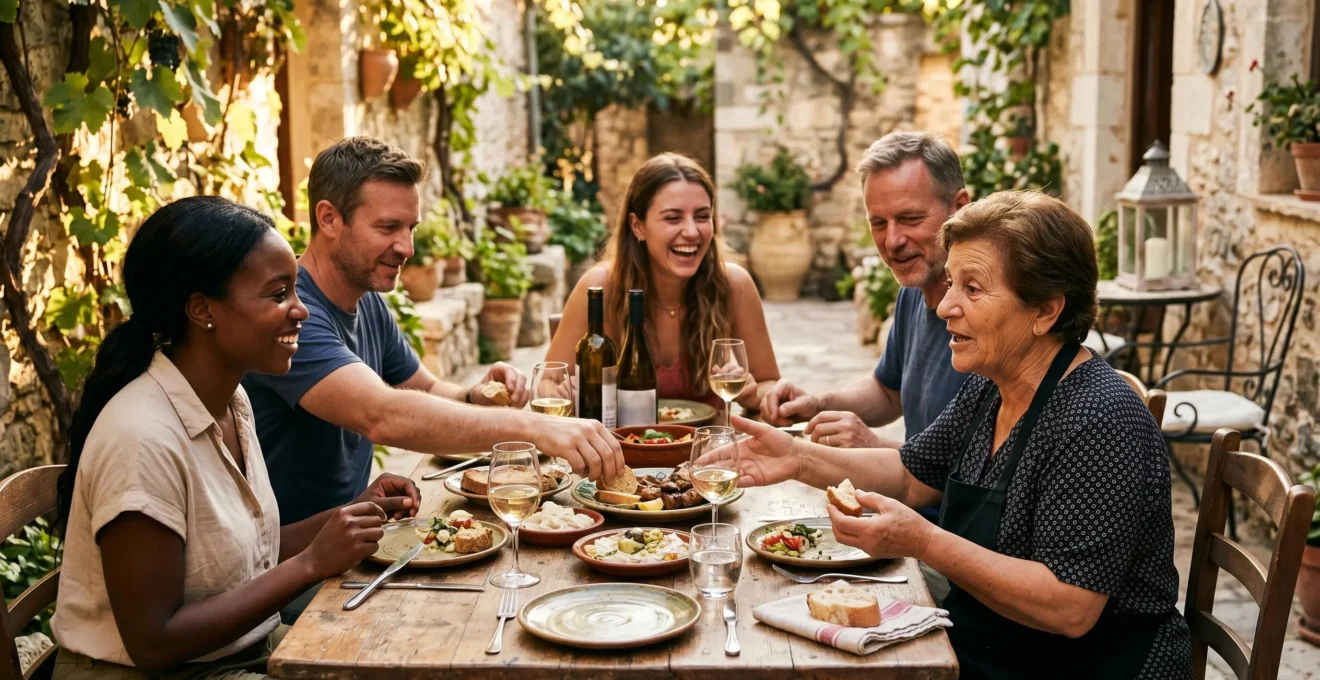
Booking a food tour transforms a simple meal into a lasting memory by providing the cultural story behind every dish.
- A local guide acts as a “culinary translator,” decoding the history and traditions that you’d miss when eating alone.
- Guided experiences offer curated access to authentic spots and producers, bypassing tourist traps and logistical hassles.
Recommendation: To truly understand what you’re eating on your next trip, don’t just find a restaurant; find a storyteller who can bring the food to life.
There’s a unique thrill in exploring a new city’s food scene on your own. You follow your nose down a cobbled alley, point at something intriguing behind a glass counter, and hope for the best. For many foodies, this is the essence of travel. But there’s often a lingering question: what am I *really* eating? You might enjoy the flavour, but the story, the history, the reason a dish exists in the first place, remains a mystery. This is the gap between simply eating and truly understanding.
While guidebooks and blogs can point you to popular restaurants, they rarely explain the soul of the cuisine. They can’t introduce you to the third-generation baker who still uses his grandfather’s starter, or explain why a particular cheese tastes of the mountain pastures where the sheep graze. The common approach gives you a list of destinations, but it can’t provide a narrative. But what if the key to a profoundly memorable meal wasn’t just about the ingredients on the plate, but about the context wrapped around it?
This is where a gastronomy tour shifts the entire experience. It’s not about convenience; it’s about connection. A great food tour is a curated journey led by a passionate local who acts as a culinary translator, turning food from mere sustenance into a living story. This guide will take you beyond the surface to explore the ‘why’ behind every bite, connecting flavours to culture and creating memories that a solo meal, no matter how delicious, simply cannot replicate.
In this guide, we’ll explore exactly how a local guide enhances your culinary journey. We will delve into how to select the perfect tour in a city as rich as Skopje, compare different types of food experiences, and provide practical tips to make your adventure seamless and unforgettable.
Summary: Your Guide to a Deeper Culinary Journey
- Why Does a Local Food Guide Make Your Meals 10 Times More Memorable?
- How to Choose Between the Many Food Tours Offered in Skopje?
- City Market Tour vs Village Farm Visit: Which Food Experience Is Richer?
- The Dietary Mistake: How to Communicate Food Allergies in Macedonian?
- How to Combine Wine Tasting and Traditional Meals in a Single Day Tour?
- Why Does a Local Food Guide Make Your Meals 10 Times More Memorable?
- Čaršija Food Guide: Which Traditional Restaurant Serves the Best Kebab?
- What Makes Traditional Macedonian Cuisine Unique in the Balkans?
Why Does a Local Food Guide Make Your Meals 10 Times More Memorable?
A meal is never just a meal; it’s a concentration of history, agriculture, and tradition on a plate. When you eat alone in a foreign city, you taste the final product. With a guide, you taste the entire story. This is the core of what makes a guided food experience so powerful. The guide is your culinary translator, transforming a simple dish of Tavče Gravče (baked beans) into a tale of family gatherings, Ottoman influence, and regional pride. They provide what we can call ‘contextual flavour’—the understanding that makes every bite richer and more significant.
This isn’t just a feeling; it’s backed by how our minds work. A study on gastro-tourism experiences revealed that the most critical factors for creating lasting memories were not fancy amenities, but the authentic and co-created relationships between tourists and their hosts. The guide facilitates this connection, turning a transactional meal into a shared human experience. As one hiring guide for culinary experts puts it, the best guides go beyond highlighting popular eateries to connecting each dish to local culture, history, and traditions.
Research Spotlight: Memory and the Tourist-Host Connection
Research into what makes a gastro-tourism experience memorable identified seven key attributes. Among the most crucial were authenticity and the development of a strong tourist-host relationship. The study showed that these personal interactions, fostered by a guide, were far more important for travelers forming lasting memories than the physical setting. A guide doesn’t just present food; they actively shape the narrative that gets imprinted in your memory.
Ultimately, the guide gives you access to the ‘why’. Why is this local honey so dark? Because the bees feed on chestnut blossoms in that specific valley. Why is the bread served with the kebab just as important as the meat? Because its texture is designed to soak up the juices perfectly. These are the details that build a sensory narrative, turning a good meal into an unforgettable chapter of your travels.
How to Choose Between the Many Food Tours Offered in Skopje?
Skopje’s culinary scene is a vibrant tapestry, and dozens of tours promise to show you the best of it. But not all tours are created equal. The key is to find one that aligns with your interests and guarantees an authentic experience rather than a generic tourist shuffle. The first step is to understand the main types of tours available and what each offers.
To help you decide, here is a breakdown of the most common food tour formats you’ll find in Skopje and beyond, each suited to a different kind of traveler. Consider what you want most from your experience: a broad overview, a deep dive into technique, or a completely personalized itinerary.
| Tour Type | Duration | Number of Stops | Best For | Key Advantage |
|---|---|---|---|---|
| Walking Food Tour | 3-4 hours | 5-8 venues | First-time visitors | Discover hidden corners and soak in neighborhood atmosphere |
| Chef-Led Experience | 4-5 hours | 3-5 curated venues | Culinary enthusiasts | Access decades of professional expertise and producer relationships |
| Market + Cooking Class | 4-6 hours | Market + 1 kitchen | Hands-on learners | Learn shopping skills and traditional cooking techniques |
| Private Custom Tour | Flexible | Customized | Special dietary needs | Fully personalized pace and menu accommodations |
Once you’ve identified the right type of tour, you need to vet the quality. An authentic tour is all about the details and the expertise of the guide. Look for specifics that signal a deep connection to the local food scene, not just a rehearsed script.
Your Checklist for an Authentic Food Tour
- Verify guide expertise: Is the guide a local chef, historian, or food blogger? The best tours highlight this specific knowledge, which is the secret ingredient.
- Check for specificity: Look for itineraries that promise ‘Galichnik kashkaval from a third-generation producer’ instead of a generic ‘local cheese’. As one resource on food tours advises, specificity signals genuine local connections.
- Assess group size: A maximum of 10-12 guests is ideal. This ensures a personalized experience and allows for meaningful interaction with your guide and the vendors.
- Evaluate post-tour value: Does the company provide a map with recommendations, recipes, or other resources? This shows they care about your entire trip, not just the hours you paid for.
- Read detailed reviews: Look for reviews from travelers like you that mention specific, unexpected discoveries or praise the guide’s unique insights and connections.
City Market Tour vs Village Farm Visit: Which Food Experience Is Richer?
When exploring Macedonian food, two quintessential experiences offer different, yet equally valuable, insights: the bustling city market and the tranquil village farm. Choosing between them depends entirely on what you define as a “rich” experience. One offers a wealth of variety and human energy, while the other provides a richness of origin and authenticity.
A tour of a place like Skopje’s Bit Pazar, one of the oldest and largest markets in the Balkans, is a full-body sensory immersion. It’s a chaotic, colourful symphony of vendors shouting, locals haggling, and the intermingled scents of fresh produce, spices, and grilled meats. Here, richness comes from diversity. You can see, taste, and learn about hundreds of ingredients in one place—from pyramids of bright red peppers for making ajvar to countless varieties of local cheeses and cured meats. It’s a snapshot of what the entire country eats, concentrated in one vibrant hub.
A village farm visit, on the other hand, offers a different kind of richness—one rooted in serenity and connection to the source. This experience is about slowing down and understanding the journey from soil to plate. You’re not just seeing the final product; you’re seeing where it begins. This is about the tactile connection with the land.
As you can see, the farm experience is profoundly direct. You might help harvest vegetables, learn from a farmer how they make their cheese, or share a meal prepared with ingredients picked just moments before. This experience is less about variety and more about depth and provenance. You leave with a deep appreciation for a single product and the family that produces it. So, which is richer? The market is a lesson in the breadth of a culture’s cuisine, while the farm is a lesson in its soul.
The Dietary Mistake: How to Communicate Food Allergies in Macedonian?
One of the biggest anxieties for foodies traveling abroad is navigating dietary restrictions and allergies. In a country like North Macedonia, where hospitality is paramount, making your needs understood is not a burden but a sign of respect. The biggest mistake is not trying. Relying on gestures or assuming English will be understood everywhere can lead to miscommunication and health risks. Learning a few key phrases in Macedonian is the most effective way to ensure a safe and enjoyable culinary experience.
Your guide will be your primary advocate, but knowing how to communicate for yourself is empowering, especially if you wander off for a snack on your own. Don’t worry about perfect pronunciation; the effort will be deeply appreciated. Focus on these crucial phrases to clearly and politely state your needs. Write them down phonetically on your phone or a small card.
Here are the essential phrases every traveler with dietary needs should know:
- I have an allergy to… – Имам алергија на… (EE-mahm ah-LER-gee-yah nah…)
- Nuts – Јаткасти плодови (YAT-kah-sti PLO-do-vee)
- Dairy – Млечни производи (MLEH-chnee PRO-eez-vo-dee)
- Gluten – Глутен (GLOO-ten)
- Does this contain…? – Дали ова содржи…? (DAH-lee O-vah SOD-ur-zhee…?)
- Without… please. – Без… ве молам. (Bez… veh MO-lahm.)
- Thank you, it is very important. – Ви благодарам, ова е многу важно. (Vee BLAH-go-dah-rahm, O-vah eh MNO-goo VAZH-no.)
When you use these phrases, you’re doing more than just protecting your health. You are engaging with the local culture on a deeper level. You are showing that you care enough to learn, and in a culture that revolves around feeding guests, this simple act of communication builds an immediate bridge of mutual respect and understanding. It turns a potential point of stress into a moment of connection.
How to Combine Wine Tasting and Traditional Meals in a Single Day Tour?
North Macedonia is home to a burgeoning wine scene, with ancient varietals like Vranec and Smederevka gaining international attention. For any foodie, pairing these local wines with traditional Macedonian meals is the ultimate terroir experience. However, orchestrating this on your own presents two major hurdles: access and logistics. Many of the best, most authentic wineries are small, family-run operations that aren’t always open to the public or easy to find. And, of course, there’s the practical issue of who will be the designated driver.
A well-designed food and wine tour elegantly solves both problems. A guide with established relationships can unlock the gates to exclusive wineries that offer a far more intimate experience than large commercial vineyards. Instead of a crowded tasting room, you might find yourself sharing a glass with the winemaker in their own cellar, hearing the story of their land and their craft firsthand. This is where you truly connect the wine in your glass to the soil outside.
The tour’s curation is its greatest value. The day is structured to build a narrative, often starting with a lighter tasting and progressing to robust reds paired with a hearty, traditional meal at the winery or a nearby village restaurant. This creates a synergistic pairing where the food and wine elevate each other, a feat that is nearly impossible to arrange through DIY planning.
Case Study: The Value of Curated Access
Analysis of culinary tourism trends shows that a key benefit of guided tours is gaining access to small, family-run producers. Companies specializing in these experiences demonstrate the value of a planned progression. For example, a tour might feature a farm-to-table dinner where the olive oil comes from a grove visited earlier, and the wine is from an exclusive local venue. According to a report on top culinary tour companies, this model not only provides a designated driver but ensures tourists experience synergistic pairings they couldn’t arrange independently.
Why Does a Local Food Guide Make Your Meals 10 Times More Memorable?
Beyond the powerful storytelling that connects you to a dish’s history, a local food guide makes your experience more memorable for intensely practical reasons. They act as your navigator and curator in a complex environment, saving you from the two things that can diminish a culinary adventure: wasted time and tourist traps. A city like Skopje, especially its Old Bazaar (Čaršija), is a labyrinth of hundreds of shops and eateries. Without a guide, it’s easy to end up at a place with a polished English menu and mediocre food, completely missing the authentic gem just one alley over.
A guide’s value lies in their curated efficiency. They have spent years, if not a lifetime, building a mental map of the city’s best. They know which burek shop has the flakiest pastry in the morning, which butcher supplies the best meat for the city’s top kebab joints, and where to find the freshest seasonal salad. A three-hour tour with a guide can deliver a concentration of quality and variety that might take days to discover on your own. You’re not just wandering; you’re on a mission with an expert who has already done all the trial and error for you.
Furthermore, a guide fosters genuine social interaction. They break the ice with vendors who may not speak English, allowing for authentic exchanges that would otherwise be impossible. This social connection is a key component of a memorable experience, creating a feeling of being a temporary local rather than a passive observer. This idea of a shared, co-created experience with a host is fundamental to what makes travel meaningful. Your guide doesn’t just show you food; they welcome you into their community’s daily life.
In essence, the guide removes the friction from discovery. They handle the navigation, the language barriers, and the selection process, leaving you free to simply absorb, taste, and enjoy. This seamlessness allows you to be fully present in the moment, which is the foundation of any great memory.
Čaršija Food Guide: Which Traditional Restaurant Serves the Best Kebab?
Asking for the “best” kebab in Skopje’s Old Bazaar (Čaršija) is like asking a Parisian for the best croissant; you’ll get a different, passionate answer from everyone you ask. Iconic spots like Destan and Turist have their loyal followers, and the debate is part of the fun. Rather than declaring a single winner, a true foodie’s goal should be to understand what *makes* a great kebab. Your guide won’t just take you to their favorite spot; they’ll teach you how to judge for yourself, turning you from a tourist into a connoisseur.
The secret to a perfect Macedonian kebab (or ќебапи) lies in a delicate balance of factors: the quality and blend of the meat, the smoky aroma from the grill, the freshness of the accompanying onions and peppers, and, crucially, the pillowy bread (lepinja) served alongside it. A top-tier establishment masters all these elements, not just one.
Instead of blindly following a recommendation, a fun and delicious approach is the “Kebab Crawl.” Order a half-portion (“pola porcija”) at two or three different legendary spots. This allows you to compare them directly while they are hot and fresh. As you do, use these insider tips to evaluate each one like a pro:
- Look for a short menu: The best places are specialists, not generalists. A restaurant that focuses almost exclusively on kebab and a few other grilled items is a sign of confidence and quality.
- Smell for real charcoal: The authentic, smoky flavour of a great kebab comes from a traditional charcoal grill. If you can smell that distinct aroma from the street, you’re on the right track.
- Observe the local crowd: A place packed with neighborhood residents, especially during lunchtime, is the strongest indicator of authentic flavour at a fair price.
- Judge the supporting cast: A great kebab joint takes pride in everything. Is the accompanying Shopska salad made with fresh, flavourful tomatoes and quality cheese? This attention to detail speaks volumes.
Ultimately, “the best” kebab is the one that you enjoy the most. By learning what to look for, you’re not just having a meal; you’re engaging in a cultural ritual and forming your own delicious opinion.
Key Takeaways
- A food tour’s primary value is the guide’s ability to act as a “culinary translator,” adding historical and cultural context to every dish.
- Choosing the right tour involves vetting guide expertise, looking for specific itineraries, and preferring small group sizes for an authentic experience.
- Communicating dietary allergies in the local language is a crucial sign of respect and ensures a safer, more enjoyable journey.
What Makes Traditional Macedonian Cuisine Unique in the Balkans?
Balkan cuisine is often painted with a broad brush, but to do so is to miss the subtle and unique identity of each country’s culinary heritage. Traditional Macedonian cuisine stands out due to its remarkable position at a historical and agricultural crossroads. It is a perfect fusion of rich Ottoman influences, Mediterranean freshness, and rustic Balkan heartiness, all nurtured by an exceptionally fertile land that produces some of the region’s best produce.
Unlike some of its coastal neighbors, Macedonia’s identity is deeply rooted in the land. This translates to a cuisine that celebrates fresh vegetables, particularly peppers, tomatoes, and onions, which form the holy trinity of many dishes, including the iconic ajvar. The country’s warm climate and fertile valleys also give it a distinct advantage in agriculture, resulting in flavours that are deep, sweet, and sun-drenched. This connection to the land is so profound that food traditions are recognized as a vital part of global heritage; in fact, nearly fifty culinary traditions have been recognized on UNESCO’s list of Intangible Cultural Heritage.
The Ottoman legacy adds another layer of complexity. Five centuries of history are evident in the widespread love for grilled meats (kebab), flaky pastries (burek), and sweet, syrup-soaked desserts (baklava). Yet, these are not mere copies. Macedonian versions often have their own unique twist, a different blend of spices, or a specific local preparation method. This blend of hearty local ingredients with sophisticated imported techniques creates a culinary landscape that is both familiar and distinctly its own.
To truly understand Macedonian food is to appreciate this delicate balance. It’s the taste of fresh mint in a yogurt sauce, the smoky char on a grilled pepper, the comforting warmth of a bean stew, and the rich sweetness of a local Vranec wine. It’s a cuisine that doesn’t shout but speaks with a deep, soulful, and authentic voice. To hear that voice clearly, you need someone to translate it for you.
To move beyond just tasting and start truly understanding the rich narrative of Macedonian cuisine, the most rewarding step is to connect with a local storyteller. Booking a well-chosen food tour is not just an activity; it’s the key to unlocking the soul of Skopje, one delicious bite at a time.