In summary:
- The bazaar’s visual clash isn’t random; it’s a deliberate cultural statement contrasting Ottoman history with modern national identity.
- Successful haggling is a polite cultural conversation, not a price battle. Knowing what is negotiable (crafts) and what is not (food) is key.
- Authenticity has sensory clues: genuine leather has a distinct smell, and true artisan workshops have visible tools and material scraps.
- To find the best food and photos, you must know where and when to go, from the oldest kebab spot to crowd-free golden hour on the Stone Bridge.
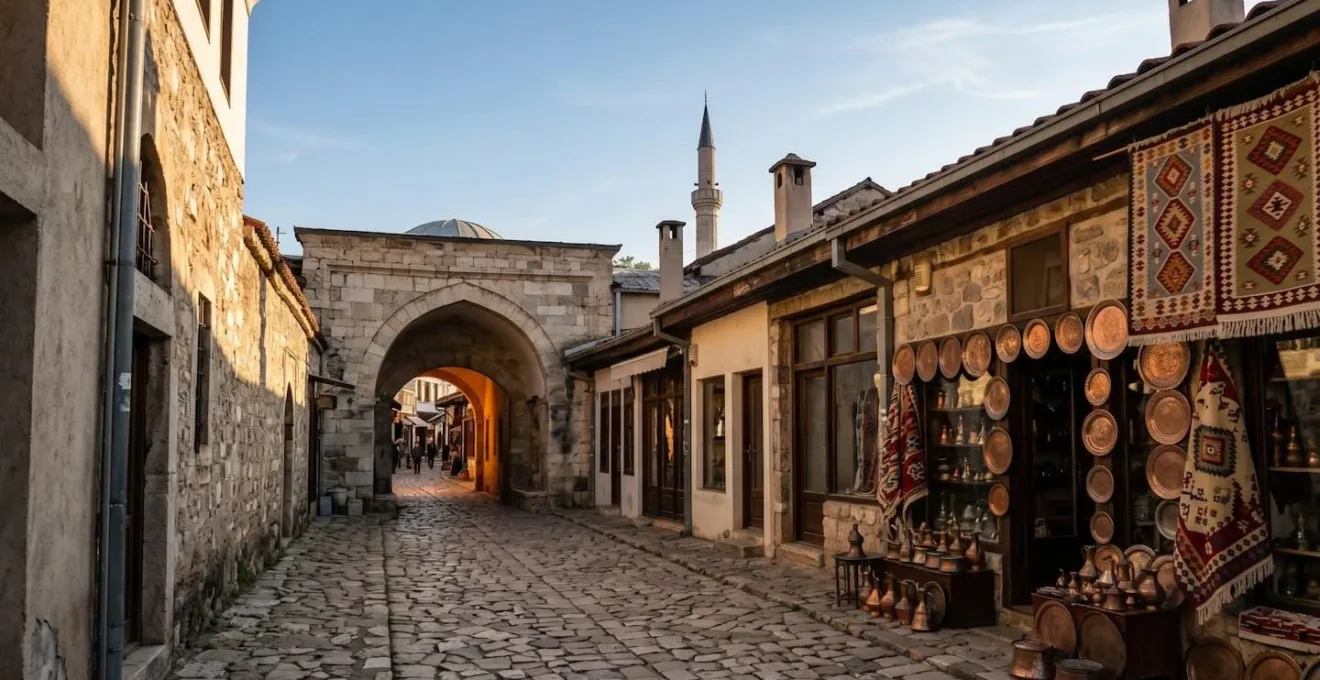
Stepping from Skopje’s monumental Macedonia Square into the Stara Čaršija, the Old Bazaar, feels like crossing a border in time. The city’s controversial neoclassical statues and fountains give way to a labyrinth of cobblestone streets, low-slung Ottoman-era buildings, and the persistent hum of commerce. For the first-time visitor, this magical chaos is both the main attraction and the biggest challenge. It’s a perfectly safe and endlessly fascinating place, but the common advice to “just get lost and wander” is a romantic recipe for ending up with a factory-made souvenir and an empty wallet.
Most guides will tell you to haggle, to try the kebab, and to admire the architecture. But they rarely explain the unwritten rules that separate a frustrating tourist experience from an enriching cultural immersion. They don’t tell you *why* the city looks so divided, *how* to engage in the commercial conversation of haggling without causing offense, or what sensory clues betray a true craftsman’s workshop. The secret to conquering the bazaar isn’t about aimless wandering; it’s about learning to read its codes.
This guide hands you the keys to that code. We will go beyond the surface to decode the bazaar’s architectural duality, master the art of negotiation, pinpoint culinary institutions, identify authentic craftsmanship, and capture its essence through a camera lens. By the end, you won’t just be a visitor; you’ll be an informed participant, capable of navigating the Čaršija with the confidence of a local.
This article will guide you through the essential knowledge needed to experience the bazaar authentically. The following sections break down everything from architectural history to practical shopping tips, ensuring you leave with genuine memories and treasures.
Summary: Your Insider’s Guide to the Skopje Old Bazaar
- Why Is the Architecture of Skopje Old Bazaar So Different from the City Center?
- How to Haggle in the Bazaar Like a Local Without Offending Shopkeepers?
- Čaršija Food Guide: Which Traditional Restaurant Serves the Best Kebab?
- When Is the Best Time to Photograph the Stone Bridge Without Crowds?
- Handmade or Factory: How to Spot Authentic Leather Goods in the Bazaar?
- Čaršija Food Guide: Which Traditional Restaurant Serves the Best Kebab?
- Why Are the “Çardak” Balconies Essential to Ottoman House Design?
- How to Capture Stunning Photos of Ottoman Architecture in North Macedonia?
Why Is the Architecture of Skopje Old Bazaar So Different from the City Center?
The stark architectural contrast between the Old Bazaar and the rest of Skopje’s center is the city’s most visible and debated feature. It’s not an accident of history but the result of a deliberate, and controversial, 21st-century nation-building project. The bazaar preserves its authentic, functional Ottoman character with its mosques, hammams, and caravanserais, while the area across the Stone Bridge was dramatically reshaped by the “Skopje 2014” project.
This massive urban overhaul aimed to forge a new national identity. As one study on the project’s impact notes, the goal was to redefine the nation’s heritage. In an article for Focus on Geography, researchers explain the project’s ideological underpinnings:
The monumental landscape constructed in Skopje tries to define Macedonia as the heir to the ancient Macedonian kingdom, but also as a bastion of Christianity, despite the long Ottoman history of the region and the large Albanian population living in the country.
– Focus on Geography Study, Constructing Nationalism Through the Cityscape: The Skopje 2014 Project
This initiative saw over 130 structures built or wrapped in neoclassical façades between 2010 and 2018, creating a grandiose but historically questionable landscape of towering statues and faux-classical buildings. This “architectural duality” makes the Old Bazaar more than just a market; it’s a living museum and a counter-narrative to the city’s modern identity project. The bazaar’s low-rise, human-scale design, focused on trade and community, stands in direct opposition to the monumental, declarative style across the river.
Understanding this visual tension is the first step to truly seeing Skopje. You’re not just looking at old and new buildings; you’re witnessing a conversation about history, identity, and culture, carved in stone and marble. The bazaar represents the city’s deep, multicultural Ottoman past, while the center projects a more recent, singular vision of its ancient roots.
How to Haggle in the Bazaar Like a Local Without Offending Shopkeepers?
In the Skopje Old Bazaar, haggling is not a battle; it’s a commercial conversation. Approaching it with the right mindset is crucial. It’s an expected and often enjoyable part of the process for specific items, but attempting to bargain on the wrong product can be seen as disrespectful. The key is to be polite, smile, and understand the unspoken rules of this cultural exchange. Your goal is to reach a price that feels fair to both you and the shopkeeper.
Before you even start, it’s vital to know what’s negotiable and what isn’t. Generally, high-value, unpriced artisan goods are open for discussion, while food and mass-produced items with price tags are not. Having cash, specifically Macedonian Denars (MKD), is a significant advantage. It shows you are a serious buyer and avoids the “I only have a credit card” scenario, which weakens your position. Avoid showing large bills until you’ve agreed on a price.
The following table, based on local market practices, breaks down where you can and cannot engage in this time-honored tradition.
| Item Category | Haggling Expected? | Typical Discount Range | Notes |
|---|---|---|---|
| Handmade Carpets & Textiles | Yes | 30-50% | Most negotiable items; artisan workshops offer best authenticity |
| Jewelry (Gold, Filigree) | Yes | 20-30% | Kujundjiska (Gold Street) vendors expect negotiation |
| Leather Goods & Copperware | Yes | 25-40% | Look for workshop signs; genuine craftsmen more flexible |
| Spices & Dried Fruits | Sometimes | 10-15% | Small discounts on bulk purchases |
| Food & Drinks | No | 0% | Fixed pricing at restaurants and cafes |
| Items with Price Tags | No | 0% | Marked prices are generally final |
To ensure your haggling experience is successful and respectful, it helps to have a clear strategy. Think of it as a friendly game with established steps. Your opening offer, your demeanor, and your payment method all play a part in the final outcome.
Action Plan: Your Haggling Strategy in 5 Steps
- Initial Offer: Start your negotiation by offering 30-50% less than the initial asking price. This sets a realistic starting point for the conversation.
- Maintain Demeanor: Always remain polite, friendly, and smile. A positive attitude transforms the negotiation into a pleasant interaction for everyone involved.
- Focus on Negotiable Items: Concentrate your efforts on high-value, handmade items like carpets, jewelry, copperware, and artisan leather goods where haggling is expected.
- Know the Non-Negotiables: Understand that items like food, drinks, or anything with a clear price tag are not open for discussion. Respect these fixed prices.
- Use Local Currency: Have Macedonian Denars ready. Using cash, rather than flashing a credit card, demonstrates you are a prepared and serious buyer, strengthening your negotiating position.
Čaršija Food Guide: Which Traditional Restaurant Serves the Best Kebab?
When you ask a Skopje local where to eat the best kebab (known locally as *ćevapi*), you won’t get a list of options. You’ll get one name: Destan. This isn’t just a restaurant; it’s a culinary institution, a benchmark against which all other kebabs are measured. For the authentic Čaršija experience, you must visit their original location in the heart of the bazaar, not their newer, more modern branches elsewhere.
What makes Destan iconic is its unwavering focus on one thing for over a century. The restaurant has perfected the art of the kebab by deliberately keeping its menu minimalist and its process consistent. This dedication to craft is what elevates a simple dish to a legendary status, making it a must-visit for anyone seeking genuine local flavor.
Case Study: Destan, Skopje’s 110-Year Kebab Institution
Opened in 1913, Destan is the oldest continuously operating restaurant in the Old Bazaar. Its enduring reputation is built on serving exclusively traditional Balkan kebabs. As detailed in a profile by travel platform Airial, the menu is purposefully simple: kebabs served in multiples of five, shopska salad, grilled peppers, and bread. This strategy allows them to master their craft. The kebabs are grilled continuously, ensuring every plate is fresh and served on their characteristic light metal plates. The service is famously no-frills and crusty—reminiscent of a classic American steakhouse—which locals consider part of the authentic experience. At Destan, the food quality is the sole focus, not the decor or presentation.
When you go to Destan, don’t expect a lengthy menu or fawning service. You are there for the kebab. Order a “desetka so kromid” (ten kebabs with onions) and a shopska salad. The meat is juicy, perfectly seasoned, and grilled over charcoal. The experience is fast, loud, and utterly authentic. It’s a taste of Skopje’s history served on a metal plate, a tradition that has resisted the tides of change for over 100 years.
When Is the Best Time to Photograph the Stone Bridge Without Crowds?
The Stone Bridge (Камен Мост) is the iconic heart of Skopje, connecting the Old Bazaar with the modern city center. For photographers, capturing its timeless beauty without a throng of tourists is the ultimate prize. Success depends entirely on timing. While midday offers bright light, it also brings harsh shadows and the peak “tour bus rush,” making a clean shot nearly impossible. The magic hours are at the very beginning and very end of the day.
The early morning golden hour (roughly 6-8 AM in summer, 7-8 AM in winter) is your best bet for a peaceful, crowd-free experience. The soft, warm light illuminates the ancient stones, and you can capture beautiful reflections in the Vardar River. The other prime window is the “blue hour,” just after sunset. The sky turns a deep blue, the bridge’s lights switch on, and the atmosphere becomes moody and romantic. This is the time for stunning long-exposure shots that capture the flow of city life against the static permanence of the bridge.
To help you plan your shoot with precision, here is a detailed guide to the lighting and crowd conditions throughout the day.
| Time Window | Crowd Level | Light Quality | Best For | Seasonal Notes |
|---|---|---|---|---|
| Early Morning (6-8 AM) | Very Low | Golden Hour / Soft sunrise light | Warm tones, peaceful atmosphere, reflections | Summer: 5:30 AM start; Winter: 7:00 AM start |
| Mid-Morning (9-11 AM) | Low-Medium | Bright, clear natural light | Detail shots, HDR photography | Ideal for spring and autumn clarity |
| Midday (12-2 PM) | Medium-High | Harsh overhead sun | Avoid for portraits; OK for architecture | Lunchtime offers brief crowd dip |
| Tour Bus Rush (10 AM – 1 PM) | Very High | Varies | Avoid if seeking empty shots | Peak season multiplies crowds |
| Late Afternoon (4-6 PM) | High | Golden Hour / Warm side-lighting | Dramatic shadows, texture emphasis | Local ‘korzo’ (promenade) time |
| Blue Hour (Just after sunset) | Medium | Deep blue sky, city lights on | Moody, romantic shots with illumination | Bridge lights activate; magical atmosphere |
| Night (8 PM+) | Low | Artificial lighting, long exposure | Light trails, fountain shows, reflections | Summer stays lively later than winter |
Beyond timing, composition is key. Don’t limit yourself to the classic head-on shot. For a more dynamic perspective, descend to the riverbank to capture the imposing arches from a low angle. Use the adjacent Art Bridge or Eye Bridge for a full-length profile of the Stone Bridge. Or, for a truly commanding viewpoint, climb to the walls of the Kale Fortress for a panoramic shot that frames the bridge, the river, and the Old Bazaar in a single, sweeping vista.
Handmade or Factory: How to Spot Authentic Leather Goods in the Bazaar?
The Old Bazaar is famous for its leather goods, but telling a genuine, handcrafted item from a factory-made import can be tricky. The secret lies in using all your senses. This is where you move beyond being a tourist and become a connoisseur. An authentic leather product has an “artisan’s footprint”—a collection of sensory clues that a mass-produced item simply cannot replicate. Before you even think about the price, perform a simple 5-senses authenticity test.
First, the smell: real leather has a rich, earthy, and slightly sweet aroma. Synthetic or “pleather” items will have a chemical or plastic-like odor. Second, the touch: genuine leather feels warm, supple, and slightly irregular. Run your hand over it; you should feel minor imperfections, which are a sign of a natural material. Fake leather feels cold, unnaturally smooth, and uniform. Third, the sight: look closely at the grain and the stitching. Real leather has an inconsistent grain pattern, while machine-made fakes have a repetitive, printed-on pattern. The stitching on handmade items is often slightly irregular, unlike the perfect, machine-aligned rows on factory goods.
Beyond the product itself, look for clues about the seller. A true artisan’s workshop is very different from a souvenir reseller’s shop. Here’s how to spot the difference:
- Look for visible tools: A genuine craftsman will have their tools of the trade—awls, leather punches, cutting knives—visible and often in use.
- Check for leather scraps: An authentic workshop will have offcuts of raw material, dye stains, and pieces in various stages of completion.
- Observe the distinct smell: The powerful, unmistakable aroma of tanning and working leather permeates a real workshop.
- Watch for active creation: True artisans are often working on their craft during business hours. Seeing them cut, stitch, or stamp leather is the ultimate proof.
- Ask direct questions: A simple “Дали е ова направено овде?” (Is this made here?) can reveal a lot. An authentic artisan will proudly explain their process, while a reseller might give a vague or rehearsed answer.
Don’t be afraid to engage with the shopkeeper. Ask about the type of leather, where it comes from, and how it was made. A passionate craftsman will be happy to share their story. This interaction is not just part of the verification process; it’s part of what makes buying a handmade item in the bazaar so special.
Čaršija Food Guide: Which Traditional Restaurant Serves the Best Kebab?
While Destan holds the crown for kebabs, a true culinary exploration of the Čaršija means looking beyond this single dish. The bazaar is teeming with hidden gems and specialized eateries that locals cherish. To eat like a local, you need to know what to eat and where to find it. The best experiences are often tucked away in small, unassuming shops that have been perfecting a single specialty for generations.
For example, you haven’t truly experienced Macedonian cuisine until you’ve had a proper Tavče Gravče. This hearty dish of baked beans is a national comfort food, best enjoyed at one of the traditional inns (*gostilnica*) hidden in the bazaar’s side streets. It’s a rich, flavorful, and deeply satisfying lunch that offers an authentic taste of home-style cooking. Similarly, while you can find Burek (a flaky pastry filled with cheese, meat, or spinach) all over the Balkans, the bakeries on the edge of the bazaar near Bit-Pazar are legendary. Go early in the morning to get it fresh from the oven, when the layers are at their flakiest.
For those with a sweet tooth, the bazaar is a paradise. Don’t leave without trying these specialties:
- Trileçe: This “three-milk cake” is a moist, decadent dessert. Seek it out at the historic Rigara sweetshop, operating since 1969, or one of the two Nexho sweetshop locations in the bazaar.
- Turkish Coffee on Hot Sand: For a unique cultural experience, visit the Ottoman Coffee Place. They use the traditional method of brewing coffee in a *cezve* heated on hot sand, a practice rarely seen elsewhere.
- Rakija Tasting: To understand the local spirit (in every sense of the word), start your journey at Rakija bar Kaldrma. Located at the bazaar’s entrance, it’s the perfect place for a welcoming taste of this potent fruit brandy.
Exploring these different tastes is what turns a simple meal into a cultural discovery. Each dish tells a story about the bazaar’s history and the diverse communities that have called it home.
Why Are the “Çardak” Balconies Essential to Ottoman House Design?
As you wander through the quieter residential pockets of the Old Bazaar or visit historic house-museums, you’ll notice a distinct architectural feature: the *çardak*. This is not just a decorative balcony; it is an essential, multi-functional element at the core of traditional Ottoman house design, reflecting the social, climatic, and cultural needs of the time. The çardak is typically an open, covered space or a projecting room on the upper floor, serving as the central hub of family life during the warmer months.
Functionally, the çardak is a brilliant piece of passive climate control. Its overhanging roof provides shade from the harsh summer sun, while its open or latticed sides allow for cross-ventilation, creating a cool, breezy living area. This made it the perfect space for daily activities, from dining and socializing to sleeping on hot nights. In a dense urban environment like the bazaar, the çardak offered a private outdoor space, a luxury that a ground-floor courtyard could not always provide.
Socially, the çardak was a semi-public space that mediated between the private interior of the home (*haremlik*) and the public world outside. It allowed family members, particularly women, to observe the life of the street without being fully seen, thanks to intricate wooden latticework known as *mushebak*. It was a space for receiving guests, for supervising the household, and for connecting with the community while maintaining a degree of privacy. Its prominent position on the building’s facade also served as a status symbol, with more elaborate carvings and a larger size indicating the wealth of the family.
The çardak’s design, often projecting over the street, also shaped the urban fabric of the bazaar. It created narrower, shaded alleyways and a more intimate, human-scale streetscape. This feature is a masterclass in how architecture can respond to climate, social structure, and urban density all at once.
Key Takeaways
- Architectural storytelling is key; understand the deliberate contrast between the Ottoman bazaar and the “Skopje 2014” project.
- Authenticity is found through sensory details and by identifying a true artisan’s workshop, not just a reseller’s shop.
- Mastering the bazaar means knowing the unwritten rules: when to haggle, where to find institutional food spots, and how to get the perfect photo without the crowds.
How to Capture Stunning Photos of Ottoman Architecture in North Macedonia?
Photographing Ottoman architecture in the Old Bazaar is about telling a story of texture, light, and time. Instead of taking wide, generic shots, a great photograph often comes from focusing on the details that give these buildings their soul. Train your eye to become a “detail-hunter,” looking for the intricate craftsmanship that defines this style. The real beauty is in the nuances that many tourists overlook.
Create a shot list focused on these specific elements. Look up inside the old caravanserais like Kapan An or Suli An to capture the geometric patterns of the wooden-carved ceilings. In mosques and hammams, zoom in on the *çini* (ceramic tiles) to capture their vibrant Iznik-style blue and white patterns. Pay attention to the unique shapes of the archways—pointed, horseshoe, and multi-lobed—and the massive, iron-studded wooden doors that guard the entrances to historic buildings. Even the carved marble ablution fountains (*şadırvan*) in mosque courtyards offer incredible close-up opportunities, as noted in the comprehensive guide by Wander-Lush.
Light is your most powerful tool for adding drama and depth. Ottoman architecture, with its deep courtyards, narrow alleys, and domed roofs, is a playground for light and shadow. Use these techniques to bring your photos to life:
- Hammam “God Rays”: In a traditional bathhouse, use the light filtering through the star-shaped roof openings. If there’s steam or dust in the air, you can capture stunning, dramatic “god-ray” effects.
- Courtyard Chiaroscuro: Photograph the courtyards of the caravanserais (*hans*) at midday. The harsh sun creates a powerful contrast between the bright center and the deep, dark shadows under the archways, perfect for a chiaroscuro effect.
- Golden Hour Minarets: Capture mosque minarets during the golden hour. The warm, low-angle light will beautifully emphasize their cylindrical shape and the intricate details of their balconies (*şerefe*).
- Contextual Juxtaposition: Create a powerful narrative by framing an Ottoman element (like a minaret or a hammam dome) with a modern or Brutalist building in the same shot. This visually tells the story of North Macedonia’s layered history.
By combining a focus on intricate details with a mastery of light and shadow, your photographs will move beyond simple documentation. They will become compelling stories that capture the true, timeless essence of the Old Bazaar’s architectural heritage.
Now that you are equipped with the keys to decode the bazaar’s architecture, commerce, and culture, the next step is to put this knowledge into practice, transforming your visit from a simple tour into a meaningful exploration.