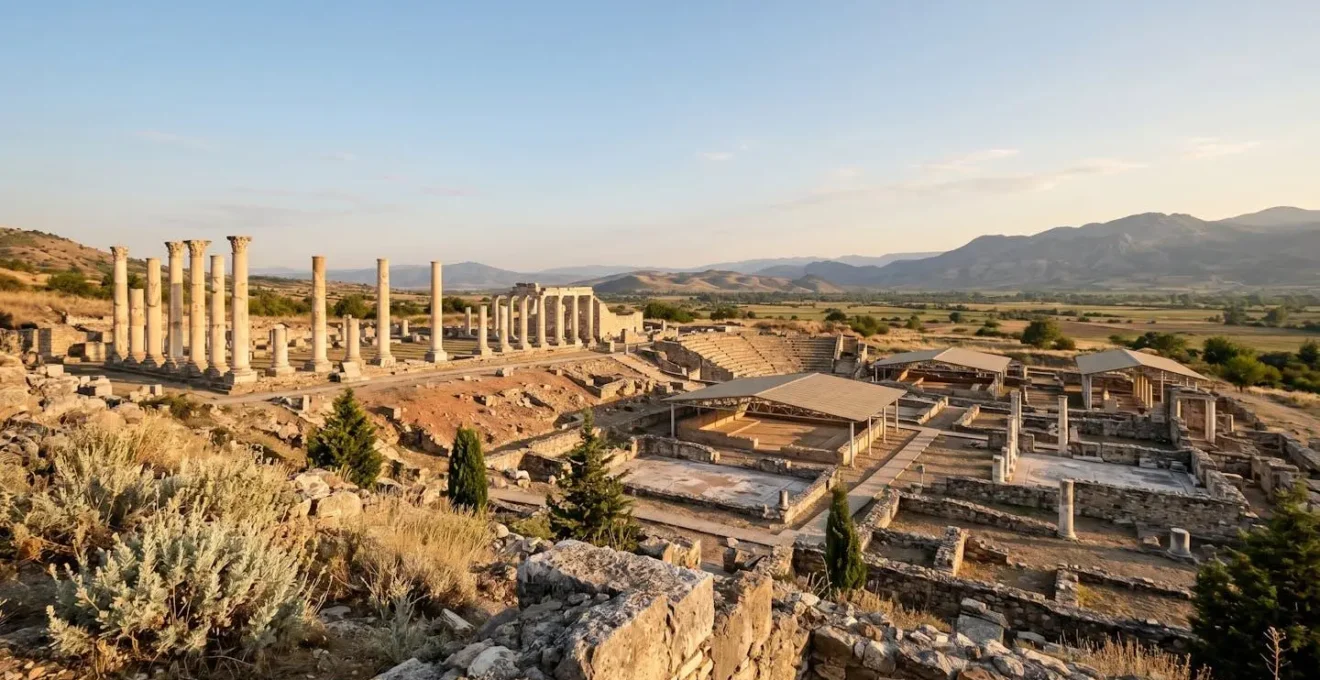
In summary:
- Choose transport based on reliability; the bus or a pre-arranged taxi for the “last mile” from Gradsko is often more practical than the train.
- Implement a “heat-smart” visiting strategy by exploring exposed areas early and saving covered mosaics for midday to avoid the intense summer sun.
- Navigate the ruins chronologically, starting from the Paeonian origins and ending with the Early Christian basilicas, to understand the site’s 700-year evolution.
- Prioritize Stobi over Heraclea for a day trip from Skopje due to its proximity and the sheer scale of a former provincial capital.
Planning a day trip from Skopje to escape the city’s bustle and immerse yourself in ancient history is an excellent idea. The Stobi archaeological site often emerges as the top candidate, a sprawling testament to the Roman and Byzantine empires. However, many tourists, armed with vague advice to “just take a bus,” find themselves unprepared for the logistical realities on the ground. They wander aimlessly under the Balkan sun, admiring ruins without grasping the epic story they tell, and often miss the very details that make Stobi a world-class site.
The common approach is to treat Stobi like any other tourist spot. But what if the key to a truly memorable visit wasn’t just about seeing the ruins, but about executing a well-planned operational playbook? This isn’t just a guide; it’s a strategic plan. We’ll move beyond generic tips and give you a clear, step-by-step framework for your expedition. We’ll cover the critical transport decisions, the on-site navigation strategy to appreciate its layered history, and the crucial timing to avoid the elements and get the most out of your time.
By treating your day trip as a small, well-organized mission, you transform a potentially frustrating outing into a deeply rewarding historical exploration. Forget just “seeing” Stobi; this guide will help you understand it, navigate it efficiently, and return to Skopje with a profound sense of discovery.
This comprehensive guide provides the practical, step-by-step plan you need. Discover how to tackle transportation, navigate the site chronologically, and make the most of your limited time.
Contents: A Strategic Guide to Stobi
- Why Are the Peacock Mosaics in Stobi Considered Masterpieces?
- Train or Bus: Which Is the Most Reliable Way to Reach Stobi?
- Is Stobi Worth Visiting If You Have Already Seen Pompeii?
- The Hydration Mistake That Ruins Summer Visits to Stobi
- How to Navigate the Stobi Ruins in Chronological Order?
- Why Are the Peacock Mosaics in Stobi Considered Masterpieces?
- Stobi or Heraclea: Which Roman Site Should You Prioritize on a Short Trip?
- How to Explore Roman Ruins in North Macedonia Beyond the Usual Guidebooks?
Why Are the Peacock Mosaics in Stobi Considered Masterpieces?
The mosaics at Stobi, particularly those in the 5th-century Baptistery of the Episcopal Basilica, are celebrated not just for their age or beauty, but for their profound symbolic meaning and artistic sophistication. The peacock, a central motif, is far more than a decorative element. In Early Christian art, it was a powerful symbol of immortality and resurrection. This deep symbolism is a key reason for their masterpiece status.
As experts in Byzantine iconography from the American University of Beirut Archaeological Museum explain, the imagery was carefully chosen to convey complex theological ideas to the faithful. Their research clarifies the rich visual language of these ancient artworks:
Peacocks are often used to represent paradise (Garden of Eden), renewal and spring, it symbolizes victory over death, apotheosis and immortality.
– American University of Beirut Archaeological Museum, Byzantine mosaic symbolism documentation
The artists at Stobi used thousands of tiny stone and glass cubes, or tesserae, to create stunningly detailed scenes. They depicted deer drinking from a kantharos (a symbol of the soul thirsting for God), various birds, and intricate geometric patterns. The peacocks, with their vibrant, fanned tails, were a visual promise of eternal life, a core tenet of the burgeoning Christian faith. It’s this combination of technical skill, rich color, and deep spiritual storytelling that elevates these mosaics from mere decoration to timeless masterpieces.
As you can see in the intricate details, the craftsmanship allowed for subtle gradients and textures that bring the symbolic animals to life. This level of artistry was a testament to Stobi’s importance as a major episcopal center. The mosaics were not just art; they were sermons in stone, meant to educate and inspire a largely illiterate congregation.
Train or Bus: Which Is the Most Reliable Way to Reach Stobi?
When planning your trip from Skopje to Stobi, the primary question is transport. While both train and bus options exist, reliability isn’t just about schedules; it’s about the entire journey, including the critical “last mile” to the site entrance. The train, for instance, offers a direct journey from Skopje. Transport data suggests a journey of around 1 hour and 21 minutes, running twice daily, which seems convenient on paper. However, local train schedules can be inconsistent, and the Stobi stop, while technically at the site, may not always be serviced as expected.
The bus is often considered the more dependable option for intercity travel in North Macedonia. Buses to the south (towards Gevgelija or Greece) run frequently from Skopje’s main bus station. Your destination stop isn’t Stobi itself, but the nearby town of Gradsko, about 5 km away. From there, you must manage the final leg of the journey. This is where pre-planning is essential. While you can sometimes ask a bus driver for a “courtesy stop” on the main highway near the Stobi turnoff, this is not guaranteed and can be unsafe.
The most practical solution is to take a bus to Gradsko and then a local taxi to the archaeological site’s entrance. The taxi ride is short and inexpensive, typically costing between 200-300 MKD ($3-5). This hybrid approach—bus for the main journey, taxi for the last mile—removes uncertainty and delivers you directly to the entrance, ready to explore. For the return journey, you can arrange a pickup time with the same taxi driver or get the contact number for a local taxi service from the staff at Stobi’s ticket office.
Is Stobi Worth Visiting If You Have Already Seen Pompeii?
This is a common question for travelers familiar with Italy’s premier Roman site. The answer is a definitive yes, but for a completely different reason. While Pompeii offers a hauntingly perfect snapshot of Roman life frozen in a single moment in 79 CE, Stobi presents something arguably more fascinating: an architectural palimpsest. It’s a city that wasn’t destroyed in an instant but lived, died, and was reborn over seven centuries.
Stobi’s 700-Year Evolution
Stobi’s story is one of continuous urban transformation. It began as a Paeonian settlement around 400 BC, grew into the capital of the Roman province Macedonia Salutaris, and even hosted Emperor Theodosius I in 388 CE. By 325 CE, it was a significant Early Christian hub, with its Bishop Budius attending the First Council of Nicaea. Unlike Pompeii, Stobi’s ruins show this evolution. For example, the Central Basilica was built over a 4th-century synagogue, which itself replaced an even older one. This layered history physically demonstrates the transition from the pagan Roman Empire to the Christian Byzantine civilization, a narrative you can’t see at Pompeii.
Where Pompeii has villas with preserved frescoes, Stobi has the ruins of a synagogue sitting beneath a Christian basilica. Where Pompeii has Roman forums, Stobi has a 2nd-century Roman theatre that was later converted and repurposed. You can literally walk through layers of history. You are not just seeing a Roman city; you are witnessing the very process of cultural and religious change that defined Late Antiquity. Visiting Stobi after Pompeii is not a repetition; it’s the sequel. It shows you what happened next in the Roman world.
The ruins of the baptistery are a prime example of this transformation, showcasing a distinct Christian architectural identity emerging from Roman foundations. So, if Pompeii is a photograph, Stobi is a feature-length film chronicling the rise and fall of civilizations on a single patch of land.
The Hydration Mistake That Ruins Summer Visits to Stobi
The most common rookie error when visiting Stobi, especially from June to August, isn’t getting lost or missing a key ruin; it’s underestimating the sun. The site is vast, open, and offers minimal natural shade. A standard visit to explore the main highlights can take a significant amount of time; visitor planning guidelines suggest between 1.5 to 2.5 hours of walking on uneven, sun-baked stone paths. Showing up at noon with a single small bottle of water is a recipe for heat exhaustion, which can quickly ruin your entire day trip.
The hydration mistake is not just about not bringing enough water; it’s about not having a heat-smart strategy for your visit. This means planning your route and timing around the sun’s position. Simply carrying more water is a passive solution; actively managing your exposure is the professional approach. You must think like a desert explorer: conserve energy, seek shade, and tackle the most exposed areas during the coolest parts of the day. A well-prepared visitor doesn’t just survive the heat; they use a smart itinerary to thrive and enjoy the site in comfort.
Instead of wandering aimlessly, follow a structured plan that prioritizes your comfort and allows you to fully appreciate the sprawling ruins without succumbing to the heat. This strategic approach is far more effective than just remembering to wear a hat.
Your Heat-Smart Itinerary Checklist for Stobi
- Early Morning (Before 11 AM): Start with the most exposed areas. Explore the 2nd-century Roman Theatre, the open-air sections of the Central Basilica, and walk the length of the Via Principalis main street while the sun is still relatively low.
- Mid-Morning to Early Afternoon (11 AM – 2 PM): Move towards the semi-shaded Palace complexes. Focus on the Theodosian Palace, with its rich mosaics, and the adjacent House of Partenius. The partial walls and structures offer intermittent relief from direct sun.
- Peak Heat Hours (2 PM – 4 PM): This is the time to retreat. Head for the covered mosaic shelters, especially the magnificent ones in the Episcopal Basilica’s baptistery. Also, use this time to visit the on-site visitor center museum, which is indoors and air-conditioned.
- Essential Preparation: Your pack list must include a minimum of 1.5 liters of water per person. Wear comfortable, sturdy walking shoes suitable for uneven ancient stones. Apply high-SPF sun protection before you arrive and bring it with you to reapply.
How to Navigate the Stobi Ruins in Chronological Order?
Touring Stobi without a plan can feel like flipping randomly through a history book. To truly understand the site’s significance, you should navigate it as a “time traveler,” walking through its history in the order it was built. This chronological approach transforms a confusing collection of stones into a coherent narrative of a city’s life, from its birth to its eventual abandonment. A logical path allows you to see how each era built upon, and often erased, the one before it.
Start your journey where the city began and move forward through time. This method requires a bit of orientation but pays off immensely in comprehension. You’ll physically experience the expansion of the city, the shift in architectural styles from Roman imperial grandeur to more functional Byzantine construction, and the profound religious transition marked by the construction of grand basilicas over older structures. This isn’t just a walking route; it’s the city’s autobiography read in the correct order.
Follow this phased walking route to peel back the layers of Stobi’s 700-year history methodically. It’s the most effective way to appreciate the full scope of what you are seeing and understand the context of each building within the city’s long and storied past.
Time Traveler’s Walking Route Through Stobi
- Phase 1 – Paeonian Origins (Archaic Period, pre-197 BC): Begin your visit at the northern terrace. This 25,000 m² area is where the earliest Paeonian settlement was established. Look for the smaller, more irregular stones in the foundation walls, which are characteristic of this early period.
- Phase 2 – Roman Imperial Era (2nd-3rd Century CE): Proceed towards the civic heart of the city. This includes the grand Roman Theatre (3rd-century construction), the Forum area, and the main paved streets like Via Principalis. Identify the large, uniform ashlar masonry blocks, a hallmark of powerful Roman engineering.
- Phase 3 – Late Antiquity Prosperity (4th-5th Century): Next, visit the luxurious residential and commercial complexes that signify Stobi’s golden age. Explore the Palace of Theodosius with its stunning marble floors and opus sectile mosaics, the nearby House of Partenius, and the Valavica commercial complex.
- Phase 4 – Early Christian Transformation (5th-6th Century): Conclude your tour at the sites that mark Stobi’s conversion to a major Christian center. See the Episcopal Basilica with its famous baptistery (built at the beginning of the 5th century) and the Central Basilica, which was constructed over the earlier synagogue. Observe how Roman columns and materials were repurposed (a technique called spolia) in these new Byzantine structures.
Why Are the Peacock Mosaics in Stobi Considered Masterpieces?
Beyond their deep symbolism, the peacock mosaics in Stobi’s Baptistery are considered masterpieces due to their exceptional technical execution and the story they tell about the city’s wealth and artistic connections. The quality of the work is a direct indicator of the patron’s status and the skill of the artisans, who were likely part of an elite, traveling workshop serving major centers in the Byzantine world. These were not local folk artists; they were masters of their craft.
The technique used is known as opus tessellatum, where small, uniformly cut cubes (tesserae) of stone, ceramic, and glass are set into a bed of mortar. What makes the Stobi mosaics stand out is the artists’ sophisticated use of color and shading. They created a wide palette, using vibrant blues, greens, and even gold-backed glass tesserae to capture the iridescent shimmer of a peacock’s feathers. They skillfully arranged the tesserae in flowing lines (andamento) to create a sense of movement and life. The subtle gradients achieved with these rough-cut stones are a testament to their incredible skill.
This level of artistry was expensive and time-consuming, reflecting Stobi’s importance as the capital of the Macedonia Salutaris province. Commissioning such a work was a statement of power and piety. The preservation of these mosaics allows us a direct look into the aesthetic values and technical capabilities of the 5th century, making them an invaluable resource for art historians and archaeologists alike. They are masterpieces because they represent the pinnacle of Byzantine mosaic art in the region, perfectly blending spiritual meaning with technical brilliance.
Key takeaways
- Stobi’s true value is its 700-year layered history, offering a narrative of urban evolution that single-moment sites like Pompeii cannot.
- A successful day trip hinges on a practical “operational playbook,” focusing on last-mile transport from Gradsko and a heat-smart itinerary for the site itself.
- Navigating the ruins chronologically, from Paeonian foundations to Byzantine basilicas, transforms a confusing walk into a coherent historical journey.
Stobi or Heraclea: Which Roman Site Should You Prioritize on a Short Trip?
For travelers with limited time in North Macedonia, a tough choice often arises: Stobi or Heraclea Lyncestis? Both are significant Roman sites, but they offer vastly different experiences and logistical demands, especially for someone based in Skopje. The decision comes down to three factors: your location, your available time, and what you prioritize in an archaeological site—scale or artistic perfection.
Heraclea Lyncestis, located near Bitola in the south, is famous for its absolutely stunning and well-preserved floor mosaics, which are among the finest in the Balkans. However, it is a much smaller excavated area. Stobi, on the other hand, was a massive provincial capital. It offers a sense of urban scale, with sprawling streets, multiple basilicas, palaces, and a theatre. As one visitor noted in a TripAdvisor archaeological site comparison, “Stobi is way bigger and more excavated.” For a day trip from Skopje, Stobi is the clear logistical winner, being only about an hour’s drive away. Heraclea would require a much longer day (3+ hours drive each way) or an overnight stay in Bitola.
The following table breaks down the key differences to help you make an informed decision based on your travel style and priorities.
| Criterion | Stobi | Heraclea Lyncestis |
|---|---|---|
| Primary Appeal | Urban planning, scale, capital city infrastructure | Pristine floor mosaics, artistic sophistication |
| Excavation Status | Extensively excavated, larger visible area | Only 12% excavated, 7 historical layers visible |
| Mosaic Highlights | Multiple mosaics across buildings, baptistery peacock notable | Extraordinary large mosaics in Great Basilica narthex (late 6th century) |
| Distance from Skopje | 80-100 km south (1 hour drive) | ~200 km southwest via Bitola (3+ hours) |
| Nearby Attractions | Tikveš wine region (largest in Balkans) | Bitola’s Širok Sokak, Ottoman architecture, Lake Ohrid access |
| Historical Role | Capital of Macedonia Secunda, Via Egnatia/Via Axius crossroads | Founded by Philip II, strategic border fortress, Via Egnatia waypoint |
| Visitor Experience | Easy day trip from Skopje, more spread out site | Requires southern Macedonia base, compact viewing area |
How to Explore Roman Ruins in North Macedonia Beyond the Usual Guidebooks?
A single day trip to Stobi is fantastic, but it only scratches the surface of North Macedonia’s rich Roman and Byzantine heritage. To go beyond the standard tourist trail, think like an ancient traveler and follow the roads. The major Roman road, the Via Axius (following the modern Vardar River valley), connected the Danube to the Aegean Sea, with Stobi as its most important junction. Structuring a multi-day itinerary along this ancient corridor allows you to connect the dots and see Stobi in its regional context.
This approach moves you from a passive tourist to an active historical explorer. Instead of just visiting isolated sites, you begin to understand the network of trade, military, and culture that connected them. For example, combining a visit to Stobi with the nearby Tikveš wine region isn’t just a nice pairing; it’s a link to a viticultural tradition that has existed in the area since Roman times. This contextual travel provides a much deeper and more rewarding experience than a simple checklist of ruins.
For the truly dedicated explorer, there are even more avenues. You can access recent excavation papers on sites like academia.edu, contact the National Institution Stobi directly for specialized tour information, or check university archaeology departments for public lectures. This transforms a vacation into a learning expedition.
Via Axius Roman Road: A Multi-Day Itinerary
- Day 1 – The Ancient Capital Route: Begin your journey at the ruins of Scupi, Skopje’s Roman predecessor. Then, drive 80km south along the ancient Via Axius corridor to Stobi, the former capital of the Macedonia Salutaris province, located at the strategic confluence of the Crna and Vardar rivers.
- Day 2 – Wine and Heritage Connection: Dedicate the day to exploring Stobi in depth, then connect its history to the present by touring the Tikveš wine region, the largest vineyard area in the Balkans. Visit a modern winery to see how the ancient tradition of viticulture continues today.
- Day 3 – Lesser-Known Fortresses: Continue your journey to explore more remote but important sites. Visit the Bargala fortress ruins near Štip and the Isar archaeological site, completing your journey along the ancient trade routes.
- Deeper Research: For advanced preparation, search for excavation reports on academia.edu, contact the National Institution Stobi (stobi.mk) for potential specialized tours, and check the Ss. Cyril and Methodius University archaeology department website for events.
You now have the complete operational playbook to plan and execute a flawless day trip to Stobi. By focusing on practical logistics, a smart on-site strategy, and a deeper historical context, you’re equipped to transform a simple outing into a memorable archaeological expedition. Now, take this roadmap and start planning your journey back in time.