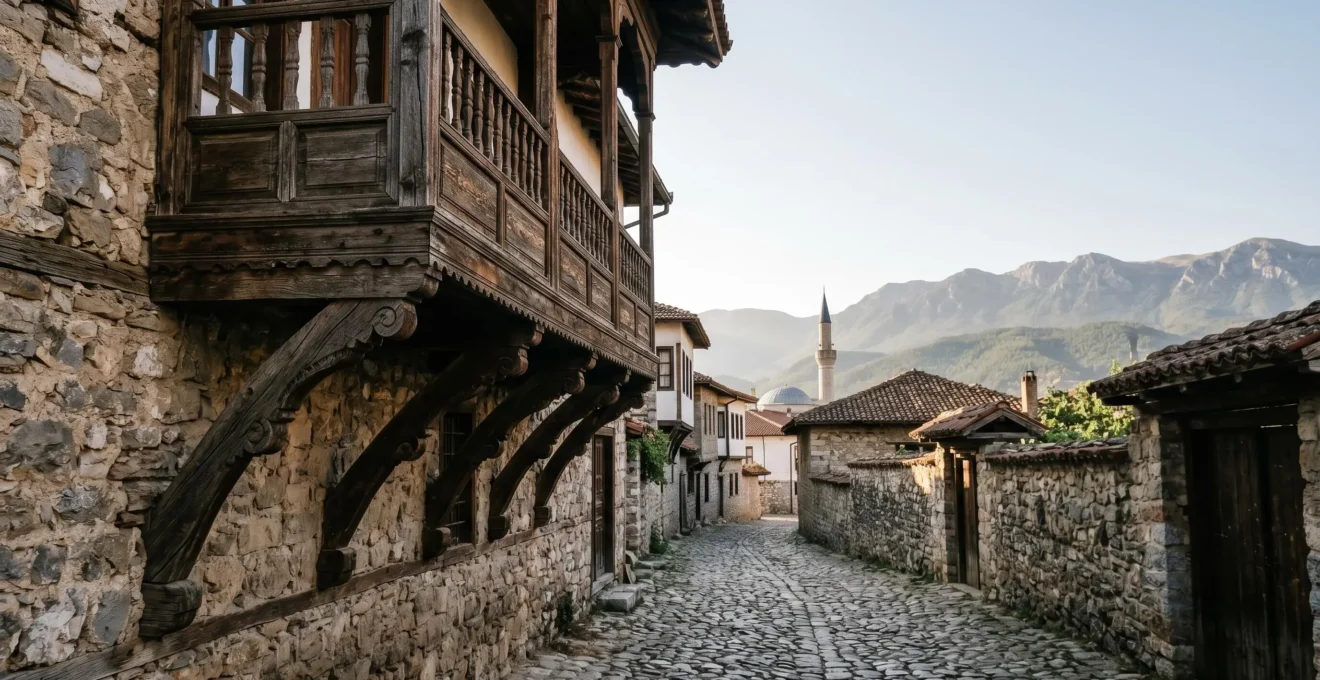
To truly capture Ottoman architecture, you must photograph its purpose—how buildings manage light, privacy, and community—not just their form.
- Golden and blue hours offer dramatically different color palettes and moods, requiring distinct technical approaches.
- Prime lenses in narrow streets create intimacy, while telephoto lenses compress landscapes to connect minarets with mountains.
Recommendation: Move beyond simple documentation. Focus on capturing details that tell a story of history and life, always prioritizing the dignity of the residents.
The winding cobblestone streets of Skopje’s Old Bazaar and the historic towns of North Macedonia are a photographer’s dream. Yet, many return with images that feel generic, capturing the buildings but missing their soul. It’s easy to fall into the trap of taking the same postcard views, following basic advice about shooting at golden hour and hoping for the best. This approach often overlooks the deep narrative embedded within the architecture itself.
The real challenge, and the greatest reward, lies in understanding *why* these structures look the way they do. Ottoman architecture is a masterclass in manipulating light, creating private sanctuaries within bustling communities, and designing spaces for social interaction. It’s a language of projecting balconies, intricate latticework, and courtyards that create a dialogue between shadow and sun. According to recent architectural research, of the 1,413 significant Ottoman-era structures once identified, only 225 are formally recognized as cultural heritage, making the task of documenting them with intention and respect all the more vital.
This guide moves beyond the basics. We will break down how to translate the architectural intent of these historic buildings into powerful photographic decisions. Instead of just listing locations, we will explore how specific lens choices, an understanding of light, and an ethical approach to framing can help you create images that are not only stunning but also deeply resonant with the spirit of the place.
To help you navigate these rich visual landscapes, this article is structured to answer the most pressing technical and creative questions a photographer faces on the ground. From choosing the right lens for tight alleyways to mastering the light on Skopje’s iconic Stone Bridge, each section provides practical, expert advice.
Summary: A Photographer’s Guide to North Macedonia’s Ottoman Heritage
- Why Are the “Çardak” Balconies Essential to Ottoman House Design?
- Sunrise or Sunset: When to Shoot the Stone Bridge for Best Colors?
- Wide Angle vs Prime: Which Lens Is Best for Narrow Cobblestone Streets?
- The Privacy Mistake: How to Photograph Old Houses Without Upsetting Locals?
- How to Frame Minarets against the Mountain Backdrop perfectly?
- Sunrise or Sunset: When to Shoot the Stone Bridge for Best Colors?
- When Is the Best Time to Photograph the Stone Bridge Without Crowds?
- How to Navigate Skopje Old Bazaar Without Falling for Tourist Traps?
Why Are the “Çardak” Balconies Essential to Ottoman House Design?
The projecting upper floors and balconies, known as a “çardak,” are arguably the most defining feature of Balkan Ottoman residential architecture. They are far more than mere decoration. Photographically, understanding their function is key to capturing their essence. The çardak was a semi-public social space, designed to overlook the street and connect the family with the community, while the recessed lower floors maintained privacy. It also served a crucial climate-control function, shading the floors below from the harsh summer sun.
Your goal as a photographer is to capture this architectural intent. Don’t just take a flat picture of the house. Look for compositions that highlight the çardak’s role. A low angle looking up can emphasize its commanding presence over the street. A shot from across the way can show how it interacts with neighboring balconies, hinting at the community connection. The most compelling images often focus on the dialogue between light and shadow that these structures create.
As the image above demonstrates, the true beauty is often in the details. The harsh midday sun, typically a photographer’s enemy, becomes a powerful tool here. It carves out the intricate woodwork of the support brackets and railings, creating a dramatic, high-contrast composition. Focus on these textures—the weathered wood grain, the hand-carved patterns, the deep pockets of shadow. These macro details tell a story of craftsmanship and time that a wide shot of the entire building can miss. This is how you photograph not just a balcony, but the history and function it represents.
Sunrise or Sunset: When to Shoot the Stone Bridge for Best Colors?
The Stone Bridge in Skopje is a timeless subject, but capturing its magnificence requires a masterful approach to light. While golden hour offers beautiful warmth, the period just after sunset—the blue hour—provides a unique and powerful palette for architectural photography. This is when the deep, cool tones of the sky create a stunning contrast with the warm artificial lights illuminating the bridge and surrounding city. It’s a time of balance, where natural and man-made light coexist in perfect harmony.
The key to a successful blue hour shot is technical precision. This isn’t a time for handheld snapshots; it’s a deliberate process that requires a tripod and a clear plan. The goal is to use a long exposure to smooth the surface of the Vardar River into a silky, reflective sheet and to make the light trails of any passing boats or people disappear. This technique isolates the bridge as a static, stoic monument against a dynamic, fluid world. Mastering these settings is essential for producing a professional-quality image.
Your Action Plan: Nailing the Blue Hour Bridge Shot
- Timing is everything: Be in position 15-30 minutes after the sun has officially set. This is when the sun is 4-6 degrees below the horizon, creating the richest blue in the sky.
- Lock down your tripod: Set your aperture to a mid-range like f/8-f/11 for a deep depth of field, ensuring the entire bridge is sharp. Keep your ISO at its base level (100 or 200) to minimize noise.
- Control your shutter: Your shutter speed will be your primary variable, likely falling between 1 and 30 seconds. Use this to get a correct exposure and to control the smoothness of the water.
- Set your white balance manually: Don’t let your camera’s auto mode “correct” the beautiful coolness. Set a manual Kelvin temperature between 4000K and 5000K to preserve and enhance the deep blue tones.
- Embrace the long exposure: An exposure of 10 seconds or more, a technique explained in a guide to blue hour photography, will not only create silky water but also has the magical effect of erasing moving people and crowds from your final image.
By following this checklist, you move from being a passive observer of the scene to an active creator. You are not just taking a photo of the Stone Bridge; you are orchestrating light, time, and color to capture a specific, evocative mood that few tourists will ever witness.
Wide Angle vs Prime: Which Lens Is Best for Narrow Cobblestone Streets?
The narrow, winding streets of an Ottoman-era bazaar present a classic photographic challenge: how to capture the sense of place when you can’t step back far enough. This is where your lens choice becomes a critical creative decision. While a wide-angle zoom lens seems like the obvious, practical choice, many professional street and architectural photographers advocate for a different approach. The constraints of a prime lens (a lens with a fixed focal length) can often lead to more powerful and intimate images.
A wide-angle prime, like a 28mm or 35mm, forces you to engage with the environment. You can’t stand back and zoom in; you have to “zoom with your feet,” moving through the space to find your composition. This process makes you a more active participant in the scene, often revealing angles and details you would have otherwise missed. It pushes you to get closer, creating images with a greater sense of immersion and emotional impact.
Case Study: The Prime Lens Advantage
Expert street photographers often prefer prime lenses because they remove one variable—zooming—allowing for faster reactions to fleeting moments. In the context of architecture, this translates to a more deliberate compositional process. A 35mm prime lens offers a perspective very similar to the human eye, resulting in images that feel natural and unstrained. Furthermore, prime lenses are generally sharper and have better low-light performance than their zoom counterparts at a similar price point, giving you superior image quality, which is crucial for capturing the rich textures of old stone and wood.
Ultimately, the “best” lens depends on the story you want to tell. A wide-angle lens is excellent for establishing context, while a short telephoto can isolate beautiful details. The following table, based on a comparative analysis of street photography lenses, breaks down the options for navigating these tight spaces.
| Lens Type | Focal Length | Best Use Case | Advantages | Limitations |
|---|---|---|---|---|
| Wide-Angle Prime | 24-28mm | Capturing full environment and architectural context in tight spaces | Gets everything in frame, encourages getting close, immersive feeling | Most intimidating, requires proximity to subjects, complex composition |
| Standard Prime | 35mm | Versatile street architecture with natural perspective | Realistic human-eye perspective, widely available, excellent image quality | Still requires getting close, can feel uninspired without strong composition |
| Short Telephoto Prime | 50-85mm | Isolating architectural details and compressing layers | Compresses perspective layers, isolates details, creates depth | Too restrictive in narrow spaces, requires distance, can feel creepy |
The Privacy Mistake: How to Photograph Old Houses Without Upsetting Locals?
The beautiful Ottoman houses you’re aiming your lens at are not museum pieces; they are homes. This simple fact introduces the most important non-technical aspect of your photography: ethics. The biggest mistake a visiting photographer can make is to treat these inhabited spaces like an empty movie set, pointing long lenses into windows or photographing people without any form of consent. This approach is not only disrespectful but also leads to sterile, voyeuristic images that lack human connection.
The principle of ethical framing is about finding beauty without intrusion. It means shifting your focus from capturing everything to capturing the right things. Instead of a wide shot of a home with people on the balcony, focus on an abstract detail: the texture of a painted shutter, the play of light on a carved door, the pattern of tiles on a roof. These detail shots can be more evocative and powerful, hinting at the life within without violating privacy. They tell a story of history, craft, and culture.
The image above exemplifies this approach. It captures the essence of the place—the weathered stone, the pop of color from the shutter—without showing a single identifiable private detail. It’s a composition of texture, color, and history. If people are part of the scene you wish to capture, the rule is simple and universal. As photography tour leader Luka Esenko advises from his experience in the region:
Most locals are comfortable being photographed, but it’s polite to gesture or ask for permission first.
– Luka Esenko, Painted Mosque of Tetovo photography guide
A simple smile, a gesture towards your camera, and a nod is a universal language. More often than not, you’ll be met with a smile in return. This small act of connection transforms the interaction from extractive to collaborative, and the resulting photograph will carry that positive energy.
How to Frame Minarets against the Mountain Backdrop perfectly?
One of the most iconic views in cities like Skopje or Tetovo is the slender, elegant form of a minaret set against the dramatic backdrop of the surrounding mountains. However, capturing this scene the way your eye sees it can be deceptive. A wide-angle lens, which you might be using in the narrow city streets, will render the mountains as small, distant, and insignificant. The secret to creating a powerful composition that emphasizes this relationship is a technique called perspective compression.
Perspective compression is an effect achieved by using a telephoto lens (typically in the 70-200mm range or longer) and shooting from a significant distance away from your subject. The long focal length magnifies the background, making distant objects like mountains appear much larger and closer to the foreground subject, in this case, the minaret. This creates a visually dense and layered image where the man-made and natural worlds are brought into a dramatic and intimate relationship. You are no longer just photographing a tower; you are orchestrating a grand scenic statement.
To achieve this effect, you need to move from being a reactive photographer to a proactive planner. Here are the key steps to mastering this advanced technique:
- Find Your Vantage Point: Scout for elevated locations far from the minaret you wish to photograph. This could be a hill, the upper floor of a building, or a bridge on the other side of town. The further away you are, the more compression you will achieve.
- Use a Telephoto Lens: A 70-200mm lens is a great start. Don’t be afraid to use it at its longest end. This is what will pull the mountains forward in your frame.
- Stabilize Your Shot: A sturdy tripod is non-negotiable. At these long focal lengths, even the slightest camera shake will ruin your shot’s sharpness. A geared head allows for the precise, micrometric adjustments needed to perfect your framing.
- Enhance the Clarity: Use a circular polarizing filter (CPL) to cut through atmospheric haze. This will make the distant mountains appear clearer, and it will deepen the blue of the sky, making your entire composition pop with color and contrast.
- Plan for the Light: Use apps like PhotoPills or The Photographer’s Ephemeris. These tools allow you to predict the exact position of the sun or moon, enabling you to plan a shot where they rise or set directly behind the minaret for the ultimate composition.
Sunrise or Sunset: When to Shoot the Stone Bridge for Best Colors?
While the post-sunset blue hour offers a cool, dramatic mood, the classic golden hour—the period shortly after sunrise and before sunset—presents an entirely different, yet equally compelling, opportunity for photographing the Stone Bridge. This is the time of warm, soft, directional light that has been celebrated by painters and photographers for centuries. Understanding how to harness this light is fundamental to architectural photography.
At sunrise, the light will be coming from the east, bathing one side of the bridge’s arches and the Kale Fortress behind it in a golden glow, while leaving the other side in cool shadow. This creates a wonderful sense of depth and three-dimensionality. The low angle of the sun will cast long shadows across the bridge’s deck, which you can use as powerful leading lines to guide the viewer’s eye through the frame. The stone itself, which can look flat in the harsh light of midday, comes alive with texture and warmth during these precious minutes.
Sunset offers a similar quality of light but from the opposite direction. As the sun drops in the west, it will backlight the bridge for viewers on the eastern bank, potentially creating a stunning silhouette effect. Alternatively, shooting from the western side will capture the warm “alpenglow” on the mountains in the distance and the last kisses of light on the statues and historic buildings lining the Vardar River. This is the time for capturing a more romantic and nostalgic mood, as the city winds down and the lights begin to flicker on.
Unlike the technical precision of blue hour, golden hour photography is more about observation and feeling. The light changes rapidly, so you must be prepared to move and recompose often. Look for reflections of the warm sky in the river, the way the golden light catches the edge of a carving, or the long, graphic shadows cast by the bridge’s lamps. This is your chance to capture the bridge not just as a structure, but as a character bathed in the most beautiful light of the day.
When Is the Best Time to Photograph the Stone Bridge Without Crowds?
The Stone Bridge is the heart of Skopje, and as such, it is almost always bustling with people. For a photographer trying to capture its timeless architectural form, crowds can be a major frustration. While technical tricks can help, the most effective strategy is often simple, pragmatic planning. The key is to shoot when everyone else isn’t.
The single most effective time to have the bridge almost to yourself is at dawn. Waking up before the city does is a small price to pay for an uninterrupted view. In the moments just before and after sunrise, you’ll be joined only by a few street cleaners and early commuters. This solitude allows you to set up your tripod in the perfect spot, experiment with different compositions, and capture the clean, powerful lines of the bridge without any human distraction. The early morning light also offers a beautiful, soft quality that is ideal for photography.
If you’re not an early riser, another strategy is to leverage a long exposure, especially during the dimmer light of twilight or blue hour. As discussed previously, an exposure lasting 10, 20, or even 30 seconds has a magical effect: because people walking across the bridge don’t stay in one place, they simply fail to register in the final image. They become transparent ghosts that are effectively erased by the camera, leaving you with a perfectly clean shot of the bridge, even during a relatively busy evening.
Beyond timing your day, consider timing your trip. North Macedonia’s tourist season peaks in the summer months of July and August. Visiting in the shoulder seasons (April-June or September-October) will not only mean fewer crowds on the bridge but also more pleasant weather and often more dramatic, cloud-filled skies. Finally, be mindful of the day of the week. The bridge will naturally be busier on a Friday or Saturday evening than on a Tuesday morning. By combining these strategic approaches, you can guarantee yourself a clear shot of this iconic monument.
Key Takeaways
- Architectural Intent: The most powerful photos come from understanding the *function* of a structure—like a Çardak’s social role—and framing your shot to tell that story.
- Mastering the Light Spectrum: Don’t just shoot at golden hour. Learn the technical differences between the warm, soft light of sunrise and the cool, high-contrast drama of blue hour to control the mood of your images.
- Ethical Composition: Your best shot is often a respectful detail, not an intrusive wide view. Prioritize the dignity of residents; this constraint will force you to become a more creative and powerful photographer.
How to Navigate Skopje Old Bazaar Without Falling for Tourist Traps?
Skopje’s Old Bazaar (Čaršija) is one of the largest and oldest in the Balkans, a labyrinthine network of streets that has been a center of commerce for centuries. With a reported 13.1% increase in foreign visitors to North Macedonia in early 2024, the bazaar’s main arteries can feel crowded, and the temptation is to photograph the most obvious, colorful displays aimed at tourists. To truly capture its spirit, however, you must look beyond the generic souvenir stalls and seek out the authentic heart of the bazaar.
The “tourist trap” for a photographer isn’t a bad restaurant; it’s a lazy photograph. The real gems of the bazaar are not the piles of mass-produced goods but the surviving pockets of genuine craftsmanship and historical architecture. Your mission is to venture into the side alleys and quieter courtyards. Look for the small, unassuming workshops where artisans are still practicing traditional crafts: filigree silverwork, leather shoemaking, or copper-smithing. These spaces are photographically rich, filled with textures, specialized tools, and a palpable sense of history.
Instead of a wide shot of a busy street, focus on a vignette: a close-up of a craftsman’s hands at work, a detailed shot of the intricate patterns on a handmade rug, or the light catching a row of traditional coffee pots. Architecturally, the bazaar is dotted with genuine wonders like historic mosques, old hammams (bathhouses), and caravanserais (roadside inns). These buildings offer compelling subjects that tell the true story of the bazaar’s heritage as a vital stop on Ottoman trade routes. Look for original stonework, carved wooden doors, and the elegant domes of the Suli An or Kapan An.
Navigating the bazaar authentically means slowing down. Sit down for a cup of Turkish tea. Observe the flow of daily life. The best photographic opportunities will reveal themselves not when you are rushing from one spot to the next, but when you are still, patient, and truly seeing the environment. This is how you move from being a tourist with a camera to a photographer telling the story of a living, breathing historical space.