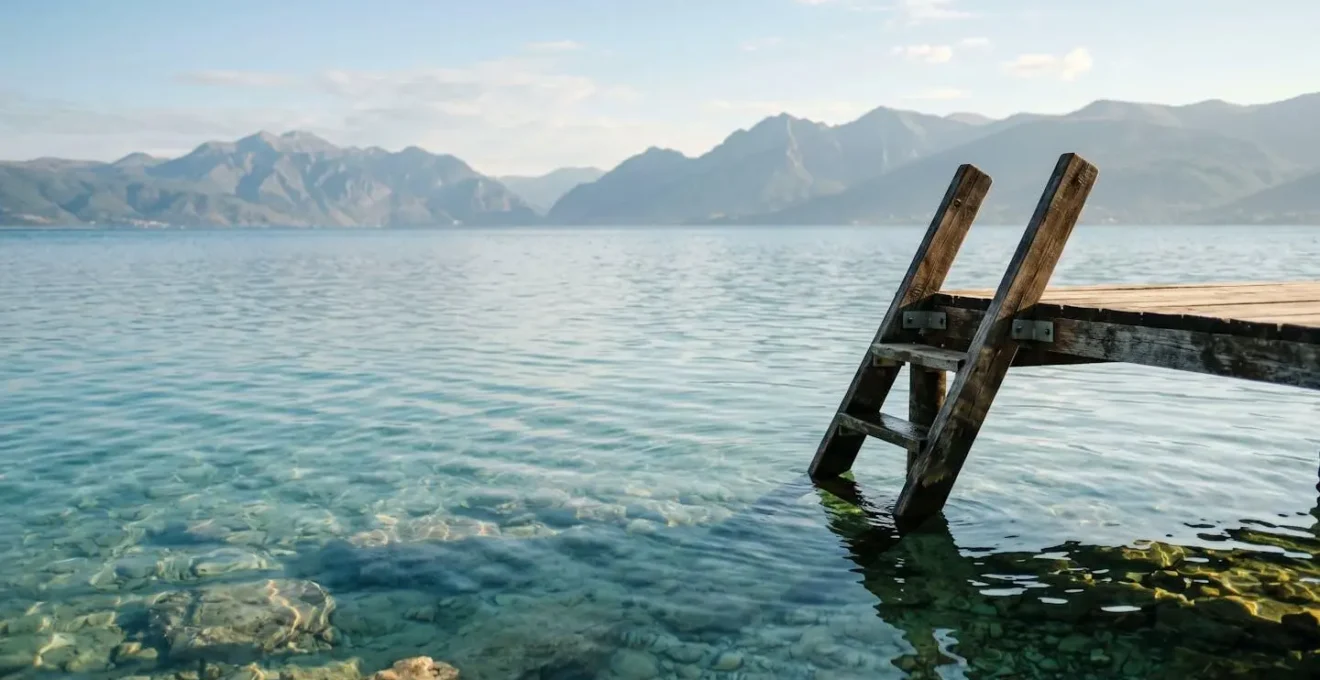
Finding clear water is easy in Lake Ohrid, but swimming smart and safely requires local knowledge about its unique ecosystem.
- The sun is deceptively strong due to a “double exposure” effect from high altitude and water reflection, making high-SPF sunscreen essential.
- The lake’s pristine clarity is a sign of a fragile, ancient environment; your swimming habits directly impact its health, especially for its endangered species.
Recommendation: Always use mineral-based, “reef-safe” sunscreen to protect the water, and adopt the local “pack out more than you pack in” philosophy on all beaches.
The first time you see Lake Ohrid, it’s the clarity that stops you. It’s not just water; it’s liquid crystal. As a local lifeguard, I’ve seen that look of awe on thousands of faces. Everyone asks the same question: “Where is the best place to swim?” The easy answer is to point towards the popular, bustling beaches. You’ll see lists of them online, touting sunbeds and cocktails, and they’re fine for a quick dip.
But that’s not the real Ohrid. The true magic of this lake—one of the oldest and deepest in Europe—isn’t just in its beauty, but in its life. Its clarity comes from being oligotrophic, meaning it has very few nutrients, which prevents algae growth. This makes it an incredibly sensitive environment, a living museum of evolution that has been recognized as a UNESCO World Heritage Site. Swimming here isn’t just a recreational activity; it’s an interaction with a precious natural wonder.
This guide goes beyond the typical tourist advice. We’re not just going to find the clearest water; we’re going to understand it. I’ll show you how to navigate the lake’s unique challenges, from the surprisingly intense sun to its hidden cold spots. More importantly, I’ll share the secrets to enjoying its waters responsibly, ensuring that the same crystal clarity that amazes you today will be here for generations to come. It’s about learning to swim like a local—with respect, awareness, and a deep appreciation for the living water around you.
This article will guide you through choosing the right beach for your style, understanding the lake’s natural characteristics, and adopting the simple practices that help protect this irreplaceable treasure. Let’s dive in, the right way.
Contents: Where to Find the Clearest Swimming Spots on Lake Ohrid?
- Gradiste or Kaneo Beach: Which Suits a Young Crowd Better?
- Why Is the Sun Stronger at Lake Ohrid Than at Sea Level?
- How to Reach the Hidden Beaches Behind the Cliffs of Trpejca?
- Is Lake Ohrid Too Cold for Swimming in Early June?
- The Littering Mistake That Locals Hate on Wild Beaches
- How to Reach the Hidden Beaches Behind the Cliffs of Trpejca?
- The Swimming Mistake That Could Disturb the Endemic Ohrid Trout
- Why Is Lake Ohrid a UNESCO Site and How Can You Visit Responsibly?
Gradiste or Kaneo Beach: Which Suits a Young Crowd Better?
For younger travelers, the choice of beach often comes down to the vibe you’re looking for: a high-energy party or a chic, scenic backdrop. In Ohrid, this choice is perfectly encapsulated by the contrast between Gradiste and Kaneo. Gradiste is essentially a daytime festival complex. It’s where you go for loud music, DJ sets, and a guaranteed social atmosphere. It’s a bit of a trek from the city center and has an entrance fee, but you’re paying for an all-day party environment with multiple bars at your disposal.
Kaneo Beach, on the other hand, offers a more bohemian-chic experience. Tucked beneath the iconic Church of St. John at Kaneo, it’s the perfect spot for stunning photos and relaxed sunset drinks. While it’s within walking distance of the Old Town, its position at the end of the boardwalk makes it feel more secluded and peaceful than the city beaches. The vibe is less about partying and more about savoring the incredible view, often with a drink from the cliffside bar, before transitioning to a romantic dinner in one of the Old Town’s hidden alleys.
To make the choice clearer, here’s a direct comparison of what to expect. This breakdown, based on an in-depth analysis of Ohrid’s best beaches, highlights the key differences for a young traveler’s priorities.
| Feature | Gradiste Beach | Kaneo Beach |
|---|---|---|
| Atmosphere | Daytime festival vibe with DJ sets | Bohemian-chic with scenic photo opportunities |
| Entry Cost | Paid complex with entrance fees | Free access |
| Sunbed Rental | 400-800 MKD (€7-14) for 2 loungers + umbrella | 400-800 MKD (€7-14) for 2 loungers + umbrella |
| Bars & Dining | Multiple bars on-site | Cliffside bar with premium pricing |
| Location | Requires transportation from city center | Walking distance to Old Town historic restaurants |
| Evening Transition | Transportation needed for late-night clubbing | Seamless walk to romantic Old Town alleys |
| Best For | Party-focused, high-energy social atmosphere | Instagram aesthetic, sunset drinks, cultural exploration |
Ultimately, your choice depends on your goal. For an unforgettable party day, Gradiste is the clear winner. For a picturesque afternoon that flows effortlessly into a cultural evening, Kaneo is unmatched. Both offer the lake’s beautiful clear water, but deliver entirely different experiences.
Why Is the Sun Stronger at Lake Ohrid Than at Sea Level?
One of the first things I warn swimmers about is the sun. It’s not like the sun at the seaside; here, it’s sneakier and far more potent. Many visitors make the mistake of underestimating it and end up with a serious burn. The reason lies in a combination of two factors that create a “double exposure” effect: altitude and reflection. Lake Ohrid sits at an altitude of nearly 700 meters (about 2,300 feet), and the atmosphere is thinner here. This means less of the sun’s harmful UV radiation is filtered out before it reaches your skin.
Scientific studies confirm this, showing a documented 10-12% increase in UV radiation for every 1,000 meters of elevation. But that’s only half the story. The second part of the “double exposure” comes from the lake itself. Because the water is so exceptionally clear, it acts like a giant mirror, reflecting the UV rays right back up at you. So, while you’re swimming, you’re getting hit by the sun from above and below simultaneously.
This powerful combination means that your standard beach sunscreen and routine often aren’t enough. You need to be more strategic and diligent about protection to stay safe. A lower SPF just won’t cut it, and you need to reapply much more frequently than you might think, especially after getting out of the water.
Your Action Plan: High-Altitude Lake Sun Protection Strategy
- Upgrade to SPF 50+ broad-spectrum sunscreen specifically formulated for high-altitude conditions with enhanced UVA/UVB protection.
- Apply sunscreen 30 minutes before water exposure and reapply every 60-90 minutes due to water reflection doubling UV exposure.
- Schedule intensive sun activities outside peak UV hours (avoid 11 AM to 4 PM) when radiation is strongest.
- Use highly water-resistant formulas (80-minute rating minimum) as Lake Ohrid’s clear water reflects rather than absorbs UV rays.
- Combine sunscreen with UV-protective swimwear (UPF 50+) for extended swimming sessions in the double-exposure environment.
How to Reach the Hidden Beaches Behind the Cliffs of Trpejca?
Trpejca is often called the “Saint-Tropez of Macedonia,” but its real treasures aren’t in the main village. They’re hidden behind the dramatic white cliffs that line the shore, accessible only by water. These secluded coves offer an unparalleled sense of discovery and some of the most pristine swimming on the entire lake. Getting to them is an adventure in itself, and you have two main options.
The first and most common method is by boat taxi. Head down to the main pier in Trpejca, and you’ll find local boatmen ready to take you. The key phrase is *”Do skrienite plazhi, ve molam”* (To the hidden beaches, please). It’s crucial to negotiate the price beforehand—either per person for a drop-off and pickup, or for a private hire of a few hours. Always confirm the exact return time before you leave the pier; there’s no phone signal on these beaches, so if you miss your ride, you’re stuck.
Your second option is for the more adventurous: renting a kayak or Stand-Up Paddleboard (SUP). This gives you the freedom to explore at your own pace, hopping from one tiny cove to the next. It takes about 30-45 minutes of steady paddling from Trpejca to reach the first set of beaches. The most important safety tip here is to watch the weather. The wind on Lake Ohrid can pick up suddenly in the afternoon, typically around 2-3 PM, making the paddle back significantly more challenging. Always check the forecast and plan to head back before the winds intensify.
Is Lake Ohrid Too Cold for Swimming in Early June?
This is a common question from early-season visitors. They see the brilliant sun and clear water and can’t wait to jump in, but they hesitate, fearing an icy shock. The answer isn’t a simple yes or no; it’s about knowing where and how to swim. In early June, the main body of the lake is definitely “refreshing.” According to ten-year data, surface water temperatures average between 18.6°C and 21°C (65-70°F). For many, this is perfectly swimmable and invigorating, but it’s not the warm, bath-like water of the Mediterranean in August.
However, the secret to a comfortable swim in June lies in understanding the lake’s unique hydrography. Lake Ohrid is fed by numerous underwater springs, or *sublacustrine springs*. These springs pump cold, pure water into the lake year-round. If you swim directly over one, you’ll feel a sudden, distinct drop in temperature. The trick that locals know is to avoid these cold pockets and seek out the warmer surface layers.
These warmer zones, or thermocline pockets, are often found in shallower, sheltered bays where the sun has had more time to heat the surface water and the influence of the cold springs is minimal. When you enter the water, move slowly. You can often feel the temperature difference. Look for areas where the water seems perfectly still on the surface. So, is it too cold? Not if you swim smart. A quick plunge might take your breath away, but a gradual entry into a carefully chosen spot will reward you with a wonderfully crisp and clear swimming experience.
The Littering Mistake That Locals Hate on Wild Beaches
There’s nothing that sours the mood of a local more than seeing litter on a pristine, wild beach. To us, Lake Ohrid is a sacred place, a “living museum” that we are obligated to protect. While most visitors understand the basics of not leaving plastic bottles or food wrappers behind, there’s a more subtle form of littering that is just as harmful and deeply frustrating: leaving behind “invisible” or “natural” waste.
This includes two main culprits: cigarette butts and organic waste like fruit peels. A cigarette butt flicked onto the pebbles might seem small, but it’s a plastic filter filled with toxic chemicals that leach directly into our oligotrophic water system, poisoning the base of the food chain. Similarly, tossing an apple core or banana peel into the bushes seems harmless, but it’s not. In the dry Macedonian climate, this organic matter decomposes very slowly, attracting pests and disrupting the natural ecosystem. It simply doesn’t belong there.
The philosophy we try to live by is the “Pack-In, Pack-Out Plus” protocol. This means you not only leave with every single thing you brought, but you also take a moment to pick up a few pieces of trash left by others. This small act transforms you from a passive tourist into an active guardian of the lake. It’s about leaving a place better than you found it. Another critical point is to never take pebbles or stones as souvenirs. The collective removal of these stones by thousands of visitors degrades the natural beach composition that protects the shoreline. Adopting this mindset shows a profound respect that locals will genuinely appreciate.
How to Reach the Hidden Beaches Behind the Cliffs of Trpejca?
We’ve covered the logistics of getting to Trpejca’s hidden beaches, but understanding *how* to be there is just as important. These are not organized beaches. They are pockets of pure wilderness, and you must arrive fully self-sufficient. This is the part of the adventure that requires a shift in mindset from tourist to explorer. There are no bars, no toilets, no sunbed rentals, and most importantly, no shade and no fresh water. The stunning white cliffs that make these coves so beautiful also reflect the sun’s heat, creating an intense environment.
Your packing list is your lifeline. A large water supply (at least 2 liters per person) is non-negotiable. High-energy snacks, sturdy water shoes for the pebbly shoreline, and a portable umbrella for creating your own shade are absolute must-haves. A waterproof bag for your phone and keys is also essential, as even a small wave can splash your belongings on the narrow shores. You are entirely on your own until your boat taxi returns or you paddle back to civilization.
This isolation is the beauty of the experience. It’s a chance to connect with the raw, untouched nature of Lake Ohrid. But it also comes with the profound responsibility of leaving no trace. Every single item you bring with you must leave with you. This is where the “Lake Guardian” philosophy is most critical. The silence and pristine condition of these coves are a direct result of visitors respecting their wild nature. Arriving prepared and leaving nothing behind is the only way to ensure these secret spots remain a paradise.
The Swimming Mistake That Could Disturb the Endemic Ohrid Trout
The exceptional clarity of Lake Ohrid is the sign of a healthy, but extremely delicate, ecosystem. As a UNESCO site, its waters conserve over 200 endemic species, meaning they are found nowhere else on Earth. The most famous of these is the magnificent Ohrid Trout (*Salmo letnica*). Unfortunately, this iconic fish is now endangered. Swimming here comes with the quiet responsibility of not adding to the pressures it faces.
The biggest mistake a swimmer can make is unintentional habitat disturbance. This happens in two main ways. The first is swimming in the wrong places. The heavily reeded areas along the shoreline and the mouths of streams flowing into the lake are critical spawning and nursery grounds for the trout. While it might look like a peaceful place to explore, your presence can disrupt breeding cycles and stress young fish. The simple rule we locals follow is: “swim in the open, not in the reeds.”
The second, less visible mistake is the sunscreen you wear. Most common chemical sunscreens contain oxybenzone and octinoxate. These chemicals wash off your skin and create a toxic film on the water’s surface that is devastating to plankton—the very foundation of the trout’s food chain. As the Earth Journalism Network has highlighted, the trout already faces immense threats.
The lake’s endemic Ohrid trout, a species found nowhere else on Earth, has been officially classified as endangered after years of overfishing, rampant coastal development, and a mysterious six-year halt in the artificial spawning program.
– Earth Journalism Network, Lake Ohrid Faces Environmental Crisis as Endemic Trout Nears Extinction
The responsible choice is to switch to a mineral-based, “reef-safe” sunscreen with zinc oxide or titanium dioxide. By applying it at least 30 minutes before entering the water, you allow it to bind to your skin, minimizing wash-off. It’s a small change that has a huge impact, directly preserving the clear, living water you came to enjoy.
Key Takeaways
- Protect Your Skin & The Lake: Always use high-SPF (50+), mineral-based sunscreen. The high altitude and water reflection create intense UV exposure, and chemical sunscreens harm the lake’s fragile ecosystem.
- Become a Lake Guardian: Adopt the “Pack-In, Pack-Out Plus” philosophy. Take all your waste with you, and pick up a few extra pieces of litter to leave the beach cleaner than you found it.
- Swim with Awareness: Stay out of reeded areas and stream mouths. These are vital spawning grounds for the endangered Ohrid Trout. Your choice of swimming spot matters.
Why Is Lake Ohrid a UNESCO Site and How Can You Visit Responsibly?
Lake Ohrid’s status as a UNESCO World Heritage site is rare and special. It’s one of only a handful of places in the world recognized for both its outstanding natural and cultural value. The “natural” part of the designation stems from its incredible age and biodiversity. Research confirming the lake’s ancient origins span approximately 1.4 million years makes it a living “museum of fossils,” home to hundreds of species that have vanished from the rest of the world. The “cultural” side honors the city of Ohrid’s rich history, with its ancient churches, icons, and architecture representing centuries of human heritage.
As UNESCO itself states, this dual designation creates a unique responsibility.
North Macedonia’s side of Lake Ohrid was declared a World Heritage Site by UNESCO in 1979, with the site being extended to also include the cultural and historic area of Ohrid in 1980.
– UNESCO World Heritage Centre, Natural and Cultural Heritage of the Ohrid Region
Visiting responsibly means understanding that you are a guest in this interconnected natural and cultural landscape. Your actions, no matter how small, have an impact. It’s not about a list of restrictive rules; it’s about a mindset of respect. It means choosing eco-conscious businesses that manage their waste properly, and it means internalizing a simple code of conduct every time you approach the water. The core principles are straightforward: protect the water quality, leave no trace, respect the wildlife, and never remove any natural souvenirs like pebbles or shells.
By following these simple steps, you shift from being a simple tourist to a conscious visitor. You actively contribute to the preservation of the very things that make Lake Ohrid so magical. It’s the most meaningful way to show your appreciation for the lake’s profound beauty and heritage.
Your next swim in Lake Ohrid can be more than just a refreshing dip; it can be an act of preservation. Embrace these principles, become a guardian of the lake, and ensure its crystal-clear beauty remains for generations to come.