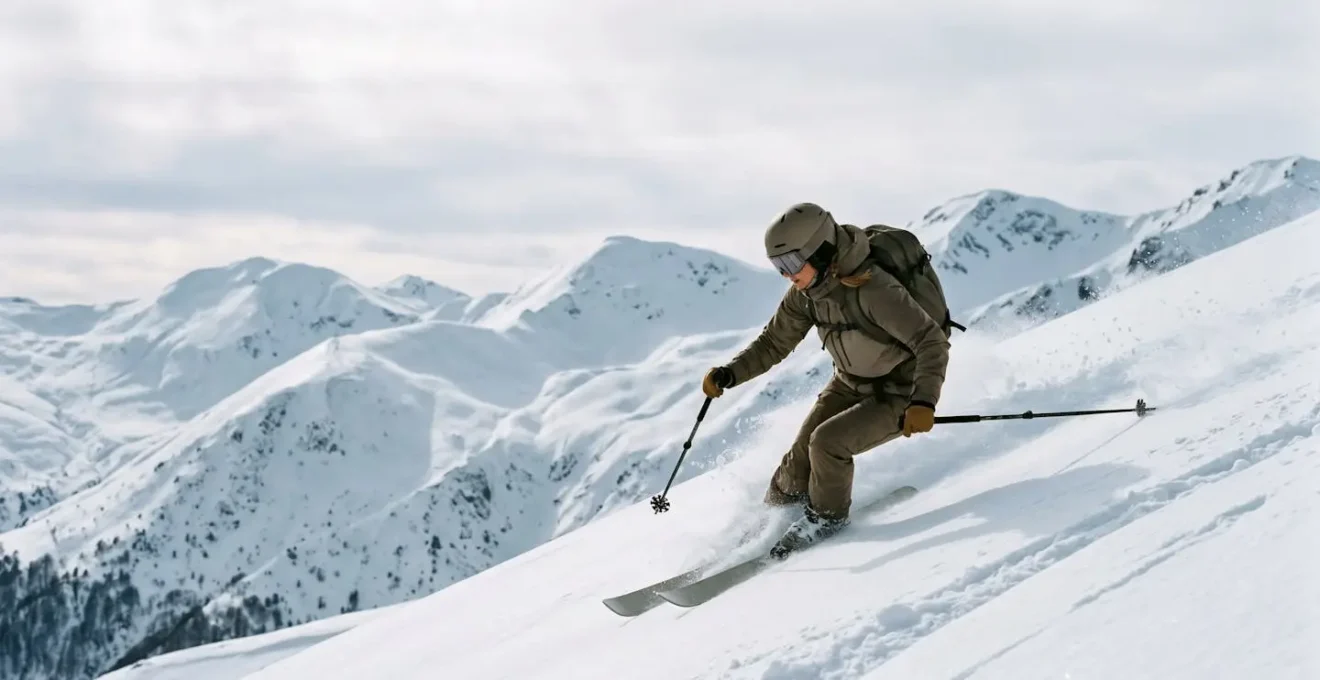
For the expert skier, North Macedonia’s challenge isn’t its scale but its unique character; it offers Europe’s best ‘challenge-per-euro’ for those willing to look beyond the piste map.
- True expert terrain is found in guided off-piste and cat-skiing, not on the limited marked black runs.
- The region’s volatile snowpack and varied conditions require a higher level of mountain sense than in the predictable Alps.
Recommendation: Splurge on a local guide or cat-ski package; this is where the real value and challenge lie, not in the lift pass.
As an experienced skier, you’ve likely ticked off the major Alpine resorts. You know the couloirs of Chamonix, the vastness of the 3 Valleys, and the price tags that come with them. Now you’re looking for something different: a genuine challenge without the crowds and the exorbitant costs. North Macedonia keeps appearing on the radar, often touted as a “cheap ski destination.” But for a technical skier, “cheap” is irrelevant if the slopes are flat and the challenges are non-existent. Is it truly a destination for experts, or just a budget holiday in the snow?
The typical travel blog will tell you about the welcoming locals and the hearty food. They’ll show you pictures of pristine, empty slopes. While true, this doesn’t answer the fundamental question of technicality. Forget the platitudes. The real value of the Macedonian mountains isn’t in trying to be a small-scale version of the Alps. Its true challenge lies in its unique character, its specific snowpack, and the opportunities it presents for those who understand that the best skiing often starts where the piste map ends.
This guide provides a no-nonsense, technical assessment from one skier to another. We’re not here to sell you a holiday; we’re here to evaluate the terrain. We will dissect the black runs, analyze the off-piste safety and potential, compare the vertical drop with brutal honesty, identify the real risks, and determine the optimal time for quality snow. This is the analysis you need to decide if North Macedonia’s slopes are worthy of your time and skill.
This article offers a detailed technical breakdown to determine if North Macedonia meets the demands of an expert skier. Explore the sections below to get a complete picture of the challenge that awaits.
Summary: A Technical Assessment of North Macedonia’s Ski Terrain
- Which Ski Resorts in North Macedonia Have Genuine Black Runs?
- Is Off-Piste Skiing Possible and Safe in Macedonian Mountains?
- Mavrovo Vertical Drop: How Does It Compare to Chamonix or Verbier?
- The Avalanche Risk Zones That Local Skiers Know to Avoid
- Late January or Early March: When Is Snow Quality Best in Macedonia?
- Which Ski Resorts in North Macedonia Have Genuine Black Runs?
- Are Mavrovo Slopes Challenging Enough for Advanced Skiers?
- How to Plan a Ski Trip to Mavrovo on a Budget?
Which Ski Resorts in North Macedonia Have Genuine Black Runs?
Let’s address the primary on-piste question directly. Yes, genuine black runs exist, but your options are concentrated and limited. The resort that stands out for advanced piste skiing is Popova Šapka. It’s here you’ll find the bulk of the country’s challenging marked terrain. Unlike resorts that optimistically label a steep but short section as ‘black’, Popova Šapka offers sustained pitches that will hold an expert’s interest, at least for a time.
The numbers provide a clear picture. The resort features a respectable 6.8 km of heavy (black) ski slopes out of its total, offering a reasonable proportion of advanced terrain compared to its overall size. These aren’t just token difficult runs; they are legitimate, steep, and often ungroomed pistes that cut through high alpine bowls. The terrain character is defined by these long, demanding descents rather than short, sharp shocks. For an expert, this means you can get into a rhythm on a single run without immediately hitting a flat section.
However, an expert’s definition of “a day’s skiing” involves variety. While the quality of Popova Šapka’s black runs is undeniable, the quantity is not. You will likely ski all of them within a morning. Therefore, you must view these pistes not as the main event, but as a high-quality warm-up for the real challenges that lie off the marked map. They serve as an excellent gauge for the snow conditions before you venture further afield.
Is Off-Piste Skiing Possible and Safe in Macedonian Mountains?
This is the critical question, and the answer is an emphatic yes. In fact, for the expert skier, off-piste is the primary reason to choose North Macedonia. The country is a burgeoning freeride paradise, offering vast, accessible, and relatively uncrowded backcountry terrain. The main method for accessing this terrain, particularly in the Šar Mountains around Popova Šapka, is through cat-skiing operations.
This image of a snowcat ascending a pristine powder field is the quintessential image of Macedonian expert skiing. It represents the shift in mindset required: the resort lifts are secondary; the real access vehicle is the snowcat, opening up thousands of vertical metres of untracked snow.
On the crucial matter of safety, the region presents a unique and compelling profile. The terrain itself contributes to a generally more stable snowpack. According to a case study on off-piste conditions, the Šar Mountains’ rounded, grass-covered topography allows snow to bond more effectively to the ground compared to the rocky Alpine faces, inherently reducing avalanche risk. This doesn’t eliminate the danger, but it changes its nature. However, this natural advantage is no substitute for expertise. All reputable cat-skiing and guiding operations enforce strict safety protocols, including mandatory avalanche safety gear (transceiver, shovel, probe) and thorough briefings led by local guides with years of specific terrain knowledge.
Mavrovo Vertical Drop: How Does It Compare to Chamonix or Verbier?
Let’s be technically precise and brutally honest: it doesn’t. Comparing the raw vertical drop of Macedonian resorts to the titans of the Alps is an exercise in futility. Chamonix’s Vallée Blanche offers a staggering 2,800m continuous descent. Verbier provides massive, lift-accessed runs well over 1,500m. Mavrovo, the country’s other main resort, operates on a different scale entirely.
The effective, top-to-bottom skiable vertical at Mavrovo is a respectable, but not world-beating, 600m+ skiable vertical. This is a solid number for a single run, but it’s the “vertical-per-hour” potential that truly defines a resort for an expert who wants to lap challenging terrain. Here, the infrastructure’s age becomes a factor. While Popova Šapka has a modern 6-seater, Mavrovo relies on an older, slower network of lifts, some dating back over 60 years. This fundamentally impacts how many challenging laps you can achieve in a day.
The table below puts this reality into stark perspective. It’s not about disparaging the Macedonian offering, but about setting realistic expectations for a demanding skier. The value here is not in chasing endless vertical, but in using that 600m of terrain wisely.
| Resort | Advertised Vertical | Effective Continuous Descent | Lift Infrastructure | Vertical-per-Hour Potential |
|---|---|---|---|---|
| Mavrovo | 600-700m | ~600m single run | 11 lifts, mixed speed (some 60+ years old) | Moderate (slower lifts impact laps) |
| Popova Šapka | 875m | ~875m single run | 9 lifts including new 6-seat express (2019) | Higher with new chairlift |
| Chamonix (Vallée Blanche) | 2,800m | 2,800m continuous | High-speed cable cars | Very high |
| Verbier (4 Vallées) | 1,500m+ | 1,500m+ continuous | Modern high-speed network | Very high |
The Avalanche Risk Zones That Local Skiers Know to Avoid
While the overall avalanche risk in the Šar Mountains is often lower than in the Alps, this is a generalisation, not a guarantee of safety. Complacency is the expert’s greatest enemy. The local climate and topography create specific, recurring risk zones that seasoned local skiers instinctively avoid. Understanding these patterns is non-negotiable for anyone venturing off-piste.
The snowpack’s character is influenced by a transitional Mediterranean-continental climate, leading to potentially rapid temperature swings. The primary danger stems from wind-loaded lee slopes, particularly on northern and eastern aspects, which accumulate deep, unstable slabs of snow. The rounded, convex nature of the peaks (what locals call ‘plat’ or ‘plateau’ terrain) is deceptive. These convex rolls can hide sudden cliffs and are notorious trigger points for slab avalanches. You must treat every smooth, wind-blown rollover with extreme suspicion.
Furthermore, the landscape is riddled with natural gullies and narrow valleys. While tempting as natural half-pipes, these features are classic terrain traps. An avalanche in a gully concentrates the debris to a massive depth, leaving no escape routes and making survival highly unlikely. Recognising and avoiding these three key features—lee slopes, convex rolls, and gully traps—is the foundation of safe backcountry travel in Macedonia.
Your Field Checklist: Macedonian Terrain Traps
- Identify wind-loaded lee slopes: Check how wind patterns in the Šar Mountains typically load northern and eastern aspects.
- Avoid convex rolls above cliffs: Assess rounded topography, which can mask sudden, dangerous elevation changes.
- Recognize gully terrain traps: Take note of narrow valleys that concentrate avalanche debris and offer no escape routes.
- Assess tree-line transitions: Be aware that the first 1,000 meters above Popova Šapka’s base are treeless, increasing exposure.
- Monitor rapid weather changes: Stay vigilant as the Mediterranean influence creates volatile conditions requiring daily reassessment.
Late January or Early March: When Is Snow Quality Best in Macedonia?
Timing is everything, especially in a region known for its climatic volatility. While the ski season can run from December to April, the sweet spot for an expert seeking quality snow is a more specific window. For deep, dry ‘Balkan powder’ ideal for freeriding, the peak period is generally from late January through February. This is when the base is typically established, and cold continental air provides the best chance for light, low-density snowfall.
The macro view of a snow crystal tells a story of temperature and moisture. The ideal conditions in late January can produce these intricate, pristine structures, indicating cold, dry snow that makes for exceptional powder skiing.
However, you must arrive with an adaptable mindset. A case study on Balkan weather highlights the region’s unpredictability, influenced by both subtropical and continental systems. Skiers should be prepared for a dramatic variety of conditions that can change within days: from concrete-hard ice to untouched powder, and even challenging “dust-on-crust” or sticky spring-like snow. This is not the Alps, where conditions can remain stable for weeks. The challenge here is partly meteorological; you must be a skilled enough skier to handle whatever the mountain throws at you. For those focused on ski touring and longer backcountry missions, early March often offers a more stable snowpack and the opportunity to ski perfect corn snow under sunnier skies, though the deep powder days are less frequent.
Which Ski Resorts in North Macedonia Have Genuine Black Runs?
Having established Popova Šapka’s credentials as the primary destination for marked advanced terrain, we must now critically assess Mavrovo. Does it contribute significantly to the country’s portfolio of genuine black runs? The answer is more nuanced. Mavrovo does have runs marked as difficult, but their character differs significantly from those at Popova Šapka.
The challenge at Mavrovo is less about sustained, high-alpine steepness and more about short, technical pitches and tree skiing. The advanced terrain is found in shorter sections that weave through the forest, requiring quick turns and line selection. For an expert, these are not runs for high-speed GS arcs, but rather for tight, dynamic, short-radius turns. They offer an excellent training ground for technical skills but may not satisfy the desire for a long, leg-burning descent.
The following comparison table synthesizes the on-piste advanced offerings of both major resorts. It clarifies their distinct strengths and helps an expert skier manage expectations. Popova Šapka offers the steep, open-bowl experience, while Mavrovo provides the lower-elevation, wooded challenge. An expert will find something to enjoy at both, but will also quickly exhaust the on-piste options.
| Resort | Total Vertical Drop | Highest Elevation | Black/Advanced Terrain | Terrain Style |
|---|---|---|---|---|
| Popova Šapka | 875m (2,870 ft) | 2,380m – 2,500m | 6.8 km marked black runs | Sustained steep pitches, alpine bowls |
| Mavrovo (Zare Lazareski) | 600-700m (2,000-2,300 ft) | 1,860m | Multiple challenging runs | Short steep sections, tree skiing |
Key takeaways
- The true expert challenge in North Macedonia lies in guided off-piste and cat-skiing, not the limited on-piste black runs.
- The snowpack is generally more stable than the Alps due to terrain, but rapid weather changes demand high mountain awareness.
- For the best value, save on accommodation and food, but splurge on local guides or cat-skiing to access the best terrain.
Are Mavrovo Slopes Challenging Enough for Advanced Skiers?
Yes, but only if you fundamentally reframe your objective. If you arrive at Mavrovo expecting a sprawling, interconnected lift system servicing endless black runs, you will be disappointed within hours. However, if you view the resort’s lifts as access points to a vast playground, then it becomes exceptionally challenging. The expert’s day at Mavrovo is not spent lapping the same groomed piste.
A proficient skier would approach the resort with a clear strategy, using the lifts to gain elevation for exploring the real terrain that lies between and beyond the marked runs. This is where the challenge is found: in linking ungroomed sections, finding natural features, and diving into the extensive tree skiing available within the 600m of vertical through the Bistra Mountain forests.
An expert’s itinerary would look something like this:
- 08:00-09:30: First tracks strategy. Take the Mavrovo 2 double chair to access the upper mountain immediately, bypassing older, slower lifts.
- 09:30-12:00: Freeride the upper bowls. Explore the ungroomed sections between marked runs and scope out lines in the open terrain.
- 12:00-13:00: Strategic hikes. Use the highest lift points as a starting line for short, rewarding bootpacks to access untouched snow zones.
- 13:00-16:00: Afternoon tree-skiing. Descend into the forests, picking technical lines through the trees for the full 600m vertical drop.
This approach transforms the resort from a limited area into a gateway. As the team at Powderhounds notes, the true value of the resort lies beyond its boundaries. Their review captures the essence of Mavrovo’s potential for the serious skier:
Mavrovo ski resort provides superb access to limitless backcountry ski touring & freeride terrain around Mt Korab (2,764m) on the border with Albania
– Powderhounds Review Team, Mavrovo Ski Resort Info Guide
How to Plan a Ski Trip to Mavrovo on a Budget?
Herein lies Macedonia’s trump card: the challenge-per-euro ratio is arguably the best in Europe. The cost is so low that it enables a strategic shift in spending. You’re not just saving money; you’re reallocating it from overpriced lift passes and accommodation to experiences that deliver a far greater level of challenge and reward, namely guiding and cat-skiing.
The basic costs are astonishingly low. Current pricing data shows a taxi from Skopje Airport to Popova Shapka costs €50-65 for four people, and day lift tickets hover around €20-30. With such low fixed costs, you can afford to invest in what truly matters.
The expert’s budget strategy is not about being cheap; it’s about being smart. You save where it doesn’t impact the quality of the skiing and splurge where it unlocks the mountain’s true potential. The table below outlines this philosophy.
| Category | Budget Strategy | Typical Cost | Value for Expert Skiers |
|---|---|---|---|
| Accommodation | Save: 3-star hotel over luxury resort | €30-60/night shared room with spa access | Adequate comfort, reallocate savings |
| Food/Dining | Save: Local restaurants over tourist spots | €60 cash often hard to spend | Authentic experience, minimal expense |
| Guided Off-Piste | Splurge: Hire local guide 1-2 days | Included in cat-ski packages | Essential for safety and terrain knowledge |
| Cat-Skiing | Splurge: Book multi-day package | €150-250/day (best value in Europe) | Unmatched challenge-per-euro ratio |
| Equipment Rental | Consider: Bring own touring/safety gear | €15-25/day basic rental | Limited high-performance options locally |
Ultimately, for the cost of a standard, crowded week in the Alps, an expert skier in North Macedonia can afford a week of guided, uncrowded, deep-powder cat-skiing. This isn’t just a budget trip; it’s a strategic investment in a superior skiing experience.
The question is no longer if North Macedonia is challenging enough, but if you are prepared for its unique demands. For an expert seeking value, adventure, and a departure from the predictable, the answer is a resounding yes. The next step is to start researching local guide services and cat-skiing operators for the upcoming season.