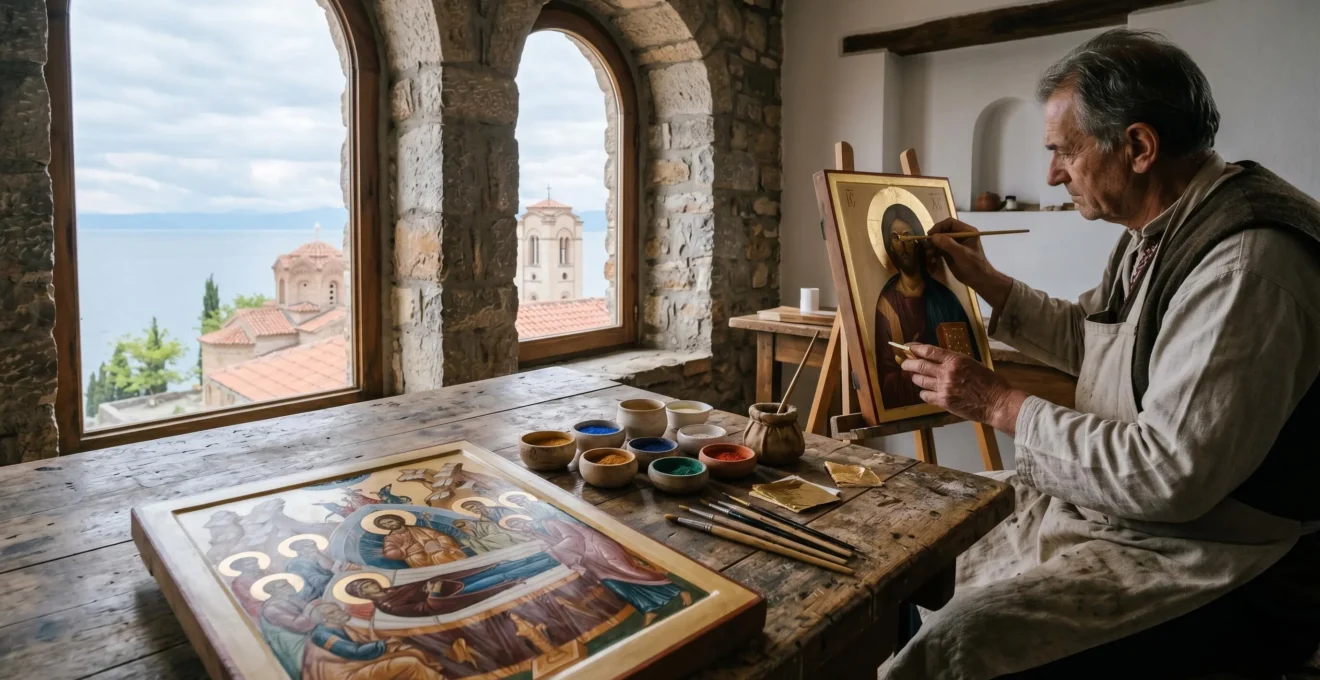
Participating in a Macedonian icon workshop is less about learning a craft and more about undertaking a spiritual practice.
- The choice of materials like egg tempera is a theological decision, designed to create a unique “inner light.”
- Authenticity is key; hand-painted icons have distinct textures and construction you can learn to identify.
Recommendation: Choose your workshop duration based on your goal: a few hours for a taste, or several days for a deep, contemplative immersion.
You stand in a small shop in the old bazaar of Ohrid, the scent of aged wood and beeswax in the air. The walls are lined with saints, their golden halos catching the light, their ancient eyes seeming to follow you. You might see this as a chance to buy a beautiful, authentic souvenir. Many travelers do. They might even seek out a generic “creative workshop” as a fun way to spend an afternoon, a common travel activity.
But to approach Macedonian iconography this way is to see only the surface. The real journey, the one that truly connects you to this ancient land, is not in acquiring the finished object but in understanding the soul of its creation. The truth is that in traditional icon painting, the process is the purpose. The patient layering of pigment is a form of prayer; the disciplined brushstrokes are a meditation. It is an act of devotion where the artist does not claim to create, but rather to reveal the sacred image already present within the wood.
This guide moves beyond mere logistics. It is an invitation to understand the ‘why’ behind the ‘how’. We will delve into the spiritual significance of the materials, the subtle language of its artistic schools, and the practical knowledge needed to distinguish the sacred from the profane. By the end, you won’t just be looking for a workshop; you’ll be preparing for a pilgrimage of paint and prayer, ready to choose an experience that resonates with your own creative spirit.
To guide you on this journey from curious traveler to initiated participant, this article is structured to answer the fundamental questions that arise. We will explore the materials, styles, and practicalities that define this sacred art form.
Summary: A Guide to the Sacred Art of Icon Painting in Macedonia
- Why Is Egg Tempera Used Instead of Oil for Traditional Icons?
- Ohrid School vs Crete School: What Are the Visual Differences?
- Real vs Print: How to Tell if an Icon Is Hand-Painted?
- The Customs Error: Can You Legally Export Old Icons from Macedonia?
- How Many Days Do You Need to Paint Your Own Icon from Scratch?
- Why Is Egg Tempera Used Instead of Oil for Traditional Icons?
- How Many Hours Does It Take to Make a Butterfly Filigree Brooch?
- Why Is Macedonian Filigree Jewelry Considered Among the Best in the Balkans?
Why Is Egg Tempera Used Instead of Oil for Traditional Icons?
To ask why we use egg tempera instead of oil is like asking why a monk chants instead of shouts. The material is not a matter of preference; it is a matter of theology. Oil paint allows for easy blending, for correcting mistakes, for a gradual and forgiving process. It is a medium of human mastery over material. Egg tempera, however, is a medium of humility. It is a simple, archaic mixture of egg yolk, water, and pure ground pigment. Once laid on the gessoed board, it dries almost instantly. It cannot be blended; it cannot be easily corrected. Each stroke is a commitment.
This technical limitation is its spiritual strength. The iconographer cannot fake the light. Instead, they must build it from the darkness. As icon painter Alina Smolyansky explains in her notes on technique, “egg tempera is applied in thin and nearly transparent glazes, laid on top of each other until the desired color, saturation and shadows are achieved”. This process begins with the darkest layer, the proplasmos, and each subsequent, lighter layer is a step toward illumination. It is a physical manifestation of the theological concept of divine light shining through and overcoming the darkness of the material world. Choosing egg tempera is choosing a path of discipline, patience, and prayer, where the light is not painted on, but revealed from within.
Ohrid School vs Crete School: What Are the Visual Differences?
As you immerse yourself in the world of Byzantine art, you will begin to notice that not all icons speak with the same voice. Two of the most influential styles you’ll encounter are the Macedonian (often typified by the Ohrid School of the 13th-14th centuries) and the later Cretan School. The differences are not merely stylistic; they reflect distinct theological emphases. The Ohrid School, blossoming during the Palaeologan Renaissance, is characterized by its humanism and emotional depth. Its saints are not distant, abstract figures, but beings filled with pathos, their faces showing inner life and connection.
Notice the drapery in Ohrid icons—it flows with a dynamic, rhythmic energy, suggesting the living body beneath. This is in contrast to the more austere, formal, and often rigid style that became prominent in the Cretan School. Where Cretan masters emphasized divine transcendence and a formal hierarchy, Macedonian painters focused on the Incarnation—the closeness of God to humanity. This comparison is not a judgment of which is “better,” but an invitation to learn a new visual language, one that communicates profound theological ideas through the turn of a head or the fold of a robe.
The following table, based on historical artistic analysis, breaks down these key visual distinctions to help you identify the unique character of the Macedonian style you will likely be learning.
| Visual Element | Ohrid/Macedonian School (13th-14th c.) | Cretan School (15th-16th c.) |
|---|---|---|
| Facial Expressions | Expressive, emotional, humanistic faces showing inner life and pathos | Austere, stern, more formal hieratic expressions |
| Drapery & Robes | Dynamic, flowing, rhythmic folds with plasticity and movement | Rigid, stylized, more geometric fold patterns |
| Light Technique | Fine white lines accentuating convex parts, modeling through highlights | More controlled, systematic light application |
| Human Interaction | Emphasis on relationships, gestures, and emotional connection | Emphasis on divine transcendence and formal hierarchy |
| Theological Focus | God’s closeness to humanity (Incarnational theology) | Divine mystery and transcendence |
Real vs Print: How to Tell if an Icon Is Hand-Painted?
In the marketplaces of Ohrid, you will find countless images of saints for sale. Many are beautiful, but not all are “icons” in the truest sense. Many are high-quality prints, paper glued to a board. While they may serve as lovely mementos, they lack the soul—the prayer and physical presence—of a hand-painted icon. As a student of the craft, or even just an appreciative buyer, training your eye and hand to discern the difference is a crucial first step. A real icon is a physical object with texture, depth, and imperfections that tell the story of its creation.
A printed reproduction, by its nature, is a flat, uniform surface. It lacks the subtle variations that are the signature of the human hand. The halo of an authentic icon is not just drawn; it is physically incised into the gesso, creating a tangible border. The paint itself has a unique, variable sheen that a printer cannot replicate. By learning to look and, more importantly, to touch, you can connect with the authenticity of the object and honor the tradition behind it. This is not about snobbery; it is about recognizing the difference between a picture and a presence.
Your 5-Step Test for an Authentic Hand-Painted Icon
- The Angle & Sheen Test: Hold the icon at a 45° angle to the light. A hand-painted egg tempera surface will show a subtle, variable satin sheen with visible micro-texture from the brushstrokes. A print will display a perfectly uniform glossy or matte finish across its entire surface.
- Examine the Halo Border: In an authentic icon, the halo’s outline is physically incised into the gesso layer before gilding. Gently run a fingernail over the edge; you should feel a sharp, tangible border that a printed image cannot replicate.
- Inspect the Wood Panel Construction: True icons are painted on solid wood panels, often with support slats (known as ‘shpongi’) on the back to prevent warping over time. The sides of the panel should show distinct layers of gesso and the natural grain of the wood.
- Check for Brushstroke Irregularities: Use magnification if possible. Look for the natural, human variations in the brushwork, slight imperfections, and the way the hand-applied pigment builds up in certain areas. Prints will show repetitive dot patterns or a perfectly even distribution of ink.
- Examine the Back & Edges: Prints are typically mounted on MDF or plywood with smooth, manufactured edges. Hand-painted icons often have uneven gesso application along the edges and may even show artist notes, a blessing, or inscriptions on the back.
The Customs Error: Can You Legally Export Old Icons from Macedonia?
A common and dangerous misconception for tourists is the allure of an “antique” icon. A street vendor might offer you a “100-year-old” piece for a tempting price. It is essential to understand that this situation presents two possibilities, both of which you must avoid. The first is that the icon is a genuine antique, a piece of national cultural heritage. In this case, attempting to export it is illegal and a grave offense against the nation’s history. According to UNESCO, the Ohrid region alone is home to more than 800 Byzantine-style icons dating from the 11th to the 14th century, which are protected as a World Heritage treasure. These belong to the Macedonian people and the world, not to a private collection.
The second, and more likely, possibility is that the “antique” is a convincing fake, artificially aged to deceive unwary buyers. In both scenarios, the correct and only ethical response is to politely decline. The laws are clear: cultural heritage of special importance cannot be legally exported. The true, and most meaningful, way to take an icon home is to create one yourself. A newly painted icon, created by you or a contemporary artist in a workshop, is considered a piece of contemporary artwork. It is perfectly legal to export and serves as a profoundly personal, rather than illicit, connection to this sacred tradition. To be safe, always ask the workshop or artist for a simple, signed certificate stating the work’s title, the artist’s name (even if it’s you), and the year of creation. This document removes any ambiguity at customs and honors the spirit of the law.
How Many Days Do You Need to Paint Your Own Icon from Scratch?
The question of “how long” is central to planning your journey. The answer depends on your goal: do you want a taste of the technique, or a deep, immersive dive into the full contemplative process? There is no single “right” duration, only the one that is right for you. A short, taster experience of a few hours can be a wonderful introduction. You will likely work on a board where the drawing and gilding have been pre-prepared, allowing you to focus on the magical process of applying the egg tempera and seeing the face of the saint emerge from the wood.
For those seeking more than a taste, multi-day workshops are essential. A 2 or 3-day immersion will allow you to participate in more of the process, from transferring the drawing to applying the first layers of color. To experience the entire, traditional method—from preparing the gessoed board and gilding the halo to painting every layer and applying the final protective olifa varnish—you would need an intensive course of at least 5 to 7 days. This is not a process that can be rushed. The drying time between layers is not a delay; it is a necessary pause for reflection, for prayer, and for the chemistry of the tempera to work its magic. The time it takes is the time it needs.
The following table outlines typical workshop formats to help you match your available time with your creative and spiritual aspirations.
| Workshop Type | Duration | What You’ll Create | Process Included | Best For |
|---|---|---|---|---|
| Taster Experience | 3-4 hours | Paint on pre-drawn, pre-gilded board | Painting face and robes only | Curious beginners, time-limited travelers |
| Immersion Workshop | 2-3 days | Complete shoulder-length icon (e.g., Mother of God) | Drawing, egg tempera preparation, painting, basic gilding | Intermediate learners wanting hands-on experience |
| Intensive Course | 4-5 days | Full icon with gilding | Board preparation (if pre-gessoed), drawing, gilding, all painting stages | Serious students, practicing iconographers |
| Apprentice Experience | 5-7 days | Icon from blank wood to varnished finish | Complete process: gessoing, drawing transfer, gilding, proplasmos, highlights, olifa varnish | Advanced students seeking mastery of full traditional method |
Why Is Egg Tempera Used Instead of Oil for Traditional Icons?
Having explored the spiritual dimension of choosing egg tempera, let us turn to its practical and technical properties, which are inseparable from its symbolic meaning. The medium’s most defining characteristic is its fast drying time. A layer of egg tempera can be dry to the touch in as little as 15 to 30 minutes. This property dictates the entire painting method. Unlike oils, which allow for wet-on-wet blending for hours or even days, tempera forces a disciplined, sequential approach. The artist must work with a clear plan, applying thin, transparent layers one after another. This is not a medium for spontaneous, expressive gestures; it is for deliberate, built-up forms.
This quick-drying nature necessitates techniques like hatching and stippling (‘ozhivki’ for the final white highlights) to create gradations of tone, rather than blending. The artist lays down a network of fine, parallel lines to build form and shadow. This technical constraint becomes a hallmark of the style, turning a limitation into a form of visual prayer. Furthermore, the paint’s unique optical quality is key. The egg yolk binder creates a semi-translucent film that, when applied in multiple layers over a brilliant white gesso ground, produces a profound luminosity. The light does not just reflect off the surface, as with opaque oil paint; it appears to emanate from within the icon itself. This inner glow is the technical goal that perfectly mirrors the spiritual aim of the art form.
How Many Hours Does It Take to Make a Butterfly Filigree Brooch?
To truly understand the unique temporality of icon painting, it is helpful to contrast it with North Macedonia’s other great craft tradition: filigree jewelry. In the workshops of Ohrid, you can watch master artisans twist and solder fine threads of silver into impossibly intricate designs. A beautiful butterfly brooch, a signature piece of Macedonian filigree, is a marvel of technical skill and precision. But how does its creation compare, in time and essence, to that of an icon?
The answer provides a profound insight into two different philosophies of craft.
Craft Time Comparison: Filigree vs. Icon Production
A skilled Macedonian filigree artisan can typically complete a butterfly brooch in 4 to 8 hours, depending on the complexity of the design and the weight of the silver wire. The process, while requiring immense dexterity, is largely linear and assembly-based: transferring the design, shaping the wire, soldering the pieces, and finally polishing the finished object. In stark contrast, a 4-day intensive icon painting workshop is not measured in a few hours but in days, governed by non-negotiable drying periods between dozens of translucent layers. A 4-day intensive course involves a minimum of 24 to 30 working hours, but the process is cyclical and contemplative. While filigree measures its process in grams of silver and technical precision, iconography measures its progress in prayer cycles, the number of glaze layers, and the quality of contemplative presence. One craft builds an ornamental object through accumulated skill; the other reveals a sacred image through a ritualized, meditative layering that cannot be rushed.
This comparison is not to diminish the immense skill of the filigree artist, but to highlight the fundamentally different nature of the iconographer’s work. One is a mastery of time; the other is a surrender to it.
Key takeaways
- Egg tempera is chosen for its spiritual and technical properties that create a unique “light from within.”
- Authentic Macedonian icons have tangible features, like incised halos and solid wood panels, that separate them from mass-produced prints.
- While exporting antique icons is illegal, creating and taking home your own hand-painted icon is a legal and deeply personal souvenir.
Why Is Macedonian Filigree Jewelry Considered Among the Best in the Balkans?
North Macedonia’s artistic identity can be seen as having two poles, two complementary expressions of its soul. On one hand, you have the sacred, contemplative art of iconography. On the other, you have the worldly, dazzling mastery of filigree. The excellence of Macedonian filigree, particularly from Ohrid, is rooted in centuries of unbroken tradition in a city that, as the UNESCO World Heritage Centre notes, is one of the oldest human settlements in Europe. This tradition, influenced by the historical Ragusan school of craft, is defined by supreme technical dexterity. Artisans create intricate patterns from silver wire so fine that they appear to be woven like lace rather than soldered metal.
Two Artistic Poles of North Macedonian Heritage
The nation’s heritage is defined by these two traditions. Filigree jewelry represents a mastery of physical materials—silver wire, heat, and precision—to create objects of exquisite worldly beauty. This tradition thrives in the workshops of Ohrid’s old town. Byzantine iconography, in contrast, uses earthly materials—egg yolk, mineral pigments, gold leaf—to create windows to the divine. For a traveler, these two crafts offer different kinds of engagement. Buying a piece of filigree supports a tradition of exquisite craftsmanship and provides a beautiful, wearable memory. Participating in an icon workshop, however, is an investment in a personal spiritual experience. It is a memory lived through prayer and paint, culminating in a sacred object imbued not with the value of silver, but with the quiet presence of your own contemplative work.
Ultimately, both crafts are born of the same culture of patience and dedication. But where filigree delights the eye with its technical perfection, the icon seeks to open the heart with its spiritual resonance. Understanding this distinction is the final step in preparing for your workshop. You are not just coming to make an object, but to participate in a conversation that has been unfolding in this land for a thousand years.
The next step, then, is not to find a workshop, but to decide if you are ready to begin the conversation—with the wood, the pigment, and the silence. When you are, the right teacher and the right path will reveal themselves to you.